Channel Partner Programs: How to Build a Partner Program That Produces Pipeline

Short answer: A channel partner program is the structure a company uses to recruit, activate and reward the partners who sell, refer, deliver or integrate its product. It covers partner types, tiers, benefits, enablement, incentives, MDF, deal registration and co-sell. But structure alone doesn’t produce revenue. So build the program around pipeline from day one. Start where you already win, run real GTM motions with those partners, and measure partner-sourced pipeline partner by partner. Then scale what works.
What is a channel partner program?
A channel partner program is the set of rules, benefits and operating rhythms that governs how you sell through other companies. It tells a partner how to join, what they get, how they earn and how you measure them. In short, it’s the system for selling with and through partners, not just with your own reps.
People search for this a few ways. “Partner program” is the broad term. It covers referral, technology, services and reseller partners, and the list goes on. “Channel partner program” usually leans toward partners who resell or deliver your product. In practice, platform companies often run one partner program with a separate track for each partner type. If you’re still choosing which B2B partnerships worth building come first, start there.
Partner program vs. partner ecosystem
A partner program is the structure you design. A partner ecosystem is the living network of partners and the customers they share with you. You can design a program in a few weeks. But you have to activate an ecosystem every single week. Our partner ecosystem guide covers the activation side.
If you’re a smaller company looking for the basics, our guide to the business partner program covers the structure in plain terms. This page goes deeper for partnerships leaders and CROs who need the program to carry a number.
What types of channel partners should a partner program include?
Most programs support more than one partner type. Each type does a different job for the customer, earns money differently and needs different support. That’s why I build the story and the motion per partner type, not one identical program for everyone.
| Partner type | What they do | How they usually earn | What they need from you |
|---|---|---|---|
| Technology alliance partner | Integrates with your product and shares your customers | Shared customers, co-sell, marketplace revenue | A real integration and a joint story |
| Reseller or VAR | Buys and resells your product, often with services | Margin or discount | Pricing, deal protection, sales training |
| Distributor | Buys in volume and resells through a network of resellers | Volume margin | A motion its resellers want to run |
| OEM partner | Embeds your product inside their own | License or revenue share | Technical depth, a clear commercial model |
| Agency or consulting partner | Recommends your product inside a broader engagement | Services revenue, sometimes referral fees | A reason to bring you into the client’s plan |
| ISV partner | Builds on top of your platform | Their own product revenue | Platform access and a joint go-to-market |
| Service-delivery partner (SI, GSI, MSP) | Implements or runs your product for clients | Services or recurring service revenue | Early access to deals, certified people, co-sell |
| Referral partner | Introduces you to buyers they already know | Referral fee at close | A simple way to submit, fast follow-up, clean credit |
And the list goes on. Real partners blur these lines, too.
Want more detail on a type? Start with our guides to the referral partner program and OEM partnerships.
Affiliate, ambassador and advisory-board programs pay individuals for introductions. That’s a different model, so this guide skips it.
What are the building blocks of a channel partner program?
Industry guides list roughly the same building blocks. Here’s my take, though. Tier and program design is the easy part. The value is in the motions you run against that structure, not the structure itself. So build each block to push partners toward deals, not just toward joining.
Tiers
Tiers group partners into levels with clear requirements and rewards. For example, AWS uses its services tiers, Select, Advanced and Premier, to recognize partners with proven expertise. So tiers give partners a ladder. Still, a tier only works as a golden carrot when the partner knows which motion gets them there. Tie each level to demonstrated selling, not paperwork. Our guide to partner tiers shows how. For how individual platforms set theirs, see our directory of platform partner programs.
Benefits
Benefits are what a partner gets at each level. Think margin, leads, co-marketing support, technical help and priority on joint deals. Price them, too. Partners rarely respect free. When an offer has no price on it, they assume there’s a catch, and it sits on someone’s desk.
Enablement and onboarding
The industry calls this enablement. The work that produces revenue is activation. Enablement takes a signed partner to a competent seller: product training, positioning, a joint value story and a first target account list. Activation is that partner actually running a GTM motion into named accounts. So end onboarding in a first motion, not a finished course. Use our partner onboarding checklist for the first 30 days. For the full method, read how to tie partner enablement to a GTM motion.
Incentives
Incentives reward the behavior you want: margin, rebates, referral fees and spiffs. Pay on outcomes like sourced pipeline and closed revenue, not on activity. The amounts are yours to set. For example, you might pay $100 for a lead, $250 for an SQO or $2,000 for a closed deal. Those are examples, not standards. The right number depends on your target customer acquisition cost. Our guide to partner incentive programs covers the options.
Market development funds (MDF)
MDF is money a vendor gives partners to create demand. AWS, for example, says its MDF helps “drive demand generation and build your sales pipeline,” paid as cash or credits. In my view, the M in MDF is market, not marketing. So spend it on motions that create pipeline, measured on cost per SQO. Our MDF guide goes deeper.
Deal registration
Deal registration lets a partner claim an opportunity and earn protection on it. It also sets rules of engagement with your direct team. But deal registration is not qualification. And you don’t need a portal for it, because nobody wants to log into a portal anyway. Run it from your CRM, off a partner lead source and a partner field. Then add more process when deal volume actually demands it. See how deal registration works.
Co-sell
Co-sell is your reps and a partner’s reps working the same accounts together. It usually starts with account mapping. Crossbeam, for instance, helps you find “accounts that are your partner’s customers but still prospects for you.” Co-sell is different from co-marketing, and the gap matters.
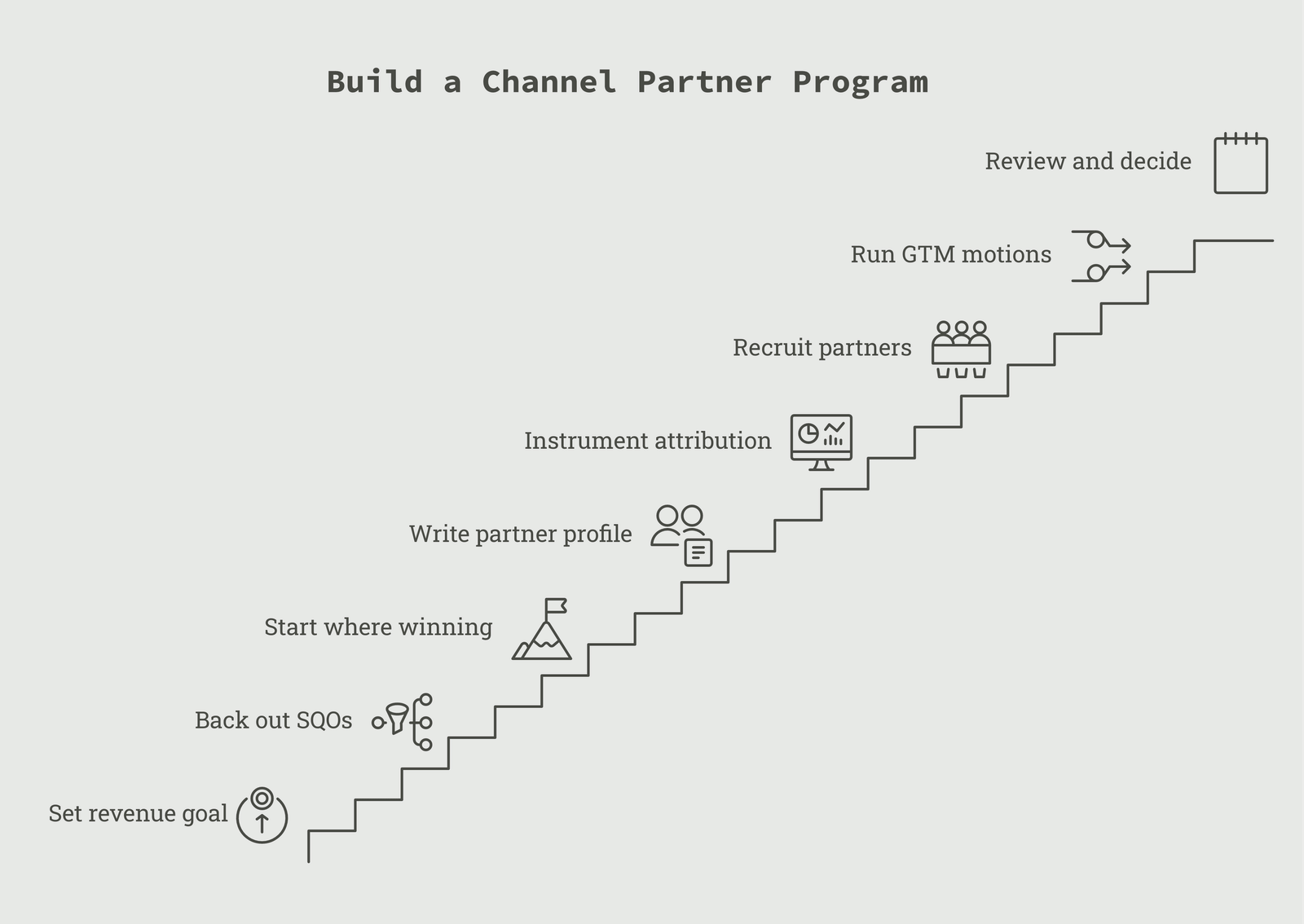
How do you build a channel partner program?
Here’s the order I use. A lot of programs get built backwards. They start with a portal and a logo wall before anyone knows what a partner actually does.
- Set the revenue goal first: decide what the program must produce and for whom. Net-new partner-sourced pipeline is the North Star. Expansion counts too. Influence helps, but it isn’t the number.
- Back the goal out into SQOs: pipeline is a leading indicator, and closed-won is the real target. Use your win rate to work out how many sales qualified opportunities you need. It’s math, not magic.
- Start where you already win: pick the partners where you already have a story and wins. Don’t test a brand-new story first. Double down where early success is likely.
- Write your ideal partner profile: define the traits of a partner that will actually produce, not just a famous logo. The profile tells you who. The GTM motion tells you what to run.
- Instrument attribution before launch: add a partner lead source and partner fields in your CRM. Then agree on what counts as sourced and what counts as influenced. That way the first win is countable the day it lands.
- Recruit partners who will act: look for partners who are actively trying to grow your business. Skip the ones who let your offer sit.
- Run GTM motions partner by partner: a GTM motion is one priced, planned campaign run with one partner or several. It targets named accounts on email, LinkedIn and cold calls made by a real human SDR, and it can include field marketing and in-person events. Write your sales rules of engagement after the first per-partner motions exist, because they fall out of that work.
- Review weekly, decide quarterly: put partner pipeline into the forecast meeting. Then, at the end of each quarter, keep what produced, cut what didn’t and add new motions.
Want to see how other companies structured theirs? Our partner program examples break down the patterns behind programs that scale.
Who should own the program?
A partnerships leader builds and runs it. But sales, RevOps and the CRO share the outcome. So get an executive sponsor who will champion the program with sales. Then check whether your AEs are comp neutral. If a rep doesn’t retire full quota on a partner-sourced deal, your own team will quietly avoid partner deals.
How do you measure a partner program?
Measure production, not roster size. Partner count, portal logins and training completions are activity, not production.
Start with the two numbers that matter most. Partner-sourced pipeline is pipeline a partner originated. Partner-influenced pipeline is pipeline a partner helped move. Both are useful. But they forecast differently, so track influence as its own KPI and never let it pad the sourced number. Here’s how to separate partner-sourced vs. partner-influenced pipeline so finance trusts the number.
| Metric | What it tells you | Why it matters |
|---|---|---|
| Partner-sourced pipeline | Deals partners originated | The North Star for growth |
| Partner-influenced pipeline | Deals partners helped move | Shows partner value on live deals |
| Activated partners | Partners with at least one real deal in motion | Separates producers from logos |
| Cost per SQO | What each sales qualified opportunity costs | Lets MDF compete with other channels |
| Pipeline by partner, by quarter | Who will produce next quarter | Makes the channel forecastable |
Watch the credit rule
If your SDR team books it, it isn’t partner-sourced. A meeting your own team booked off a partner’s account list is your meeting. Run the motion with the partner, under their name, and it counts as partner-sourced. Credit still follows each company’s own attribution policy, so write yours down.
Aim for a forecast, not a report
Yes, you need partner-sourced pipeline. Ultimately, though, you need forecastable partner-sourced pipeline. So have each partner manager forecast SQOs per partner, by month. Then roll those forecasts up against the company target. You’re either above it or below it. If you’re below, the gap tells you what to run next: another campaign, another account planning session or a new partner.
Why do most channel partner programs stall?
Programs stall right after recruitment. Partners sign, attend the kickoff and then go quiet. Partnerships are a relationship business. If you sign a partner and then don’t give them any attention, the partnership usually just disappears. Recruited isn’t the same as activated.
Here’s where I see programs get stuck.
1. Tiers dangle a carrot with no path
Leaders say, “You won’t reach gold tier without more partner-sourced pipeline.” Partners want the tier. But does that make them act? Often the goal just feels out of reach. And even when they try, they don’t know which motions to run or where to start.
2. Campaign in a box with no visibility
So the next move is a campaign in a box on the partner portal. Download it and run it. Then what? Did it go out? Which accounts got it? Did they change the messaging? How many meetings did it book? You can’t answer any of that.
To be fair, the box isn’t the problem. Reps who run a well-built campaign as designed beat reps who freelance. What’s missing is a named owner and someone following up.
3. You’re one vendor of many
A services partner works with many tech partners. And a platform is one product of many in a partner’s bag. So handing over your sales materials doesn’t make you their priority.
4. Joint campaigns don’t scale
Joint campaigns work, but only for a select few. Your own marketing team has limited capacity. Say you manage ten partners and only three qualify for joint campaigns. What happens to the other seven? Usually, you hope. That’s where a partner marketing strategy built on GTM motions helps.
5. Partner managers get buried in operations
Partner managers are in the relationship business. They should be great at strategy, advocating internally and building trust. But building lists, calling account owners and chasing replies isn’t a good use of their time. Even account mapping often wastes the first ten minutes of the meeting while someone clicks through the data live. So here’s what a healthy partner management operating rhythm looks like instead.
The real fix is structure
People say partnerships take time. No, they take structure. Time is what you spend without it. Hope is not a plan, and yet partner programs run on hope.
What makes a partner program produce pipeline?
A partner program produces when someone runs GTM motions with partners every week, against named accounts, with every touch tracked. The tiers and benefits govern the channel. But the motions fill it.
Run the motions in the partner’s name
The best motions pair your goal with a partner’s reason to call the same accounts. For example, you might run outbound into shared accounts, open doors in a partner’s vertical or reopen closed-lost deals through a partner. But partners are typically bad at outbound. So when partners won’t run the motion themselves, run it for them, from their domain, into the agreed list. When the motion runs as the partner, the meeting counts as partner-sourced.
Fix account mapping before you scale it
Set the agenda before every mapping session. Pull the named accounts the day before and put them in the calendar invite. Then sort each one as an ask, a give or a mutual. Keep the session standalone, too. Account mapping squeezed into the last 15 minutes of a regular call doesn’t happen. Done this way, a 30-minute data review becomes a list of owned next steps.
Let partners fund the program
Here’s the shift. Partners fund programs, not tools. Ask a partner to pay for your software and they’ll say no. Instead, show them a program that will produce a set number of SQOs. Then the conversation changes. Programs are often funded by partners through MDF, so a program could cost you $0. Q4 is a good time to ask, because many partners have year-end MDF they’re expected to spend.
Use an independent third party
Partner managers manage relationships. Lists, calls and follow-up aren’t their job. And you can’t see inside your partners’ systems to watch campaigns go out. There’s a data problem too. You often hold data you can’t share with a partner, but can share with a vendor. So an independent third party in the middle is often the only way to get full visibility for both sides. The partner only ever sees the target account names.
That’s the work we do as a B2B partnerships agency. Mid-market teams can run the program with us through Accelerate My Partner Program. It starts with a four-month pilot for 10 partners at $30,000. Enterprises with large ecosystems can hand the motions to us through Partner-Sourced Pipeline, from $50,000 a quarter. Building from scratch instead? Our Build or Rebuild My Partner Organization program grades every partner and designs the team.
Related reading
- B2B Partnerships Guide: How to Build a Program
- Channel Optimization: A Playbook for Partner Revenue
- Channel Partner Ecosystem: What It Is and How To Build It
- Channel Partner Incentives: Design Them for Behavior
- Channel Partner Lead Generation: Build an Engine
Frequently asked questions
What is a partner program in simple terms?
It’s a company’s structured way of working with other companies that help it sell, deliver or extend its product. It covers how partners join, what they get and how they earn.
What’s the difference between a partner program and a channel partner program?
They overlap heavily. A channel partner program usually emphasizes resellers, distributors, MSPs and other partners who sell or deliver your product. “Partner program” is the broader term. It also includes referral, technology and services partners, and the list goes on.
How do channel partners make money?
It depends on the type. Resellers earn margin. Referral partners earn a fee at close. Services partners and MSPs earn service revenue around your product. Technology partners win shared customers and co-sell deals.
How long does it take to build a channel partner program?
The first GTM motion can be working about two weeks after the workshop. For a full partner organization build, we hand leadership a board-ready plan in about eight weeks on average. After that, the program matures quarter by quarter as you keep what works.
Do I need a PRM to run a partner program?
No. A PRM is good for deal registration, portals, tiering and incentives once volume grows. But a PRM doesn’t drive pipeline. Engagement and execution do. So start with partner fields in your CRM, a registration form and a weekly review.
How many partners should a new program start with?
Start with the partners where you already win and where both sides have committed to act. Those partners show you which motions work. Add more once the first group produces pipeline.
How do you get partners to actually run campaigns?
Give them motions with named accounts, clear messaging and someone to do the work. If they still won’t send, run the motion from their domain on their behalf. Then show every party the activity in real time.
The bottom line
A channel partner program isn’t a document you launch. It’s a set of motions you run every week. Build the structure, sure. But judge the program on one thing: forecastable partner-sourced pipeline, partner by partner, quarter by quarter. If your program can’t show that yet, start there.
Forecastable is an independent third-party professional services company. Our evaluations of other vendors are based on publicly-available information as of November 2026 and our own client experience.
Want to see what your channel partner program could produce, and how much of it your partners could fund? Book a Program-Fit Analysis
Uncover Your Growth Potential
Schedule a Discovery Call