Partner Ecosystem: What It Is, Who’s In It and How to Make It Produce

Short answer: A partner ecosystem is every company that shares your customers and can help you win them: technology partners, resellers, distributors, OEMs, agencies, ISVs, implementation partners, and the list goes on. But a list of signed partners isn’t an ecosystem. It becomes one when you know which partners share which accounts and you run GTM motions across that overlap. So judge it on one thing. Does it produce partner-sourced pipeline you can forecast, partner by partner, quarter by quarter?
What is a partner ecosystem?
A partner ecosystem is the network of outside companies that touch the same buyers you do. Some sell your product. Others integrate with it, implement it or advise the customer on what to buy.
Here’s the part most definitions skip. A roster is not an ecosystem. Partnerships are a relationship business. If you sign a partner and then don’t give them any attention, the partnership usually just disappears. What’s left is a logo on your partner page. That’s a directory.
So a partner ecosystem needs three things to be real:
- Overlap: you know which partners share which customers and prospects.
- Motion: you run specific campaigns with those partners into those accounts.
- Measurement: you track what each partner sources and influences, in your CRM.
Even the analysts are pushing on this. In an August 2026 Forrester blog, Kathy Contreras wrote that “partner names alone reveal very little about the value a partner actually delivers.” I agree. Label a partner by what it does for a shared customer, not by the contract it signed.
What types of partners are in a partner ecosystem?
We sort partners into seven types. Each one does a different job for the customer, so each one needs its own story and its own GTM motion. That’s why I build the story and the motion per partner type, not one generic program for everyone.
| Partner type | What they do for a shared customer | A GTM motion that can fit |
|---|---|---|
| Technology alliance partners | Integrate with your product, including platforms and hyperscalers | Overlap Outbound into shared accounts |
| Reseller partners (VARs, MSPs) | Sell your product, often bundled with their own services | A packaged joint offer they take to their accounts |
| Distributor partners | Carry your product to many resellers at once | A pre-workshopped program the distributor offers its resellers |
| OEM partners | Embed your product inside theirs | A joint package sold like its own SKU |
| Agency and consulting partners | Advise the buyer on strategy and tools | Vertical Door-Opener in their industry |
| ISV partners | Build apps or extensions on your platform | An “ideal stack” motion that wins net-new deals on top of your platform |
| Service-delivery and implementation partners (SIs, GSIs) | Deploy, integrate and run your product | Cross-Sell (Whitespace) into customers they already serve |
And the list goes on. Of course, real partners blur these lines. A GSI might resell, implement and advise all at once. That’s fine. Pick the role that matters for the accounts you’re going after this quarter.
Two notes from the field. First, distributors want resellers. So arm the distributor with a motion its resellers feel they have to take to their accounts. Second, services firms hold a strong position in co-sell. They bring the expertise and the customer relationships, which is why tech partners often fund the motions they run.
One more note on scope. We work only with B2B partners like the seven above. Affiliate, ambassador and advisory-board programs are a different model, built on individual introductions, and they aren’t part of this guide.
What’s the difference between a partner ecosystem, a partner program and a channel?
People use these words like they mean the same thing. They don’t. And mixing them up is how teams end up measuring the wrong thing.
| Term | What it is | What it’s measured on |
|---|---|---|
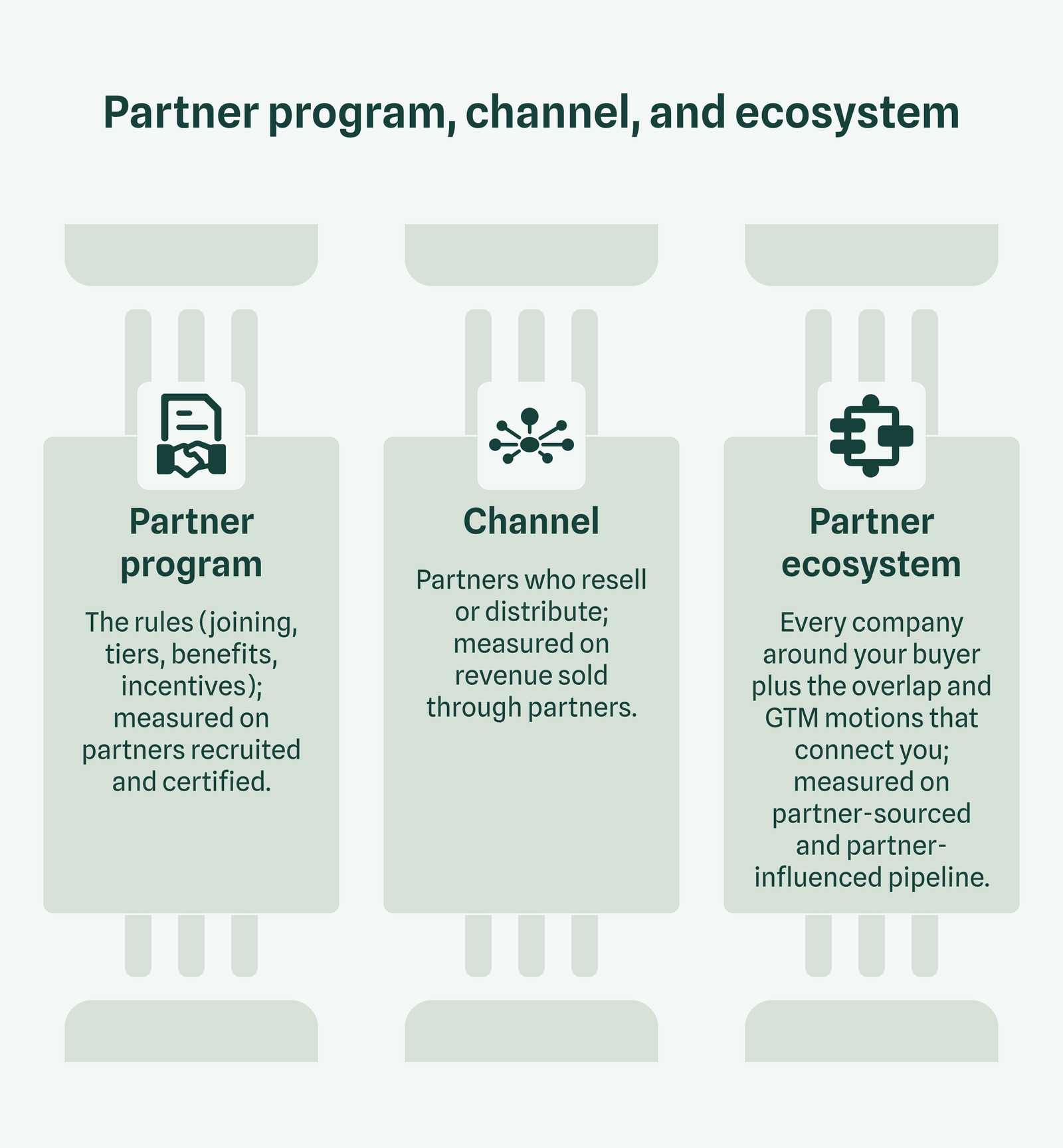
| Partner program | The rules: how partners join, tiers, benefits, incentives | Partners recruited and certified |
| Channel | The partners who resell or distribute your product | Revenue sold through partners |
| Partner ecosystem | Every company around your buyer, plus the overlap and motions that connect you | Partner-sourced and partner-influenced pipeline |
In short, the program is the structure you build. The channel is one slice of partners who sell. Meanwhile, the partner ecosystem is the whole network, and it only counts when it produces. For the structure side, our guide to building a channel partner program goes step by step.
Two related terms come up a lot. Ecosystem-led growth is the strategy of using partner data to drive revenue, and our post on how ecosystem-led growth increases deal size covers the numbers side. Nearbound is the idea of surrounding a buyer with people they already trust. Both depend on a partner ecosystem that actually works.
How do you build a partner ecosystem?
People tell me partnerships take time. No, they take structure. Time is what you spend when you don’t have any. Here’s the order we build in, and the order matters.
Steps 1 to 3: decide where to win and who helps
- Name where you need to win. Pick the outcome first: net new logos, a vertical, expansion, rip-and-replace, retention, a new market or a launch. Then let the partner list follow the goal, not the other way around.
- Map your overlap. Before you recruit anyone, find out which partners already share your customers and target accounts. But hold your sales team back from the raw overlap data until there’s a motion and clear instructions behind it.
- Tier your partners. Strategic partners get a joint go-to-market plan, regular account mapping, named co-sell accounts, co-marketing and events. Managed partners get a lighter touch. Here’s a rule worth adopting: if a partner won’t commit to a regular account-mapping process, it isn’t a strategic partner.
Steps 4 to 6: run motions and prove them
- Workshop one GTM motion per partner. A GTM motion is a priced, defined campaign run with one partner or several into a named account list. Then agree on the accounts, the story and who does what before anything goes out.
- Run it, in the partner’s name. Email, LinkedIn and cold calls from a real human SDR go out under the partner relationship. Some motions add field marketing or an in-person event. Also, real people handle the replies and the follow-up.
- Track every result in your CRM. Count meetings, sales qualified opportunities (SQOs) and closed-won revenue by partner. And for every goal, write down how you’ll track the actuals before the quarter starts.
Step 7: scale what works
- Turn winning motions into a repeatable menu. Once a motion produces, run it again with the next partner of the same type. That’s how a few good campaigns become an ecosystem.
Notice what’s missing from that list. There’s no step that says “buy a PRM” or “recruit 100 partners.” You can add tools later. But a PRM doesn’t drive pipeline. Engagement and execution do.
How do platforms orchestrate a partner ecosystem?
Platforms have the hardest version of this problem. They might have hundreds of technology and services partners. And every one of them wants something different. For how individual platforms structure theirs, see our directory of partner programs.
So here’s the trap. When each partner pulls its own way, the platform gets pulled apart. We call that being ecosystem-involved. By contrast, being ecosystem-led means the partners pull the platform toward growth. The difference is orchestration.
Put a menu of GTM motions in front of partners
The model we use with platforms works like a restaurant menu. First, we learn where the platform needs to win. Then we workshop which partners should produce, and we build priced GTM motions around those goals. For example, a menu might include:
- Co-sell, new accounts: Overlap Outbound, Vertical Door-Opener, Competitive Rip-and-Replace and Champion Moves.
- Co-sell, customers: Open-Opportunity Surround, Wake the Dead for closed-lost deals, Cross-Sell (Whitespace) and Upsell.
- Co-marketing: fully run webinars, happy hours and dinners, roadshows, virtual event series and conference activation.
Next, partners get invited to pick from the menu. The platform can send the invites, its partner managers can, or we send on the platform’s behalf. You don’t say no to the chef. When a platform puts a real menu in front of partners, they want a seat at the table.
Let partners fund the motions they pick
Here’s the second half. Partners fund programs, not tools. Ask a partner to pay for your software and they’ll say no. But ask them to put money behind a motion that will produce a set number of SQOs, and the conversation changes.
So the hand-raisers fund the first motions. That money often comes from market development funds (MDF) or other discretionary budgets. Our MDF guide covers how those funds work. As a result, the program may not come out of the platform’s budget at all.
What does it really take? For a platform or a GSI, plan on about $50K a quarter, and that gets split with partners. And when partners fund the motions, any surplus can fund more programs and the tooling behind them. It goes back into the program, not back to anyone as cash.
GSIs see the same logic from the other side. Technology partners fund GSI-run motions because every deal the GSI opens is net new for them. Meanwhile, the GSI keeps the implementation work, the managed services, the partner-sourced credit and any referral fees.
Give every party the same view
Then everything runs in the open. The platform, the partners and the people running the work all see activity as it happens. That’s how you keep a multi-partner program honest. There’s a data benefit too. A platform often holds data it can’t share with a partner but can share with a vendor. With a third party in the middle, partners only ever see the target account names. Our partner ecosystem program for platforms is built on exactly this model.
Where does partner data fit in a partner ecosystem?
Partner data is the foundation. Without it, you’re guessing which partners matter. With it, you know which accounts you share and where each partner can help.
Crossbeam sits at the center of every program we run. It describes account mapping as taking a list of your pipeline and cross-referencing it with a partner’s list. Also, each company controls what it shares, partner by partner. We’re Crossbeam’s Solutions Partner of the Year, so yes, I’m biased.
Still, don’t wait for every partner to join before you start. When a partner isn’t on Crossbeam, it doesn’t stop the work. Trade a manual list on a set cadence, like monthly, and act on it as soon as it arrives. Connected data matters for scale, not for starting.
Overlap is a starting point, not pipeline
But finding overlaps is the easy part. Crossbeam’s own help center has an article titled You’ve found your overlaps, now what? for a reason. The work starts after the match.
Here’s the mistake I see most. Teams open Crossbeam live in an account mapping session and burn the first ten minutes scrolling. Instead, set the agenda of named accounts in advance. Then sort every account into one of three buckets:
- Ask: accounts where you want the partner’s help getting in.
- Give: accounts where you can help the partner get in.
- Mutual: accounts where you both have a reason to be in the room.
After that, every account leaves the meeting with an owner and a next step. Our account mapping session guide has the agenda template. If you’d rather hand this off, our Crossbeam account-mapping service puts a real person on your overlaps every day.
Who should do the work?
Partner managers are in the relationship business. I expect them to be great at strategy, at advocating internally and at building trust. However, building lists, making calls and chasing replies isn’t a good use of their time. So give that work to someone else and let partner managers do the job they were hired for.
How do you measure partner ecosystem impact?
Measure the ecosystem on pipeline and revenue. Not partner count, not logos and not certifications. Two numbers matter most.
- Partner-sourced pipeline: the partner created the opportunity. They opened the door.
- Partner-influenced pipeline: the partner helped an existing opportunity move, with an intro, insight or credibility.
We break down the rules in partner-sourced vs partner-influenced pipeline. The short version: net-new partner-sourced pipeline is the North Star. Partner-sourced expansion counts too. Partner-influenced helps, but it isn’t the number. So track influence as its own KPI, and never let it pad the sourced number.
Get the credit rule right
There’s one rule that settles most arguments. If your SDR team books it, it isn’t partner-sourced. But when the motion runs with the partner, in the partner’s name, it counts as partner-sourced. Of course, credit always follows each platform’s own attribution policy, so check yours before you report.
Track cost per SQO and forecast by partner
Also, track what each partner motion costs per SQO. That’s the number every MDF dollar competes on. It lets you compare a partner motion with trade shows or paid media on equal terms.
Finally, the goal isn’t just partner-sourced pipeline. You want partner-sourced pipeline you can forecast. So have each partner manager forecast SQOs per partner, by month, and roll those up against the company target. If you’re below it, the gap tells you what to run next. Our guide to partnership pipeline forecasting shows how to build that view, partner by partner.
Related reading
- Ecosystem Qualified Lead: What an EQL Is
- Ecosystem-Qualified Leads: What an EQL Is
- Partner-Led vs Ecosystem-Led Metrics
- Software Ecosystem: What It Is and Why It Wins
- What Is Ecosystem-Led Growth (ELG)? A Clear Guide
Frequently asked questions
What is a partner ecosystem in simple terms?
It’s the group of companies around your buyer that can help you win them. That includes partners who integrate with you, resell you, implement you or advise your customers. It counts as an ecosystem when you work the shared accounts together.
What are the main types of ecosystem partners?
We use seven: technology alliance, reseller, distributor, OEM, agency and consulting, ISV, and service-delivery or implementation partners, and the list goes on. Many partners fill more than one role.
Do I need a PRM to run a partner ecosystem?
No. A PRM is good for deal registration, portals, tiering and incentives once you have many partners to manage. But it won’t create overlap, motions or measurement. Start with partner data, a few working GTM motions and clean CRM attribution.
What’s a partner ecosystem strategy?
It’s your plan for where partners help you win, which partners you focus on and which motions you run with each one. A good strategy names the accounts and the outcome, not just the partner list.
How many partners should a partner ecosystem have?
There’s no magic number. What matters is how many partners are producing pipeline this quarter. Start where you already have a story and wins, prove a motion, then add more.
Who should own the partner ecosystem?
The partnerships leader owns the strategy and the relationships. Sales and marketing leaders should share the pipeline number. And the day-to-day work of lists, outreach and follow-up can sit with a dedicated team or an outside partner.
The bottom line
A partner ecosystem isn’t the logos on your partner page. It’s the shared accounts, the GTM motions you run across them and the pipeline they produce. So start with overlap, focus on the partners who can move named accounts, and let partners fund the motions they pick. Then measure all of it in your CRM. Hope is not a plan. An ecosystem with structure runs on a forecast.
If you want a team to run those motions with your partners, that’s what we do as a B2B partnerships agency. Our Partner-Sourced Pipeline program runs it every quarter.
Forecastable is an independent third-party professional services company. Our evaluations of other vendors are based on publicly-available information as of November 2026 and our own client experience.
Want to know which partners in your ecosystem can produce pipeline, and how much they could fund? Book a Program-Fit Analysis
Uncover Your Growth Potential
Schedule a Discovery Call