B2B Partnerships: A 2026 Operating Guide for Revenue Leaders

B2B partnerships are commercial relationships between two business organizations designed to produce joint customer outcomes and shared revenue. The category covers reseller channels, technology integrations, services and SI alliances, marketplace co-sell motions, and a long tail of joint go-to-market relationships. Strong B2B partnerships compound on operating discipline; weak ones run on personality and produce inconsistent quarters. The thing that separates the two is whether the partnership has a documented operating model, not whether it has a logo on a slide.
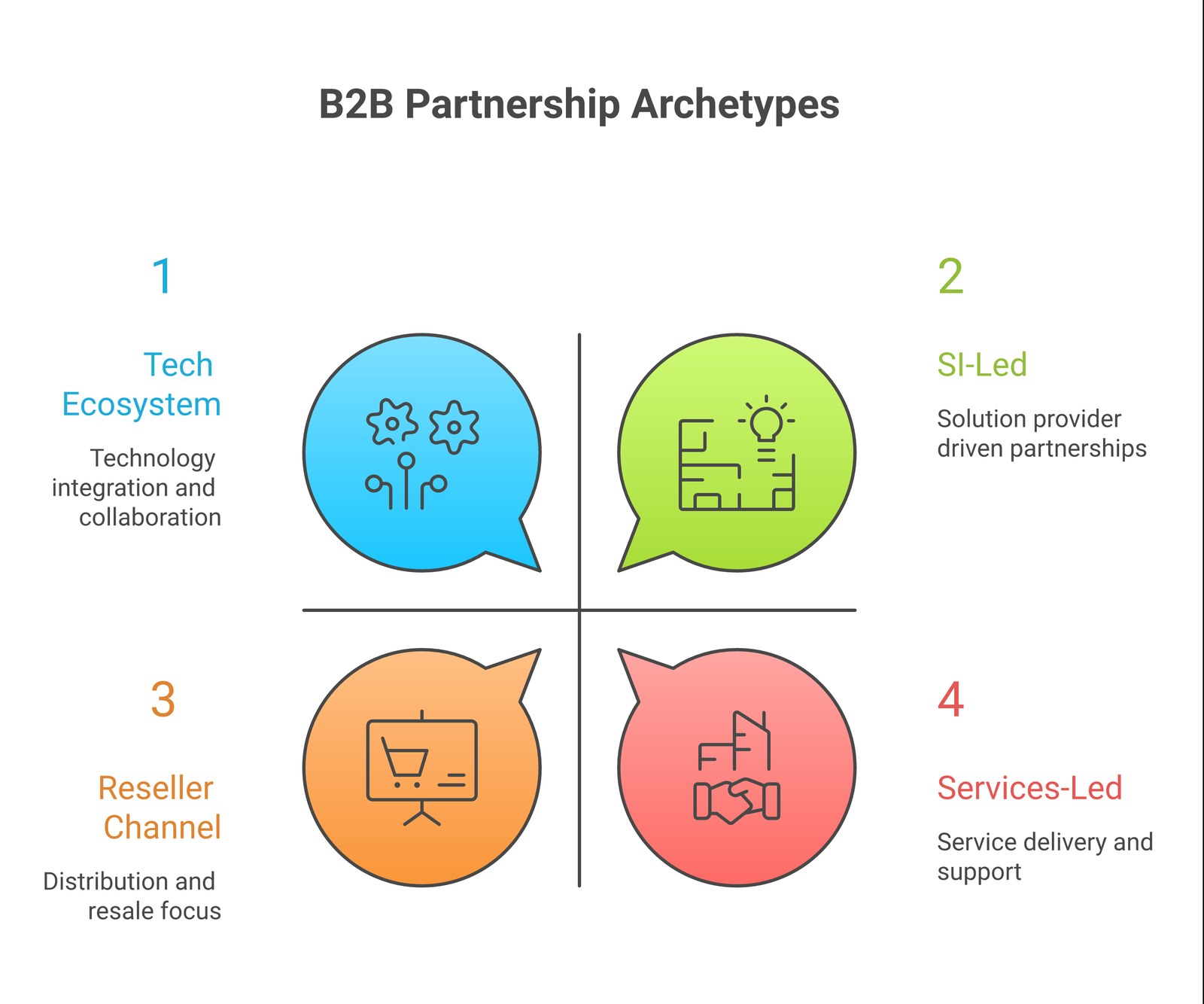
This is the topic I get asked to define most often, usually because the term is used inconsistently across the industry. “B2B partnerships” is sometimes used to mean reseller programs, sometimes tech-ecosystem alliances, sometimes services partnerships, sometimes channel marketing relationships, and sometimes any of the above wrapped in a referral fee. The framework that organizes the category is the four-archetype model: reseller-channel, tech-ecosystem, services-led, and SI-led. Every B2B partnership fits one of the four, and the operating model differs across the archetypes.
This piece covers what B2B partnerships are, the four canonical archetypes, the operating layers that turn the relationship into joint pipeline, the failure modes I see most often, and how B2B partnerships fit inside the broader partner program.
What are B2B partnerships?
B2B partnerships are formal commercial relationships between two business organizations, structured to produce joint customer outcomes and shared revenue. The relationship typically includes a documented operating model, defined economic mechanics, named partner contacts at both organizations, and a measurement framework. Casual referral relationships and one-off co-marketing campaigns are not B2B partnerships in the operating sense; they are tactical activities.
The category covers a range of structural shapes. Reseller partnerships transfer the right to sell the vendor’s product to a partner that owns the customer relationship. Technology partnerships integrate two products and create a joint customer experience that neither product produces alone. Services partnerships bring in a consultancy, agency, or accounting firm to implement, configure, or extend the vendor’s product. SI partnerships put a system integrator at the center of an enterprise account. Marketplace partnerships route deals through transactional marketplaces (AWS, Azure, Salesforce AppExchange) with a co-sell motion attached.
B2B partnerships differ from B2C partnerships and from supplier relationships in three operating dimensions. The customer is a business, which means the buying committee, the procurement cycle, and the decision criteria are structurally different. The relationship is multi-quarter, which means the operating cadence has to span procurement cycles. The economic mechanics are commercial, which means partners are paid through margin, fees, or shared revenue rather than through marketing spend.
The four canonical B2B partnership archetypes
Four canonical archetypes cover most B2B partnerships in 2026: reseller-channel, tech-ecosystem, services-led, and SI-led. Each has a different success metric, partner profile, and operating cadence. Treating all four as the same category is the most common strategic mistake I see at customer organizations.
Reseller-channel
The partner resells the vendor’s product to end customers, typically with margin protection and a defined territory or segment. Success metric: percent of revenue running through the channel and partner-sourced revenue. The reseller partnership is the original B2B partnership archetype and remains the largest category by revenue. Common operating cadence: monthly per-partner pipeline review, quarterly business review, annual program reset with margin-band updates.
Tech-ecosystem
The partner is a technology vendor whose product complements or integrates with the vendor’s. The partnership produces a joint customer experience and joint pipeline. Success metric: joint pipeline plus partner-touched revenue. Common operating cadence: biweekly joint pipeline review, monthly account-mapping refresh, quarterly co-sell strategy session. The tech-ecosystem archetype is the fastest-growing category in 2026 and the one driving the ELG operating model.
Services-led
The partner is a consultancy, agency, or accounting firm that implements or recommends the vendor’s product. Success metric: implementation-attached revenue plus year-two retention on partner-implemented accounts. Common operating cadence: monthly partner-led pipeline review, quarterly implementation-quality review, annual certification refresh.
SI-led
The partner is a system integrator driving deals into enterprise accounts. The vendor’s product is a component of a broader engagement. Success metric: enterprise-named-account revenue per SI partner. Common operating cadence: monthly named-account review per SI, quarterly executive sponsor alignment, annual program-level reset. The SI-led archetype is structural for enterprise GTM and is often the dominant motion at companies selling into Fortune 500 accounts.
The four operating layers of a B2B partnership
Strong B2B partnerships run four operating layers regardless of archetype: a documented operating model, named economic mechanics, a recurring operating cadence, and an attribution model that survives finance review. Programs missing any of the four have a structural reason for the underperformance the team is debating.
Documented operating model
The first layer is the operating model document. The document captures who the partner is, what the joint motion is, what each partner contributes, what each partner gets, and how the relationship is measured. Without the document, the partnership runs on the personalities of the people running it, which produces a relationship that doesn’t survive a CRO change.
Named economic mechanics
The second layer is the economic mechanics. For reseller-channel partnerships, the mechanics are margin and renewal economics. For tech-ecosystem partnerships, they are shared customer expansion and integration revenue. For services-led partnerships, they are implementation services and recurring engagement margin. For SI-led partnerships, they are enterprise contract value and the SI’s own margin on the broader engagement.
Recurring operating cadence
The third layer is the operating cadence. Strong partnerships run on a monthly joint pipeline review with named accounts and explicit dispositions, a quarterly business review with the partner’s leadership team, and an annual program-level reset.
Attribution model that survives finance review
The fourth layer is the partner attribution model. The model defines what counts as partner-touched, partner-influenced, partner-sourced, and partner-led, and gets signed off by finance. Without finance sign-off, the partnership program loses the funding fight every quarter.
Common pitfalls in B2B partnership operating design
Five recurring failure modes account for most of the underperformance I see at customer organizations.
- Treating partnerships as a marketing function. Partnerships reporting to a CMO instead of a CRO produces partnership programs optimized for logo placement and co-marketing rather than joint pipeline.
- Mixing archetypes into one program. A single program covering reseller, tech-ecosystem, services, and SI partners produces an average program in each.
- No operating model document. A partnership running on personality rather than documented operating model collapses the first time someone changes roles.
- Single-touch enablement. Treating partner enablement as a launch event plus a portal. The recurring cadence is what makes the partnership compound.
- No attribution model. Running a partnership without a finance-approved attribution model produces a partnership that loses the funding fight every quarter.
Tools and operating cadence stack
| Operating stage | Partner data | Workflow / PRM | Attribution | Cadence |
|---|---|---|---|---|
| Pilot (1-3 partners) | Shared spreadsheet | None | CRM partner-touched flag | Monthly per partner |
| Early (3-10 partners) | Crossbeam, PartnerTap | Light PRM | Sourced / influenced split | Monthly per partner + quarterly QBR |
| Operating (10-30 partners) | Crossbeam at scale | Introw, Impartner | Closed-loop attribution | Biweekly joint pipeline + quarterly QBR |
| Mature (30+ partners) | Crossbeam plus enriched data | PRM plus partner-side workflow | Executive attribution model | Joint forecast call with CRO |
Forecastable’s POV
My take is that B2B partnerships are the single most under-operated revenue motion in modern B2B. The category has been around for decades, the vocabulary is mature, and the tooling is sophisticated; what’s missing is operating discipline. Companies that compound on B2B partnerships treat them as a system with documented operating models, named economic mechanics, recurring cadence, and finance-aligned attribution.
The pattern that compounds
The B2B partnerships I see compound across multi-year horizons share four traits. The partnership has a written one-page operating model that survives a CRO change. The economic mechanics are documented from the partner’s side, not just the vendor’s. The cadence is monthly joint pipeline review with named accounts and explicit dispositions. The attribution model is signed off by finance and audited annually.
The contrarian position
The contrarian position is that B2B partnerships should report to the CRO, not the CMO, in any company where the partnership program is meant to produce joint pipeline. The CMO reporting line produces partnerships optimized for logo placement and co-marketing; the CRO reporting line produces partnerships optimized for joint pipeline and finance-defensible attribution.
Frequently asked questions
What are B2B partnerships?
Formal commercial relationships between two business organizations, structured to produce joint customer outcomes and shared revenue.
What are the four canonical B2B partnership archetypes?
Reseller-channel, tech-ecosystem, services-led, and SI-led.
How do B2B partnerships differ from supplier relationships?
B2B partnerships are about joint customer outcomes and shared revenue; supplier relationships are about input procurement.
Should B2B partnerships report to marketing or revenue?
Revenue (CRO or CEO), not marketing. Marketing reporting produces partnerships optimized for logo placement.
What are the four operating layers of a strong B2B partnership?
A documented operating model, named economic mechanics, a recurring operating cadence, and an attribution model that survives finance review.
How long does it take to establish a B2B partnership that produces results?
Two to three quarters of operating cadence with a small partner cohort before formalizing the program template.
What is the most common B2B partnership mistake?
Treating partnerships as a marketing function, mixing archetypes into one program, or running without a documented operating model.
Next step
If your B2B partnerships are reporting into marketing, that’s the first thing to change.
Forecastable is an independent third-party professional services company. Our evaluations of other vendors are based on publicly-available information as of May 2026 and our own client experience.
Talk to our team about building a B2B partnerships function that reports into revenue →
By Alex Buckles
Uncover Your Growth Potential
Schedule a Discovery Call