Partner Marketing Strategy: What Actually Works

What is a partner marketing strategy?
Short answer: A partner marketing strategy is a plan for generating pipeline with and through partners, using joint campaigns, shared audiences, and co-branded programs aimed at a number. It is marketing that reaches a partner’s trusted audience, not just marketing that features a partner’s logo. The goal is deals, not decoration.
The strategy is often confused with co-branding, which is one tactic inside it. A real partner marketing strategy is built around the pipeline a partner’s audience can produce.
Why a partner marketing strategy matters in 2026
A partner marketing strategy matters because a partner’s audience already trusts them, and reaching a warm audience through a partner converts far better than reaching a cold one alone. As traditional demand generation gets more expensive and less effective, the partner’s audience becomes one of the few channels that still works. A strategy is how you tap it deliberately instead of running the occasional joint webinar.
In 2026, buyers tune out vendor marketing but still listen to the partners and platforms they rely on. A partner marketing strategy puts your message in front of buyers through a source they already believe, which is why partner-influenced pipeline often carries a higher win rate. Ignoring it leaves your best distribution channel unused.
The strategy also multiplies marketing reach without multiplying budget. Each partner brings an audience you did not have to build, and a coordinated program turns many partner audiences into a compounding source of pipeline. That leverage is why partner marketing is a strategy, not a series of one-off campaigns.
How a partner marketing strategy actually works
A partner marketing strategy works by choosing the right partners, building joint programs around shared audiences, and measuring the pipeline they produce. The components below are what the strategy contains.
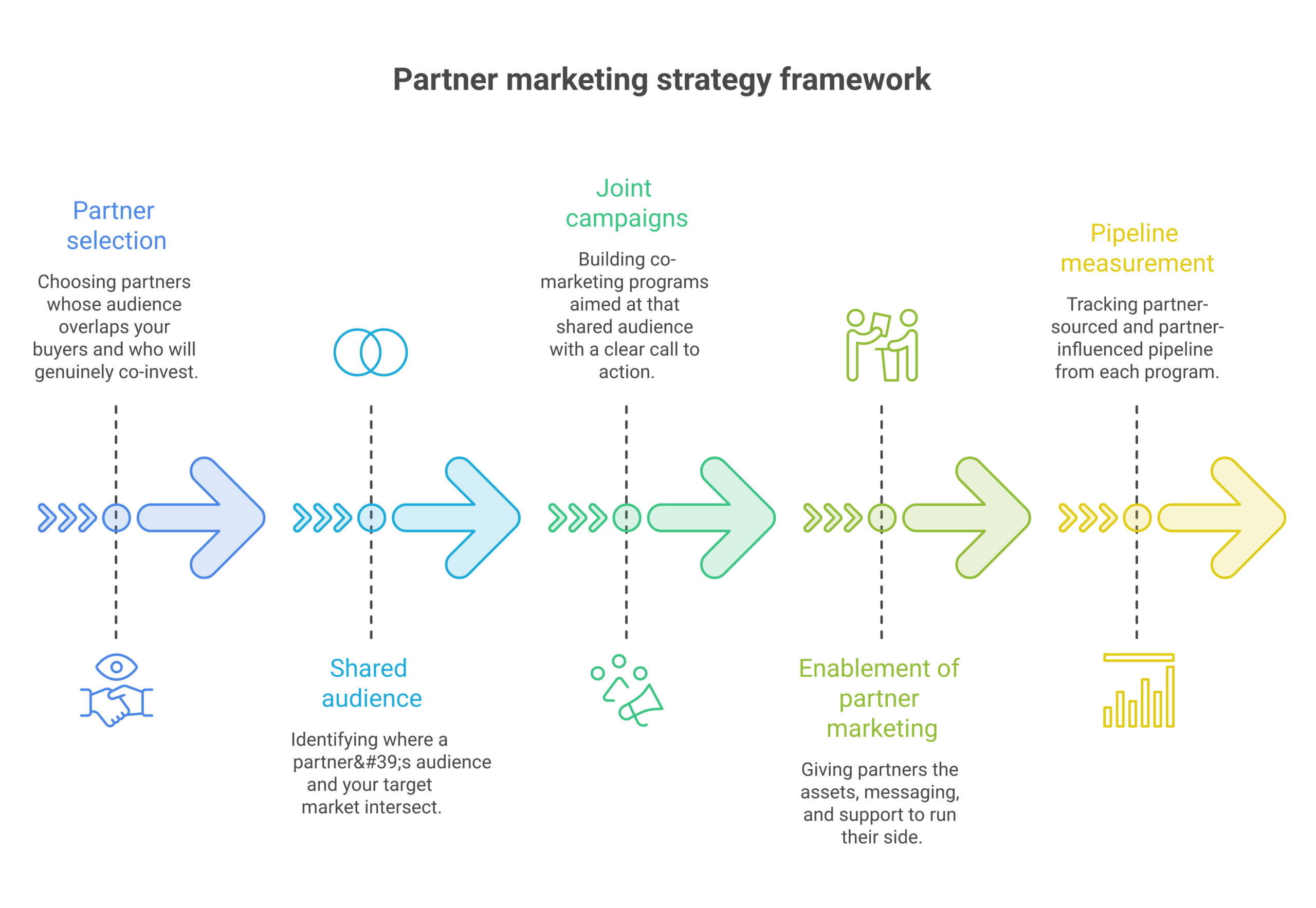
- Partner selection: Choosing partners whose audience overlaps your buyers and who will genuinely co-invest, rather than running programs with any partner willing to co-brand.
- Shared audience: Identifying where a partner’s audience and your target market intersect, so campaigns reach the buyers a partner can actually influence.
- Joint campaigns: Building co-marketing programs, from events to content to nurture, aimed at that shared audience with a clear call to action and offer.
- Enablement of the partner’s marketing: Giving partners the assets, messaging, and support to run their side, because most partners lack marketing capacity and stall without help.
- Pipeline measurement: Tracking partner-sourced and partner-influenced pipeline from each program, so budget flows to the partners and campaigns that produce.
Common pitfalls in a partner marketing strategy
- Co-branding without a number: Producing logos-on-a-slide programs with no pipeline target turns partner marketing into a cost center. Aim every program at a measurable result.
- Running programs with any willing partner: Choosing partners by who says yes rather than whose audience fits fills the calendar with low-yield campaigns. Select for audience overlap.
- Ignoring partner marketing capacity: Expecting partners to run their side without support ignores that most have little marketing bandwidth. Enable them or the program stalls.
- One-off campaigns, no program: Treating partner marketing as occasional joint webinars misses the compounding of a coordinated program. Build a repeatable motion.
- No pipeline measurement: Judging partner marketing on leads or attendance instead of pipeline and revenue rewards activity over results. Measure the deals.
What this looks like in practice
A worked example: a company ran partner marketing as a stream of co-branded webinars, one whenever a partner asked. Attendance looked fine and pipeline was invisible, because nothing was aimed at a number or measured past the registration list. The team rebuilt it as a strategy: it picked three partners whose audiences closely matched its buyers, built a coordinated program of content and events around each shared audience with a clear offer, and gave those partners the assets and support to run their half. It tracked partner-influenced pipeline from each program in CRM. Two of the three programs produced real pipeline, the third did not, and budget shifted accordingly the next quarter. The lesson was that a partner marketing strategy works when it is built around shared audiences and measured in pipeline, because co-branding without a number is decoration, not demand generation.
Forecastable’s POV on a partner marketing strategy
Our position is that partner marketing fails when it optimizes for co-branded activity instead of pipeline, and most programs are activity machines. The comfortable version produces joint content and counts registrations. The version that earns budget picks partners by audience fit, builds programs around a number, and measures the pipeline they generate. Marketing through a partner’s trusted audience is too valuable to waste on decoration.
We also think partner marketing has to enable the partner, because most partners cannot execute alone. The vendor that ships a co-branded asset and expects the partner to drive the campaign will watch it stall. The programs that produce treat the partner’s marketing capacity as the constraint it is and provide the assets, messaging, and support to run the partner’s side. Enablement is what turns a willing partner into an actual channel.
Forecastable is a partnerships operating platform focused on connecting partner conversations and actions to CRM pipeline and revenue. We do not run your campaigns; we make partner-sourced and partner-influenced pipeline visible in the forecast, so you can see which partners and programs produce and fund them accordingly. A partner marketing strategy generates the demand; visibility proves which partner audiences turned into revenue.
Forecastable is a partnerships operating platform and a category authority, not a PRM vendor. Any third-party tools or firms referenced in this space are independent third-party products, and mentioning them is not an endorsement. Evaluate any marketing approach against your own partner mix, motion, and CRM.
Frequently asked questions
What is a partner marketing strategy?
It is a plan for generating pipeline with and through partners using joint campaigns, shared audiences, and co-branded programs aimed at a measurable number, not just co-branded content.
How is partner marketing different from co-branding?
Co-branding is one tactic; a partner marketing strategy is the broader plan for reaching a partner’s audience and producing pipeline. Co-branding without a pipeline goal is decoration.
How do you choose partners for marketing?
By audience overlap with your buyers and genuine willingness to co-invest, not by which partners are simply willing to put a logo on an asset.
Why do partner marketing programs stall?
Often because the partner lacks marketing capacity and gets no support. Enabling the partner’s side of the program is usually what keeps it moving.
How do you measure a partner marketing strategy?
By partner-sourced and partner-influenced pipeline and revenue from each program, tracked in CRM, not by leads or event attendance alone.
What makes partner-influenced pipeline convert well?
It reaches buyers through a partner they already trust, so the message carries more credibility than cold vendor marketing, which often lifts win rates.
Next step
If your partner marketing is a stream of co-branded webinars nobody measures, rebuild it as a strategy: pick partners by audience fit, aim programs at a number, enable the partner’s side, and track partner-influenced pipeline. Start your growth journey now to make partner marketing pipeline visible in the forecast. The partner program hub frames how a partner marketing strategy connects to co-selling and attribution.
Uncover Your Growth Potential
Schedule a Discovery Call