Referral Partner Program: What It Is and How to Run It

Short answer
Short answer: A referral partner program is a structured way to pay partners a fee for introducing you to customers they already have relationships with, without asking them to sell or deliver your product. It works when the referral is easy to submit, credited cleanly, and followed up fast, and it stalls when it is a form in a portal that no one is asked to fill out.
Here is the position. A referral program is the lowest-friction partner motion there is, which is exactly why it gets neglected. Companies stand it up, announce it once, and then wonder why the referrals never come.
What is a referral partner program?
A referral partner program is an agreement under which a partner introduces a prospect to you and earns a fee if that introduction turns into revenue. The partner does not carry a quota, resell your product, or deliver services. They make a warm introduction into an account where they already have trust, and you take it from there.
It is the simplest rung on the partner ladder. A reseller transacts the sale and carries margin. A value added reseller wraps services around the product. A referral partner just opens the door. That simplicity is the whole point: the ask is small, so a much wider set of firms, consultants, agencies, and complementary vendors will say yes to it than would ever sign a reseller agreement.
Define it plainly the first time it comes up, because “referral” and “affiliate” get used interchangeably and they are not the same. An affiliate program is usually high-volume, low-touch, and driven by a tracking link. A referral partner program is lower-volume, higher-value, and driven by a human introduction into a specific account. The mechanics, the payout, and the follow-up are all different.
Why a referral partner program matters in 2026
A referral partner program matters because a warm introduction converts at a rate cold outbound cannot touch. When a trusted advisor tells their customer “you should talk to these people,” the deal starts with credibility already transferred, and buyers increasingly arrive with exactly that kind of partner already involved, per work widely cited from Jay McBain on the partner-surrounded buying journey.
The second reason is cost. A referral program is the cheapest partner motion to stand up and run. There is no margin to fund, no deep enablement, no co-delivery. You pay for outcomes, a fee on closed revenue, which means the program is close to pure upside if the introductions are real. For an early-stage company that cannot yet fund a full reseller channel, a referral program is often the first partner motion that makes sense.
The catch is that low friction cuts both ways. Because the ask is small and the program is cheap, it is easy to launch and easy to ignore. A referral program produces when someone actively asks specific partners for specific introductions and closes the loop fast, and it goes silent when it is a standing offer no one is working.
How a referral partner program actually works
A referral partner program runs on a five-part model. Skip any part and you have a payout page no one uses.
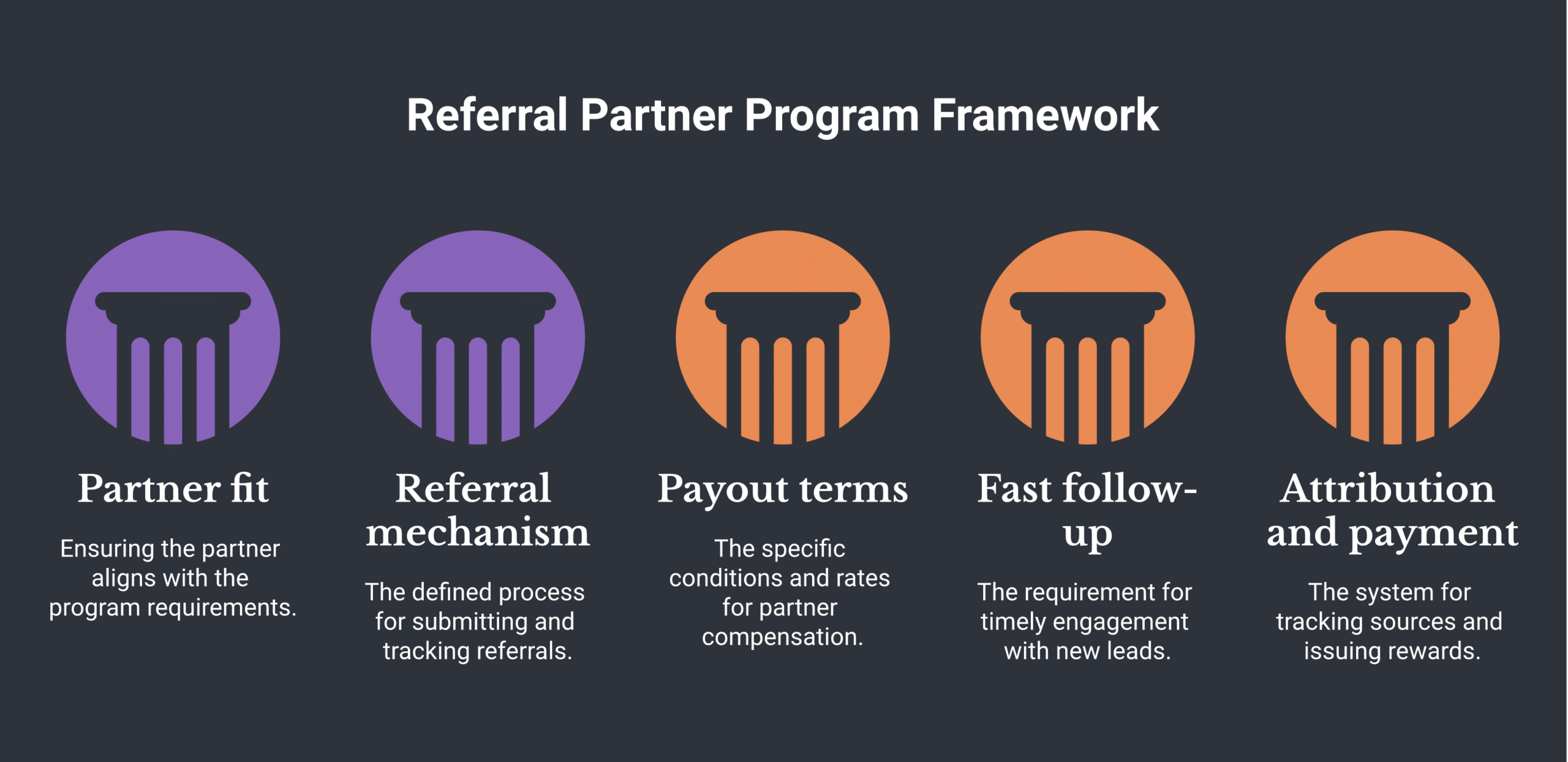
- Partner fit: recruit firms and individuals whose customers overlap with your ideal accounts, consultants, agencies, and complementary vendors who are already in the room, rather than anyone who will sign up for a link. A referral partner is only as valuable as the accounts they can open.
- The referral mechanism: make submitting a referral take under two minutes, a short form, an email intro, or a Slack message, because every step of friction cuts the number of referrals you actually get. If a partner has to log into a portal they forgot the password to, the referral never happens.
- Payout terms: set a fee that is worth a partner’s reputation, a percentage of first-year revenue or a flat amount per closed deal, and state clearly when it is paid. A payout that feels token relative to the trust the partner is spending gets no repeat referrals.
- Fast follow-up: contact a referred prospect within a day and keep the referring partner informed of what happens, because a partner who introduces you to their customer is lending you their credibility and will stop if you drop the ball or go dark. Speed and communication are the entire retention mechanism.
- Attribution and payment: track each referral from submission to close, credit the right partner, and pay on time, so partners trust the program and keep referring. A referral partner who has to chase a payout tells other potential partners not to bother.
The through-line is that a referral program is a relationship you have to work, not a page you publish. The low friction that makes it easy to launch is the same thing that makes it easy to neglect, and neglected referral programs are the most common dead partner motion there is.
Common pitfalls
- Launch and forget: announcing the program once, then never asking a specific partner for a specific introduction, so the standing offer produces nothing.
- Friction in submission: routing referrals through a clunky portal, so partners give up before they submit and just make the intro off the record with no credit.
- Token payouts: setting a fee too small to be worth a partner’s reputation, so partners refer once, get an underwhelming check, and never refer again.
- Slow or silent follow-up: letting a referred lead sit or going dark on the referring partner, which burns the trust the partner spent and ends the relationship.
- Broken attribution: failing to track referrals cleanly, so partners get credited wrong or paid late and stop trusting the program.
What this looks like in practice
A worked example shows the difference between a payout page and a program. In my work with partnerships teams, the referral program is almost always the motion that exists on paper and produces nothing. It was launched, a fee was set, a form was built, and then no one owned working it.
The fix is not a better form. We identify the specific partners whose customers overlap with the accounts the company wants, and someone actually calls those partners and asks, by name, for the introductions that make sense this quarter. When a referral comes in, it gets worked within a day and the referring partner hears back fast. That is deliberate: the program does not generate referrals, a person asking specific partners for specific introductions does. The first handful of worked referrals become the proof that the program can produce, and that proof is what justifies asking a wider set of partners.
The lesson is that a referral partner program is a set of relationships someone has to actively work, not a standing offer you post and forget.
Forecastable’s POV
A referral partner program fails for a boring reason: no one owns working it. Because it is the cheapest and lowest-friction partner motion, it is the easiest to launch and the easiest to ignore, so it becomes a payout page that produces a trickle of accidental referrals and nothing deliberate. Leadership then concludes referrals do not work, when what did not work was leaving the program unattended.
The fix is to treat the referral program like a light sales motion: recruit for fit, make submitting trivial, pay a fee worth the partner’s reputation, follow up fast, and attribute cleanly. Ask specific partners for specific introductions rather than waiting for the offer to work itself. Prove the motion with a handful of well-fit partners before scaling recruiting. Order of operations matters: worked referrals first, a big partner list second.
At Forecastable we operate at that activation layer. We are a partnerships operating platform focused on connecting partner conversations and actions to CRM pipeline and revenue, the flywheel from conversations to actions to pipeline to revenue. Your tooling can hold the referral forms and the payout logic. Our Co-Sell Alignment Specialist is delivered as part of the service and uses the platform to run the motion that keeps referrals flowing and to attribute what each partner sources.
My bet: the programs that win work their referral partners like a pipeline source, and the ones that treat the program as a set-and-forget payout page keep wondering why the introductions never come.
Forecastable is an independent third-party. Any tools, vendors, or third-party figures referenced here are described from public information for the reader’s own evaluation, not as paid placements.
Frequently asked questions
What is a referral partner program? A referral partner program is a structured agreement where a partner introduces you to a customer they already trust and earns a fee if the introduction turns into revenue. The partner does not sell, deliver, or carry a quota; they open the door and you close the deal.
What is the difference between a referral partner and an affiliate? An affiliate program is high-volume and low-touch, driven by a tracking link and often aimed at consumers or self-serve products. A referral partner program is lower-volume and higher-value, driven by a human introduction into a specific account, with a fee paid on closed revenue.
How much should you pay referral partners? Enough to be worth the partner’s reputation. Common structures are a percentage of first-year revenue or a flat fee per closed deal. A payout that feels token relative to the trust the partner spent making the introduction will not earn repeat referrals.
How do you make a referral program produce? Recruit partners whose customers overlap with your target accounts, make submitting a referral take under two minutes, ask specific partners for specific introductions, follow up within a day, and attribute and pay cleanly. Do not launch it and wait.
Do you need software to run a referral program? Not to start. A short form and clean tracking are enough at first. Software helps once volume grows and manual tracking breaks down; the production still comes from someone actively working the partners, not from the tool.
Next step
Look at your referral program and ask when a partner last submitted a referral because someone asked them to. If the honest answer is that the program is a page no one works, the problem is not the partners; it is that no one owns the motion.
If you want the motion that keeps referrals flowing and credited, that is what we do. Start your growth journey with Forecastable and we will run it on top of your program. Our partner program guide covers how the pieces fit together, and the channel partner guide and referral partner agreement guide go deeper on structuring the relationship.
Uncover Your Growth Potential
Schedule a Discovery Call