Partner Incentive Programs: What Works in 2026

What are partner incentive programs?
Short answer: Partner incentive programs are the structured rewards a vendor offers partners for taking specific actions, from registering a deal to closing one to renewing a customer. They exist to move behavior, not to say thank you, and the good ones pay for outcomes the vendor could not buy any other way.
The trap is treating incentives as a discount line. They are a behavior tool. Every dollar you put into a program should be buying a partner action you can name, and if you cannot name the action, you are funding goodwill rather than growth.
Why partner incentive programs matter in 2026
Partner incentive programs matter because partner attention is the scarcest resource in the channel. A partner with twelve vendor relationships spends their selling time where the path to revenue is clearest, and incentives are how you compete for that time without simply buying it at a loss. The vendor who rewards the right action at the right moment gets the partner’s next deal; the vendor who pays late or pays for nothing specific gets ignored.
In 2026 the pressure is sharper because finance is scrutinizing every channel dollar. A program that cannot tie a payout to a sourced or influenced deal is the first thing cut in a budget review. That makes measurement the difference between a program that survives and one that disappears, and it pushes incentive design toward actions you can actually track in CRM rather than soft commitments you cannot.
There is also a trust dimension. Partners talk to each other. A program that pays accurately and on time builds a reputation that pulls deals toward you, while one that disputes payouts or moves the goalposts mid-quarter teaches an entire community to deprioritize you. The incentive is only half the value; the reliability of paying it is the other half.
How partner incentive programs actually work
A partner incentive program runs as a loop from defined action to verified payout. The components below are the parts that have to function for the program to change behavior rather than just spend money.
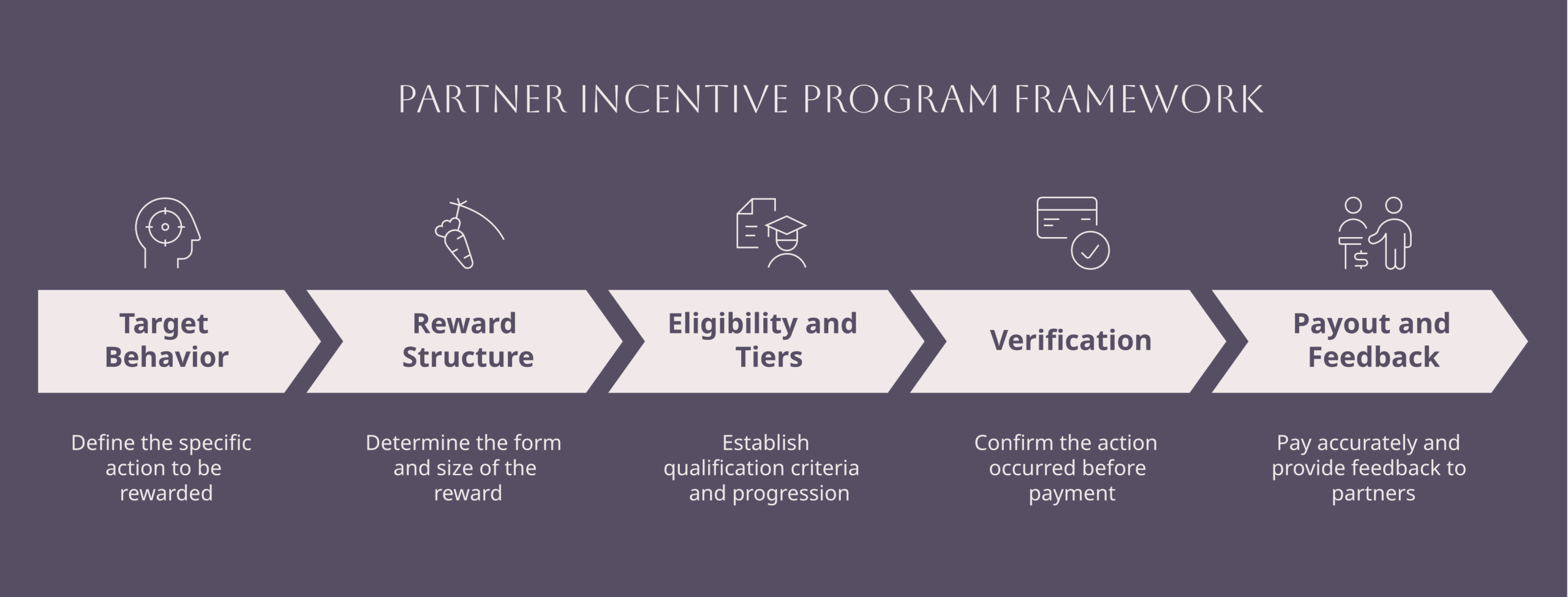
- Target behavior: Name the exact action you are paying for, such as a registered deal, a sourced opportunity, a completed certification, or a renewal. A program with no named behavior pays for activity that would have happened anyway.
- Reward structure: Decide the form and size, whether a margin uplift, a rebate, a spiff, an MDF allocation, or a tiered bonus. The structure should make the desired behavior the most rewarding path the partner can take.
- Eligibility and tiers: Define who qualifies and how partners move up. Tiers work when the next level is reachable and the benefit is worth the effort; they fail when the ladder is invisible or the top rung is impossible.
- Verification: Confirm the action actually happened before paying, using CRM records rather than partner say-so. This is where most programs leak, because unverified payouts train partners to claim rather than to sell.
- Payout and feedback: Pay accurately and on a predictable schedule, then show the partner what they earned and why. Fast, transparent payment is what makes the next quarter’s behavior change stick.
Common pitfalls in partner incentive programs
- Paying for activity, not outcomes: Rewarding webinar attendance or portal logins feels measurable but buys motion, not revenue. Pay for actions that sit on the path to a closed deal.
- Incentives nobody understands: If a partner cannot explain how they earn the reward in one sentence, they will not chase it. Complexity in the rules is complexity the partner routes around.
- Slow or disputed payouts: A reward that arrives two quarters late, or that gets clawed back on a technicality, does more damage than no program at all. The reliability of payment is the program.
- Flat rewards for unequal effort: Paying the same spiff for a tiny deal and a strategic one tells partners to chase volume over value. Scale the reward to the outcome you actually want more of.
- No measurement spine: If you cannot trace a payout back to a CRM record, finance cannot defend the budget and you cannot prove the program works. Unmeasured incentives are the first cut.
What this looks like in practice
A vendor ran a flat referral spiff and a portal-activity bonus, and could not explain to finance what either bought. Partners collected the activity bonus for logging in and treated the referral spiff as too small to chase, so the best opportunities went to vendors with clearer rewards. The program spent its full budget and moved no measurable pipeline.
The rebuild was about behavior and proof. The activity bonus was killed. The referral spiff was replaced with a tiered reward that scaled with deal size and only paid on a registered, CRM-verified opportunity. Payout moved to a fixed monthly schedule with a named owner. Because every reward now tied back to a deal record, whether tracked in the partner system or a relationship platform such as Introw or Euler, finance could see exactly what each dollar sourced, and partner-sourced pipeline rose because partners trusted that bringing a real deal would actually pay.
Forecastable’s POV on partner incentive programs
Our position is that an incentive is a sentence: pay this partner this amount when they do this specific thing. If you cannot write that sentence, you do not have a program, you have a budget waiting to be wasted. The discipline of naming the behavior is what separates incentives that change a quarter from incentives that decorate one.
We also think most programs over-index on the size of the reward and under-index on the certainty of it. Partners are rational; they invest where the payoff is reliable, not where it is largest in theory and uncertain in practice. A modest reward that always pays on time beats a generous one that arrives late or gets disputed, because the partner is pricing in the risk every time they decide where to spend their selling hours.
Finally, treat the incentive program as a measurement instrument, not just a spend. Every verified payout is a data point about what your partners actually do for revenue, and connected to your CRM it becomes the clearest read you have on partner contribution. That turns the program from a cost finance wants to cut into a source of the attribution that justifies the whole channel.
Forecastable is a partnerships operating platform. Any third-party tools named here are independent third-party products, and naming them is not an endorsement of one over another. Decide how your incentives should be structured for your own partners, margins, and sales motion.
Frequently asked questions
What are partner incentive programs?
They are structured rewards a vendor pays partners for specific actions, such as registering a deal, sourcing an opportunity, completing a certification, or renewing a customer. The point is to move behavior toward revenue, not to offer a general discount.
What types of partner incentives are there?
Common forms include margin uplifts, rebates, spiffs, market development funds, deal-registration bonuses, and tiered performance bonuses. The best form depends on the behavior you are trying to buy and how you can verify it.
How do you measure if a partner incentive program works?
Trace every payout back to a CRM record and compare the partner-sourced or influenced pipeline it generated against the spend. If you cannot connect a reward to a deal, you cannot prove the program and finance cannot defend it.
Why do partner incentive programs fail?
Usually because they pay for activity instead of outcomes, the rules are too complex to chase, or payouts are slow and disputed. Partners deprioritize programs they cannot understand or trust to pay.
How big should a partner incentive be?
Large enough to make the desired action the partner’s best use of time, and scaled to the size of the outcome. Reliability of payment matters more than raw size, because partners price in the risk of not getting paid.
Should incentives be tiered?
Tiers help when the next level is genuinely reachable and the benefit is worth the climb. They backfire when the ladder is invisible or the top rung is unreachable, which just signals that effort will not be rewarded.
Next step
If your incentive budget is fully spent but you cannot tell finance what it bought, the problem is design and measurement, not the size of the rewards. Forecastable helps partnerships teams tie every incentive to a CRM-verified action so payouts are accurate, behavior actually shifts, and partner-sourced revenue is something you can prove. Start your growth journey now to make your incentives buy outcomes instead of activity. The partner program hub frames how incentives fit the wider program design.
Uncover Your Growth Potential
Schedule a Discovery Call