Partner Tiers: How to Build a Ladder That Produces

What are partner tiers?
Short answer: Partner tiers are the named levels in a partner program, such as registered, silver, gold, and platinum, that sort partners by how much they produce and reward each level with progressively better benefits. They are meant to be a production ladder, a way to give your best partners more and ask more of them in return, and they only earn their place when the level a partner sits at is tied to the revenue they source or influence rather than to how long ago they signed a form.
Most programs build tiers backward. They design four levels, attach benefits, and then sort partners into them by activity, and the ladder becomes a filing system instead of an incentive.
The tiers that work reward the behavior you actually want, which is producing pipeline, and make advancement something a partner earns by selling, not by attending.
Why partner tiers matter in 2026
A partner program with one flat level treats a partner who sourced a million dollars the same as one who signed and went quiet, and both notice. Tiers exist so you can concentrate your best benefits, your co-sell attention, and your margin on the partners who move revenue, instead of spreading everything evenly across a roster.
Done well, partner tiers are a motivation engine. A partner who can see the next level, knows exactly what it takes to reach it, and wants the benefits waiting there has a reason to bring you more deals. That is the whole point of a ladder, to give producing partners somewhere to climb.
In 2026, with partnership teams under pressure to show partner-sourced revenue rather than partner headcount, tiers are also a governance tool. They let you set a real bar for staying in the program and quietly retire the partners who never clear it, so your attention goes where it produces.
How partner tiers actually work
Partner tiers work as a production ladder tied to revenue: you set the levels around what you want partners to produce, define objective requirements to reach each level, attach benefits that get materially better as partners climb, review placement on a real cadence, and connect the whole thing back to partner-sourced pipeline in the CRM. Each component keeps the ladder honest, and any tier that rewards tenure or attendance instead of production is where the program starts leaking. The parts below are what a working tier structure includes.
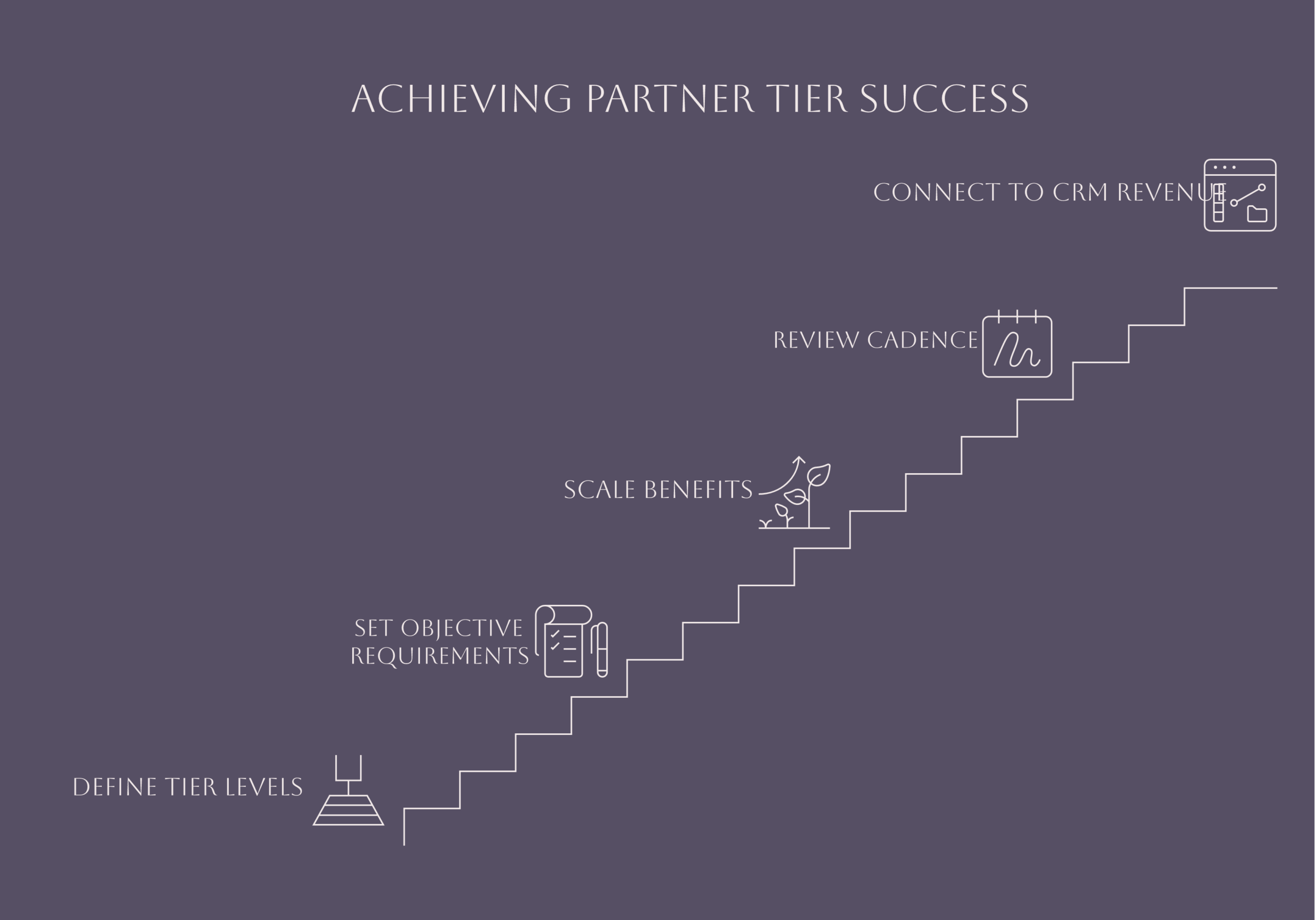
- Tier levels tied to production: Define the levels, three or four is plenty, around the revenue and behavior you want to reward. Base the boundaries on what a producing partner actually looks like, not on a tidy pyramid, so the level a partner sits at means something.
- Objective requirements: Set clear, measurable criteria to reach each tier: partner-sourced revenue, certified sellers, active co-sell deals, whatever maps to production. Requirements a partner can verify for themselves beat subjective judgment, because they turn the ladder into something a partner can plan against.
- Benefits that scale with the tier: Make the benefits at each level materially better than the one below, higher margins, more co-sell support, better leads, earlier roadmap access. If gold and silver feel the same, no one has a reason to climb.
- Review cadence and movement: Recalculate placement on a set schedule, usually annually, with both promotion and demotion. A tier a partner can never lose is a title, not a level, and a ladder no one can fall off stops motivating anyone.
- Connection to CRM revenue: Tie tier placement to partner-sourced and partner-influenced pipeline you can see in the CRM. If you cannot measure what a partner produced, you cannot place them fairly, and the tiers drift back to tenure and gut feel.
Common pitfalls with partner tiers
- Tiers based on tenure, not production: Placing partners by how long they have been signed rewards survival, not selling. A partner who joined three years ago and never produced should not outrank one who sourced real pipeline last quarter.
- Benefits that barely differ between levels: If the jump from silver to gold buys a slightly bigger logo on a directory page, no partner will work for it. The benefits have to be worth the climb.
- No demotion: A ladder that only goes up fills the top with partners who earned platinum once and coasted. Real tiers move both directions, so status reflects current production.
- Too many levels: Six or seven tiers split your roster so thin that the distinctions stop meaning anything and the admin overhead swamps the benefit. Three or four levels carry all the signal you need.
- Requirements no one can see: If partners cannot tell why they landed where they did, the tiers feel arbitrary and demotivating. Publish the criteria and show partners their standing against them.
What this looks like in practice
A software company ran a four-tier program where placement was based on years in the program and a soft “engagement” score the partner team assigned by feel. The top tier was crowded with partners who had signed early and produced little, while a handful of genuinely productive newer partners sat two levels down, quietly frustrated. The ladder was demotivating exactly the people it should have been rewarding.
They rebuilt the tiers around one thing: partner-sourced revenue tracked in the CRM, with certified-seller and active-co-sell requirements layered on top. Every level had published criteria a partner could check against their own numbers, benefits that stepped up sharply at each rung, and an annual review that moved partners both ways. Within a year the top tier was populated by partners actually producing, several coasting incumbents dropped and either re-engaged or left, and the newer producers climbed and brought more deals because the climb was finally worth it. The tier chart went from a seniority list to an incentive that changed behavior.
Forecastable’s POV on partner tiers
Our position is that partner tiers should be the last thing you design, not the first, and they should reward production, full stop. A program that opens with a four-level pyramid and then goes looking for partners to fill it has optimized the packaging before it has a product. The tiers only mean something once you know what a producing partner looks like, so define that first and build the ladder around it.
That reframes what advancement is for. A tier is not a thank-you for loyalty, it is a lever, more benefits and more attention pointed at the partners bringing you revenue so they bring you more. The instant a tier rewards tenure or attendance, it stops being a lever and becomes a cost, because you are spending your best benefits on partners who are not producing.
Forecastable is a partnerships operating platform that connects partner conversations and actions to CRM pipeline and revenue, the flywheel of Conversations to Actions to Pipeline to Revenue. We are a category authority on running partner-led growth, not a PRM vendor, and we sit complementary to the PRM that administers your tiers and benefits. Our job is to make it visible which partners actually produce, so tier placement reflects revenue rather than seniority.
Any third-party tools or firms referenced in this space are independent third-party products, and mentioning them is not an endorsement. Design your tier structure against your own partner mix, margins, and CRM before committing to it.
Frequently asked questions
What are partner tiers? Partner tiers are the named levels in a partner program, such as silver, gold, and platinum, that sort partners by production and give each level better benefits. They work as a production ladder when placement is tied to partner-sourced revenue rather than tenure.
How many partner tiers should a program have? Usually three or four. Fewer than three leaves no room to reward production; more than four splits the roster so thin that the levels lose meaning and the admin overhead outweighs the benefit.
What should partner tier requirements be based on? On measurable production: partner-sourced or partner-influenced revenue, certified sellers, and active co-sell deals. Objective, verifiable criteria let partners plan against the ladder instead of guessing why they landed where they did.
Should partners be able to lose a tier? Yes. A ladder that only moves up fills the top with partners who qualified once and coasted. An annual review with both promotion and demotion keeps tier status tied to current production.
How are partner tiers different from partner types? Partner types describe what a partner does, such as reseller, referral, or systems integrator. Tiers describe how much a partner produces within a program. A program can have several types, each with its own tier ladder.
Do you need a PRM to manage partner tiers? A PRM helps administer tier status, benefits, and portal access once you have partners to manage. It does not decide who deserves which tier; that comes from partner-sourced revenue you track in the CRM.
Next step
If your tier chart is crowded at the top with partners who signed early and produced little, the ladder is measuring tenure instead of revenue. Rebuild it around partner-sourced pipeline in the CRM, publish the criteria, and let partners move both ways. Start your growth journey now to build tiers that reward production, not paperwork. The partner program hub frames how tier design connects to enablement, co-selling, and measurement.
Uncover Your Growth Potential
Schedule a Discovery Call