Alex Buckles
One AI Team for Your Partner Program, Not One Per Partner Manager

Short answer: Don’t hand every partner manager their own AI tool and hope it adds up. Run one AI team for the whole partner program, with shared partner data, shared rules and one memory of every partner. Ours has two AI agents: Eva, an AI partner manager assistant, and Alex, an AI agent that acts as a Chief Partnerships Officer. You can bring your own agent or use ours. Either way, a person approves every send.
What goes wrong with one AI per partner manager
Most partner teams are adopting AI the same way. Each partner manager picks a tool, writes some prompts and builds a few shortcuts. And it feels like progress.
But it doesn’t add up to a program. Here’s why.
- It lives in one person’s head: When the partner manager leaves, the prompts, context and shortcuts leave too.
- Most partner managers aren’t builders: They don’t have the skills to wire AI into partner data, and they shouldn’t need to.
- The rules drift: Each person’s AI writes, qualifies and follows up differently, so partners get a different experience from each.
- Nobody sees the whole program: Ten private AI setups can’t tell your CRO which partners are behind plan.
So the work stays scattered. And partner data, the thing that makes AI useful here, never gets centralized. For a closer look at the role itself, see what an AI partner manager actually automates.
Why per-seat AI is the wrong model
And there’s a cost problem, too. Paying per seat made sense when software was a tool each person used. It makes less sense when AI agents do the work.
TSIA argues that AI breaks per-seat SaaS economics, and partner programs feel it first. Why pay for seats when you can pay for outcomes? One AI team serves the whole program, so you’re not buying the same capability ten times.
What one AI team looks like
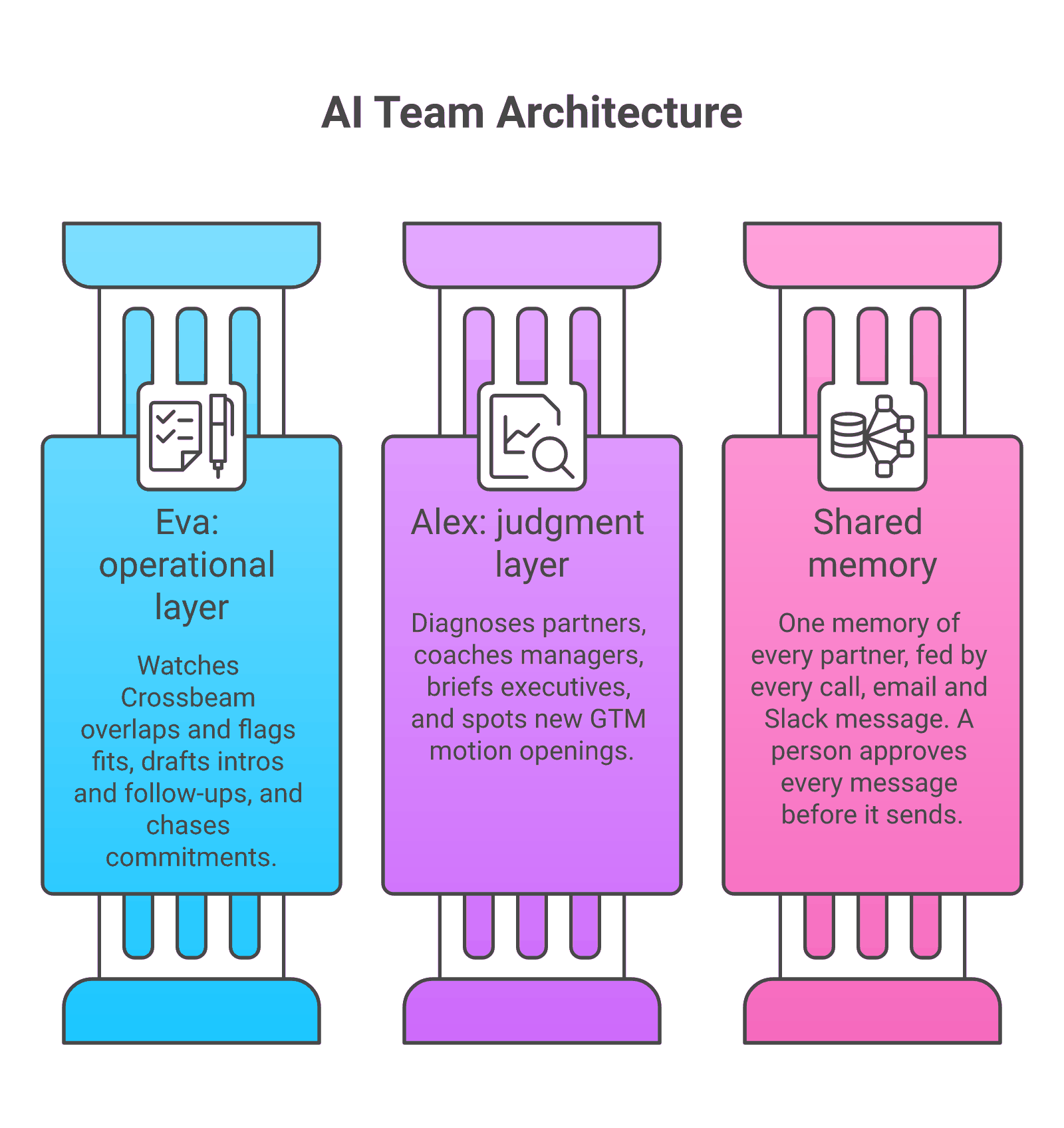
Our AI team has two layers, and each AI agent is clearly labeled as an AI agent wherever it appears.
Eva: the operational layer
Eva is our AI partner manager assistant. Eva handles the work that buries partner managers:
- Watching partner data: Eva monitors Crossbeam overlaps and flags the ones that qualify for a stored GTM motion.
- Drafting the next step: Eva writes the intro, the follow-up or the reply and queues it for a person.
- Chasing commitments: Eva tracks who owes what on both sides and prompts the follow-up.
- Keeping records clean: Eva logs touches, updates plans and pulls action items from calls.
But Eva never auto-sends. Every message goes to a human for approval first.
Alex: the judgment layer
Alex is an AI agent that acts as a Chief Partnerships Officer. Where Eva handles tasks, Alex looks across the program.
In a program we run with you, Alex diagnoses partners, coaches partner managers and briefs executives monthly on what’s working and what to cut. In a program we produce for you, Alex spots openings for new GTM motions and gives leaders insight on how to adjust them.
One memory of every partner
Because both agents work from the same data, the program has one memory. Then every call, email and Slack message with a partner feeds it. So any partner manager, or any leader, can ask what’s happening with a partner and get the same answer.
Bring your own agent, or use ours
But you probably already own AI tools. Most mid-market and enterprise companies run agentic tools that security has approved and that already connect to their systems. So we start there.
We work inside the tools you already have
Instead, it’s a bring-your-own-agent model. If your team uses Claude, Dust, Lindy, Glean or another AI tool that can connect to MCP servers, we configure the work around it. If you don’t have one, we help you set up your first.
Eva runs inside your own Claude environment, on schedules or on demand. And any other AI agent your team uses internally can call on Eva and Eva’s expertise. So the specific AI tool matters less than you’d think. Pick what’s already installed.
Why we don’t sell our own AI credits
And we chose not to be in the AI credits business. You run the AI on your own subscription, so you see exactly what it costs. That’s how it should be. Transparency around AI usage matters for everybody, and you keep control of the spend.
Keep a human in the loop
AI on a partner program should earn trust in steps, not all at once.
From on demand to always on
When teams start, most follow the same path. First a person asks the AI to do something. Then it runs on a schedule. Finally, it watches for events, like a new overlap, and acts when one arrives. At every stage, it routes the work for human approval before anything sends.
Meet sellers where they already work
But sellers won’t open another app. So put partner signals into the tools they already use, like their AI assistant or their CRM. The AI team should come to them, not the other way around.
Adopt it one problem at a time
But don’t try to automate the whole program in a month. Pick one problem, like chasing commitments after account mapping sessions. Fix it, prove it, then add the next. Impartner’s look at the role of AI in partnerships describes a similar shift from operations to decisions.
How Forecastable’s AI team works
At Forecastable, we deliver partner-sourced pipeline as a service. We build your partner program and run it with you or for you, and we’re measured on pipeline and revenue.
Eva and Alex are part of how we run it. Real people on our team run the work, and the AI agents monitor, suggest and take background actions, with a human always in the loop. You never have to log in to our platform. Everything can run through AI apps like Claude via our MCP.
There’s no new tech to buy and no seats. No PRM required. Co-sell automation is included in every program, running on your Crossbeam data and the AI tools you already own. Partners can fund or co-fund the program through MDF, so it can cost you $0. Meet the team on our AI team page.
FAQ
What is an AI team for a partner program?
It’s a shared set of AI agents that serves the whole partner program from one set of partner data, rules and records, instead of separate AI tools for each partner manager.
Who are Eva and Alex?
Both are AI agents. Eva is an AI partner manager assistant that handles operational work. Alex is an AI agent that acts as a Chief Partnerships Officer, diagnosing partners and briefing executives.
Can we use our own AI agent?
Yes. We work with the AI tools you already own, such as Claude, Dust, Lindy or Glean, and configure the work around them.
Does the AI send messages to partners on its own?
No. AI drafts and queues. A person approves every send.
Do we pay per seat for the AI team?
No. There are no seats. The AI runs on your own subscription, so you see and control what it costs.
The bottom line
AI won’t fix a partner program one partner manager at a time. It works when the whole program shares one AI team, one set of data and one set of rules, with people approving what goes out. Start with one problem, use the tools you already own, and let the team grow from there.
Forecastable is an independent third-party professional services company. Our evaluations of other vendors are based on publicly-available information as of October 2026 and our own client experience.
Book a Program Fit Analysis to see what one AI team could take off your partner managers’ plates →
Related reading:
Uncover Your Growth Potential
Schedule a Discovery Call