Alex Buckles
Partner Attribution Is the Floor, Not the Ceiling

Short answer: Partner attribution tells you which partner sourced or helped which deal. Everything in a partner program rests on it: the forecast, pay, MDF and next year’s plan. That’s why it’s the floor, not the ceiling. Most programs rely on one CRM field that someone fills in by hand. We capture partner attribution from every call, every email and every Slack message, then use it to measure what partners actually changed.
Why partner attribution is the floor
At Forecastable, attribution is everything. If it’s wrong, every decision built on it is wrong too.
Think about what depends on it. Your forecast assumes some number of partner deals. Partner managers get paid on it. MDF gets justified with it. And next year’s plan gets built from what partners produced this year.
So when attribution is wrong, you don’t just mis-credit a deal. You plan next year from a story that didn’t happen.
Define sourced and influenced before work starts
Most credit fights start because nobody agreed on the words. So agree before the first GTM motion runs, in writing.
- Partner-sourced: The partner originated a new opportunity for you, before it became a sales-qualified opportunity (SQO).
- Partner-influenced: The partner helped accelerate an opportunity that already existed.
An SQO is an opportunity your sales team has accepted as real pipeline. Timing only matters for sourced credit. After the SQO, a partner can add real value. But that’s influence.
Track the two separately. Never add them together and call it “partner revenue.” If you’re choosing a model, I covered the options in partner attribution models for B2B SaaS.
Watch the benchmark trap
This matters when you compare yourself to others, too. Headline numbers for “partner revenue” often blend sourced and influenced. So hold your own definitions constant, and don’t panic when someone else’s number looks bigger.
For a young program, I’d use the tighter sourced definition. It’s harder to game, and the risk of rewarding the wrong behavior outweighs the credit you might miss.
Why a CRM field isn’t enough
Most companies track partner deals with one field. It’s a lead source, or a list of partner names. A seller fills it in, sometimes.
That’s not real tracking. It’s a guess, typed late. Sellers forget. Partner touches happen in calls and Slack threads the CRM never sees. And manual logging always falls behind.
The fix isn’t asking people to log more. It’s capturing the work where it already happens, so nobody has to ask.
Capture attribution from every call, email and Slack message
Partnership work happens in conversations. So that’s where attribution has to come from.
Call recorders weren’t built for partnerships
I haven’t found a call recorder built for the nuances of partnerships. Generic recorders give you one flat summary. But a partner call isn’t a sales call.
One account mapping session can cover five to ten accounts, each with its own owner. Some partner calls have 20 to 30 partner reps on them. And half of what matters is discussed but never committed. A flat summary loses all of it.
What partner call analysis has to catch
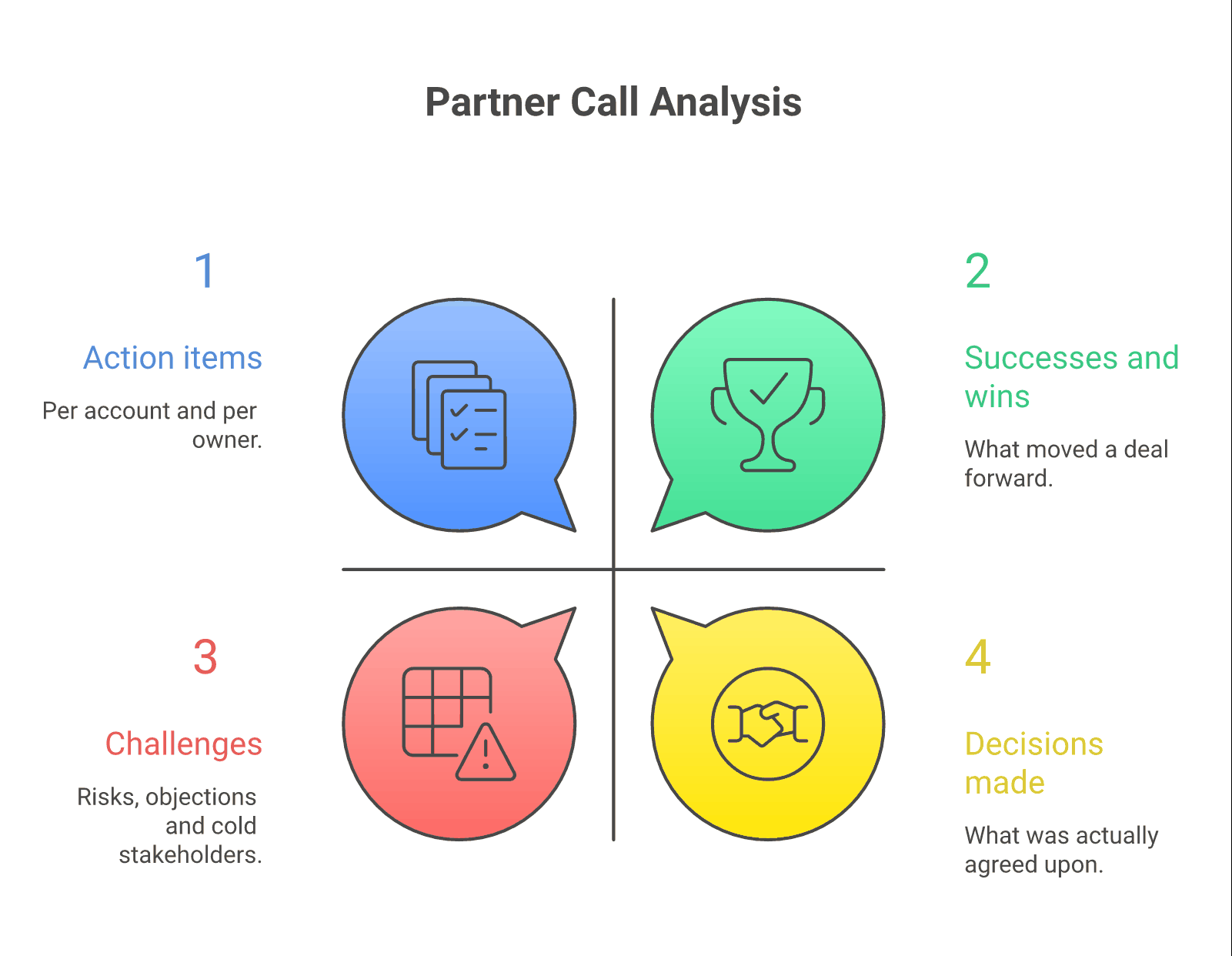
So we built our own call analysis. It connects to the call recorders you already use, like Gong and Fathom. Then it reads the transcripts. And it checks every call for:
- Action items: Per account, per owner, on both sides.
- Successes and wins: What a partner did that moved a deal.
- Challenges: Risks, objections and stakeholders going cold.
- Decisions made: What was actually agreed, not just discussed.
Email and Slack count too
Calls are only part of it. Partners also reach you by email, Slack and Teams. Our inbox shows only communications with partners, so the noise drops away and the partner record stays complete. And when a goal gets adjusted casually in a partner conversation, the plan should update without anyone typing it in.
Beyond the floor: measuring what partners actually change
Attribution tells you a partner was there. Impact tells you if it mattered. That’s the ceiling, and most programs never reach it.
Partner-washing
Partner-washing means putting a partner’s name on a deal the partner didn’t change. A partner name on the opportunity doesn’t count. A logged action tied to an outcome does.
So measure impact at three stages:
- Before the SQO: Did the partner introduce the opportunity? That’s sourced.
- During the sales cycle: Did the partner bring new stakeholders, handle objections, reduce competitive risk or shape the solution?
- After the close: Did the partner speed up time to value, protect the renewal or drive expansion?
Let the numbers decide
If a partner shows up on deals and win rate, deal size and cycle time don’t move, that’s washing. The data will show it. And if they do move, you’ve found a partner worth investing in. Impartner makes a similar case for rethinking partner success beyond bookings.
The rule that keeps attribution honest
We don’t approve a GTM motion until there’s a reliable way to pull in its results automatically. That means sends, replies, meetings and opportunities flowing into your CRM.
If we can’t connect to your systems and see that, attribution is lost. So we solve it before launch, not after. Partner data helps here too. Crossbeam documents how its data can feed automated attribution in Salesforce.
How Forecastable handles partner attribution
At Forecastable, we deliver partner-sourced pipeline as a service. We build your partner program and run it with you or for you, and we’re measured on pipeline and revenue.
But we don’t just log deals. Instead, we drive the right behaviors with complete accountability, so attribution is right, forecasts hold and next year gets planned from what actually happened. Attribution comes from every call, email and Slack message. It flows through our call analysis, our partner inbox and native Salesforce and HubSpot integrations.
There’s no new tech to buy and no seats. No PRM required. Co-sell automation is included, running on your Crossbeam data and the AI tools you already own. Partners can fund or co-fund the program through MDF, so it can cost you $0. See how it works on our co-sell orchestration platform page.
FAQ
What is partner attribution?
Partner attribution is the record of which partner sourced or influenced which deal. It drives forecasts, partner comp, MDF decisions and planning.
What is the difference between partner-sourced and partner-influenced?
Partner-sourced means the partner originated a new opportunity before it became an SQO. Partner-influenced means the partner helped accelerate an opportunity that already existed.
What is partner-washing?
Partner-washing is crediting a partner on a deal when the partner didn’t change the outcome. Measure impact on win rate, deal size and cycle time to catch it.
Can call recorders handle partner attribution?
Not on their own. Partner calls cover many accounts, owners and companies at once. You need analysis that extracts actions and outcomes per account and per owner.
How do you capture partner attribution without manual logging?
Capture it from where the work happens: call transcripts, email, Slack and calendar, connected to your CRM.
Related reading
- The Cost of Not Having a Partner Program
- How to Set Partner Attribution Windows for Long B2B Sales Cycles
- Multi-Touch vs Last-Touch Partnerships Attribution: What B2B SaaS Should Pick
The bottom line
Attribution is the floor. Without it, every number in your partner program is a guess. Build it from every call, email and message, define sourced and influenced before you start, and then go past it. The real question isn’t whether a partner was on the deal. It’s whether the deal changed because they were.
Forecastable is an independent third-party professional services company. Our evaluations of other vendors are based on publicly-available information as of October 2026 and our own client experience.
Book a Program Fit Analysis to see what your partner attribution is missing →
Related reading:
Uncover Your Growth Potential
Schedule a Discovery Call