What Is AI for Partnerships? A Builder’s Take

Short answer: AI for partnerships is the layer of judgment, automation, and analysis that sits between partner data and partner action. Today it does three things well. It ranks partner overlap accounts by likelihood to close. It drafts the first version of partner-aware outreach. It synthesizes what happened in partner meetings so the next move is obvious. It cannot yet own a number, repair a stalled relationship, or pick which partner to invest in next quarter. Those still belong to a human.
AI for partnerships, defined
The phrase “AI for partnerships” gets stamped on every product that adds a chat box to a dashboard. So the first job is to draw a line.
Real AI for partnerships is the judgment layer. It sits between two things every partner program already has: partner data, and partner action. Partner data are the inputs. Account overlaps from Crossbeam, deal-reg records from your PRM, partner-meeting notes, partner-driven pipeline in your CRM. Partner actions are the outputs. The email an account executive sends a partner contact, the joint plan that gets attached to a stalled deal, the decision to invest more time in one partner over another.
Between those two layers is judgment. Which overlap is worth a play? What does this partner-aware outreach actually need to say? What just happened in this partner meeting and what is the next move? AI for partnerships, when it is real, automates and accelerates that judgment.
When it is not real, it just renders the partner data in a different color and bolts a chat box to it.
What AI for partnerships does well today
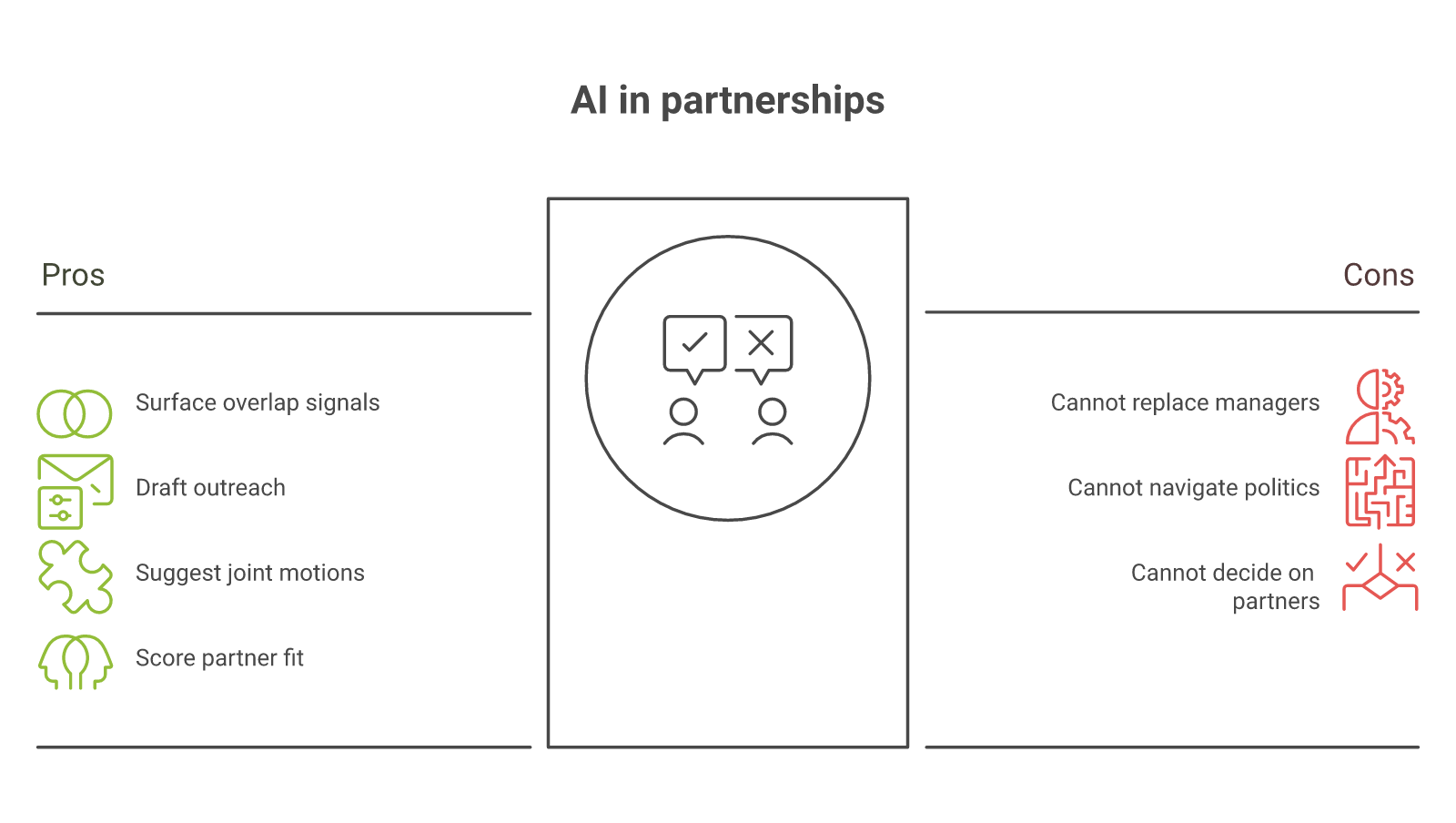
Three capabilities are mature enough to ship meaningful value right now. A real AI-for-partnerships product has all three.
1 – Account matching across partner overlaps, ranked by likelihood to close. Partner overlap data is abundant. Crossbeam alone has populated this layer for thousands of programs. The hard part has never been finding overlaps. The hard part has been deciding which fifteen of the four hundred matter this week. AI handles this. It cross-references overlap data with deal stage, partner relationship strength, partner-AE history, and your ICP signals. It returns a ranked list. The account executive’s job stops being “scroll the list” and starts being “run the play on the top five.”
2 – First-draft partner-aware outreach. AI does the first draft well. Partner-aware outreach is a specific genre. It needs to reference a real shared context, signal partner credibility, and propose a real next step. Generic AI generates the wrong tone for this. AI trained on partner-aware patterns generates a starting point that an AE can edit in two minutes instead of writing in twenty. The AE still owns the send. AI just owns the blank screen.
3 – Partner-meeting synthesis. Every partner meeting produces three things: what was said, who is supposed to do what, and what is the actual next move. The first one is mechanical. Conversation intelligence platforms have done this for years. The second and third are judgment. AI for partnerships, when it is integrated with the partner-data layer, can synthesize the meeting and surface the next move on both sides of the partnership. Without the integration, you just get a transcript.
What AI for partnerships cannot do, yet
The honest list of what is still a human job is short, and important.
- Own a number. AI does not have skin in the game. The partner manager’s quota does not move because the AI suggested better matches. AI is a multiplier on a human number-owner.
- Repair a stalled partner relationship. Partner relationships go stale for human reasons. Trust gets dented. A bad referral lands. The partner’s own internal politics shift. AI cannot show up at the customer dinner that fixes it.
- Pick which partner to invest in next quarter. This is a strategic call that depends on factors no AI has. The CRO’s view of the next twelve months. The CEO’s read on the partner’s leadership. The board’s tolerance for ecosystem risk. AI can model the scenarios. It cannot make the call.
- Replace the human judgment that turns signal into a play. AI ranks the overlap. A human still has to decide whether to run the play, when, and through whom.
The pattern is consistent. AI is excellent at the work that is repetitive, judgment-light, and integration-heavy. Humans remain better at the work that is relational, strategic, and accountable.
AI for partnerships versus AI-native PRM
The category is new enough that vendor marketing keeps blurring the terms. A clean way to hold them apart:
| Term | What it means |
|---|---|
| AI for partnerships | The broader judgment layer that sits between partner data and partner action |
| AI-native PRM | A PRM platform built with AI as a core layer, not as a chatbot retrofit |
| Partner conversation intelligence | A subset focused on partner-call and partner-meeting analysis |
| Agentic partner ops | The emerging layer where AI moves from suggesting to executing inside the seller’s workflow |
AI-native PRM is one product category inside the broader AI-for-partnerships layer. Partner conversation intelligence is a subset focused on calls and meetings. Agentic partner ops is the next frontier, where the AI does not just recommend the next move; it executes it inside the AE’s CRM workflow.
All three are useful framings. None is a synonym for AI for partnerships as a whole.
How to evaluate an AI partnerships tool
The vendor pitch always sounds good. Run the tool against this five-question checklist before you sign.
- Does it match accounts across partner overlaps and rank them by likelihood to close?
- Does it draft the first version of partner-aware outreach?
- Does it synthesize partner meetings and surface specific next moves?
- Does it integrate with your partner-data platform (typically Crossbeam) and your PRM?
- After all of that, do you still have to do the matching, the writing, and the synthesis yourself?
If the answer to question five is yes, it is not AI. It is a UI. Real AI for partnerships does the work in the background and presents the output. Fake AI for partnerships gives you a chat box that asks you to do the work.
The agentic partner ops layer
The next year of progress in this category is going to happen in agentic partner ops. The shift is small to describe and large to operate.
Today: AI ranks accounts. The AE looks at the list, picks the top five, opens the CRM, drafts the outreach, sends it, books the partner meeting, attends it, summarizes it, and updates the deal-reg.
Soon: AI ranks accounts. AI drafts the outreach. The AE approves it. AI sends it from the AE’s inbox. AI books the partner meeting. AI attends it as a notetaker. AI updates deal-reg with the right next-move flag. The AE shows up for the work that requires actual judgment and presence.
The shift is not that AI does more thinking. The shift is that AI does more execution. The judgment layer stays human. The execution layer keeps getting taken over.
This is the direction Forecastable’s product is heading, alongside the operational service we already deliver.
How Forecastable approaches AI for partnerships
We are a services-plus-software company. The Co-Sell Alignment Specialist role and our customers’ Partner Managers do the human work that does not automate well: the partner-relationship layer, the judgment calls, the trust-building, the ownership of named outcomes. The AI layer underneath that role accelerates everything that is repetitive: the matching, the drafting, the synthesis. The combined model, services plus AI, is how we deliver predictable partner pipeline without your team adding headcount.
Crossbeam sits underneath us in the data layer. Our AI consumes Crossbeam overlap data alongside CRM and meeting-intelligence data, runs the judgment, and feeds the next-move signal into the AE’s workflow. We do not compete with Crossbeam. We extend it.
FAQ
What is AI-native PRM? A PRM platform built with AI as a core layer, not as a chatbot bolted onto a legacy product. AI-native PRM uses AI for matching, automation, and synthesis throughout the workflow, not just in a sidebar.
Can AI replace a partner manager? No. AI handles the busywork: overlap matching, draft outreach, post-meeting synthesis. The partner manager still owns relationships, judgment, and the number. AI is a multiplier on the human, not a substitute.
Is partner conversation intelligence the same as AI for partnerships? No. Partner conversation intelligence is a subset focused on call and meeting analysis. AI for partnerships is the broader judgment layer that includes account matching, outreach drafting, and meeting synthesis across the whole program.
How is Crossbeam using AI? Crossbeam is investing across overlap discovery and partner-data enrichment. The data layer they own is one of the most valuable inputs for any AI-for-partnerships product, including ours.
Will AI for partnerships work for small programs? Yes, with one caveat. AI amplifies whatever inputs already exist. Bad partner data plus AI equals bad recommendations faster. Get the partner-data foundation right first, then layer AI on top.
What is an AI judgment layer for partnerships? The decision layer that sits between partner data and partner action. It takes inputs from your partner-data platform, your PRM, and your CRM, and recommends specific next moves. It is what separates real AI for partnerships from a dashboard with a chat box.
Bottom line
AI for partnerships is real and it is a multiplier, not a replacement. Today it does three things well: matches accounts, drafts outreach, synthesizes meetings. It cannot yet own a number, repair a relationship, or pick the right partner. The frontier is agentic partner ops, where AI moves from recommending the next move to executing it. If a tool says it does AI for partnerships but you still have to do the matching, the writing, and the synthesis yourself, that is not AI. That is a UI.
Talk to our team about installing the AI judgment layer in your partner program. forecastable.com/start-your-growth-journey-now →
Forecastable is an independent third-party professional services company. Our evaluations of other vendors are based on publicly-available information as of May 2026 and our own client experience.
Uncover Your Growth Potential
Schedule a Discovery Call