Alex Buckles
Designing a Partner Organization: 8 Weeks to a Board-Ready Plan

Short answer: Designing a partner organization means deciding which partners matter, which GTM motions they’ll run, what roles you need and what the board should expect, quarter by quarter. Most companies hire first and figure it out later. Do it the other way around. With real partner data, most partner organizations can be analyzed and planned in about eight weeks, even programs with hundreds of partners. The output is a plan your board can approve and your team can run.
Why partner organizations need redesigning now
Two things are forcing the question.
First, money. Private equity firms are bringing us in to reorganize entire partnerships departments after an acquisition or a raise. Often they’re moving away from traditional channel roles.
Second, AI. It has changed what partner roles do, which people should fill them and what expertise they need. A partner manager used to spend hours on admin: logging, chasing and building reports. AI can carry much of that now. So the role shifts toward running motions and holding partners accountable.
That’s why I see two kinds of projects. Some companies need to build a partner organization from scratch. Others need to rebuild one that was designed for a world that no longer exists.
What a board-ready plan has to answer
A partner profile or a list of target partners isn’t a board plan. Boards want to know what they’re buying and when it pays back.
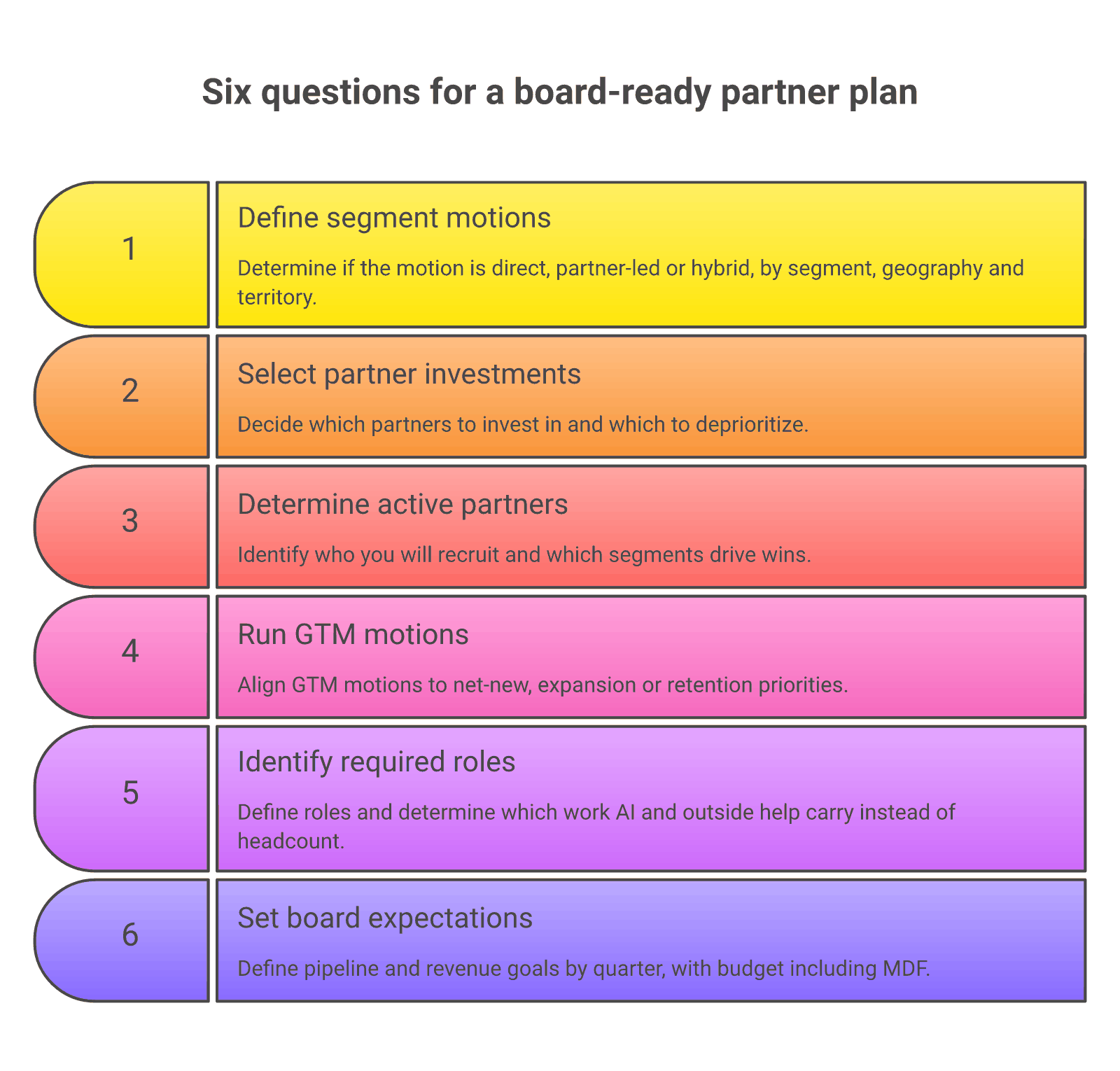
So a board-ready plan answers questions like these:
- Which motion fits each segment: Direct, partner-led or hybrid, by segment, geography and territory.
- Which partners to invest in: And just as important, which to deprioritize.
- How many partners will be active: Who you’ll recruit, and which segments you expect to drive wins.
- Which GTM motions will run: Tied to the company’s top priorities, like net-new, expansion or retention.
- What roles you need: And which work AI and outside help can carry instead of headcount.
- What the board should expect: Pipeline and revenue goals by quarter, with the budget to match, including MDF.
Before any of that, I ask four plain questions. When does your fiscal year end? When is the board meeting or budget deadline? Which verticals matter most? And which product bets need pushing?
How the eight weeks work
Eight weeks is the average, from data to a board-ready plan. Most programs, even with hundreds of partners, can be analyzed in that time. Only the largest programs take longer.
Partner data first
The plan starts with real data, not opinions. That means your CRM, your partner list and partner overlap data from Crossbeam. Your strongest partners usually share data quickly. So if a partner won’t share at all in the first several weeks, that itself tells you something.
Partner interviews and workshops
Next, talk to the partners. Short interviews and workshops with your top partners show what’s in it for them and what they’d actually run. That belongs in the first phase, not after the plan is written.
Segment analysis
Then run the numbers by segment, geography and territory. This is where the mix of direct, partner-led and hybrid gets decided, with evidence instead of instinct.
The plan itself
Finally, put it together: partners, motions, roles, goals by quarter and budget. Partner-level goals should roll up to company goals, so the board can see how the total is built.
Hire sales-minded people, and fewer of them
The roles question is where most redesigns go wrong.
Sales rigor beats channel tenure
It’s easier to teach a salesperson to run partnership motions than to teach a partnerships person sales rigor, accountability and discipline. So if your plan doesn’t include sales-minded hiring, you’re just hiring traditional channel people. That’s a recipe for failure. TalentFueled places sales-minded partnership talent for exactly these roles.
AI before headcount
A partner manager stuck under admin work doesn’t need a second partner manager. They need the admin gone. Moving that work to AI, plus a specialist who runs the operations, buys capacity without the cost and lag of a hire.
Prove motions before you scale the team
Then add people where the motions are already working. Get wins first. Those wins justify the investment, and they show you exactly which roles to add next. By then, a hire isn’t a bet. It’s reinvestment.
Common mistakes in partner organization design
I see the same mistakes often:
- Hiring before the business case: Write down what partnerships must deliver before you hire a leader to deliver it. Otherwise you’ll retrofit a discipline that’s already gone ad hoc.
- Confusing a partner list with a strategy: Knowing who your partners are isn’t the same as knowing what they’ll produce.
- Building tiers with no bench: Don’t split roles into tiers until enough of the team is steady in the basics.
- Planning without the fiscal calendar: A great plan that lands after the budget is set waits a year.
For an outside view of how the role is changing, BlueThread’s analysis of the partner manager role in 2026 is worth reading.
How Forecastable builds and rebuilds partner organizations
At Forecastable, we deliver partner-sourced pipeline as a service. We build your partner program and run it with you or for you, and we’re measured on pipeline and revenue.
Build or Rebuild My Partner Organization is our offering for this work. Some companies bring us in after a private equity raise to build a partner organization from scratch. Others need a reorg because AI changed the roles. On large projects, we do all of the work: the data, the partner interviews, the analysis and the board-ready plan. And when the plan calls for sales-minded hires, TalentFueled can source them.
There’s no new tech to buy, no seats and no PRM required. Co-sell automation is included, running on your Crossbeam data and the AI tools you already own. And partners can fund or co-fund the GTM motions through MDF. If you’re a private equity firm planning this across a portfolio, see how we design partner organizations.
FAQ
How long does it take to design a partner organization?
About eight weeks on average, from data to a board-ready plan. Most programs, even with hundreds of partners, fit that window. The largest programs can take longer.
What should a board-ready partner plan include?
The right motion by segment, which partners to invest in, how many will be active, which GTM motions will run, the roles needed and quarterly pipeline and revenue goals with a budget.
Should we hire a partnerships leader first?
Not before you’ve written down what partnerships must deliver. Build the plan, then hire against it.
What kind of people should a modern partner organization hire?
Sales-minded people who bring rigor, accountability and discipline. It’s easier to teach them partnerships than the reverse.
How has AI changed partner organization design?
AI can carry much of a partner manager’s admin work. So you can run more partners with fewer people, and roles shift toward running motions and accountability.
The bottom line
Don’t hire your way into a partner strategy. Plan your way into the hires. Start from the data, talk to the partners, decide the motions, then build the roles around them. Eight weeks of that work beats a year of guessing.
Related reading:
Uncover Your Growth Potential
Schedule a Discovery Call