Atlassian’s Komal Shah Said Five to Eight Partners Per Enterprise Deal Is the New Default. Most Companies’ Operating Cadence Is Still Built for One.

Short answer: Atlassian’s Komal Shah said it on the ELG Summit stage: five to eight partners are now involved in each enterprise deal. However, most partner-program architectures, the deal-reg system, the comp plan, the partner-manager assignment, are still built for one partner. Therefore, the cadence problem is structural. Specifically, four operating layers, the shared mental model, the better-together story, pipeline choreography, and mutual action plans across N partners, are the work.
There’s a line from Atlassian’s Komal Shah, on the ELG Summit 2025 stage, that should reorient how every enterprise software leader thinks about their partner program.
Therefore, “As we’ve moved into the enterprise space, we’re seeing five, six, seven, eight partners oftentimes involved with helping a customer solve the solution.”
Five to eight partners per enterprise deal.
Read it again.
The traditional partner-program architecture, single-partner deal registration, one-touch attribution, “primary partner” comp logic, the partner manager assigned 1:1 to a partner relationship, was designed for a world where deals were primarily bilateral. Vendor plus customer, with maybe one channel partner involved in delivery. That world doesn’t exist anymore in enterprise. And the data is increasingly impossible to ignore.
The data is no longer ambiguous
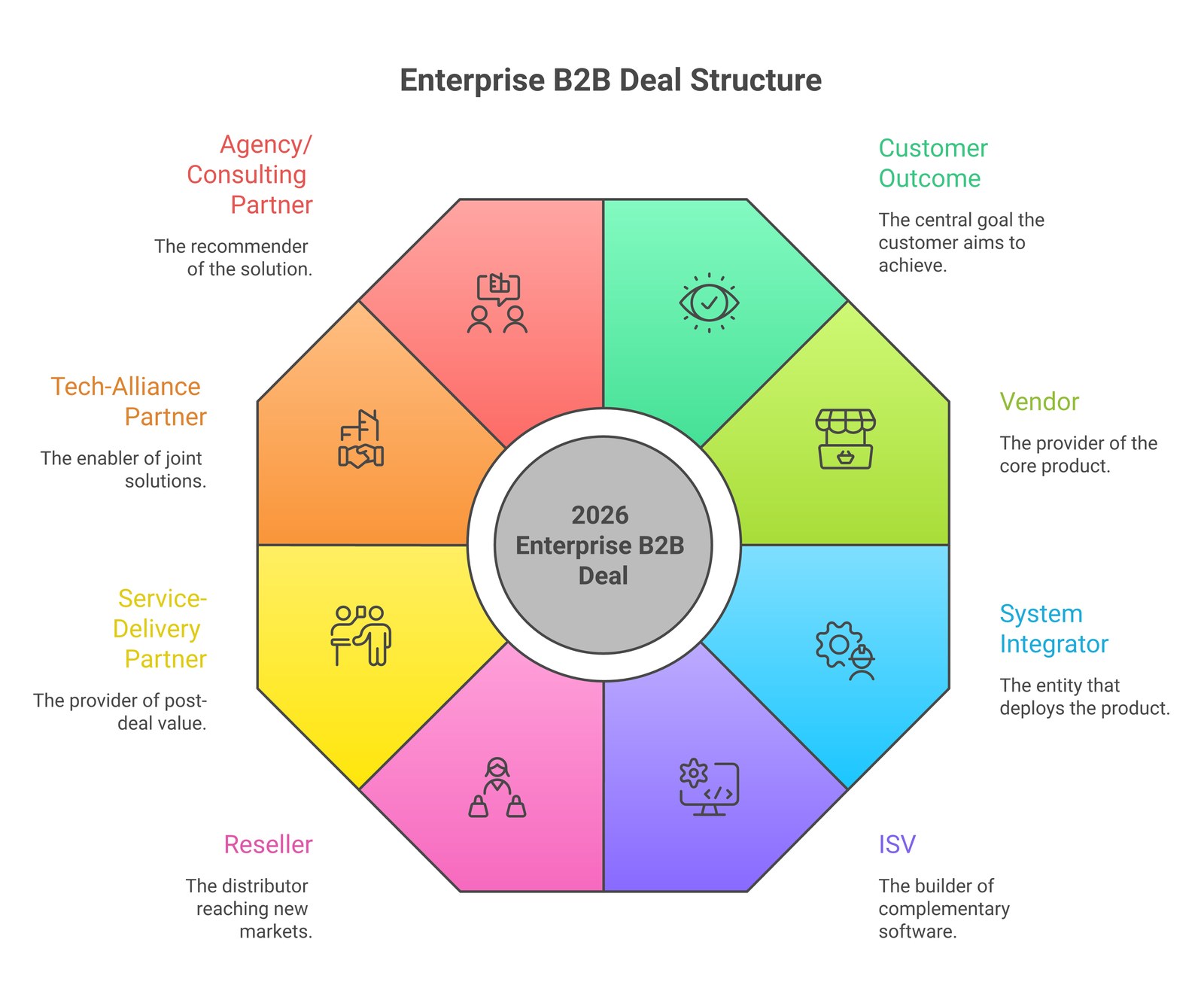
Specifically, atlassian’s own internal analysis, surfaced via the same ELG Summit conversation: 80%+ of engagements involve a partner in some format. That isn’t the partner-friendly companies. The five to eight partners pattern is everyone.
Bridge Partners and Jay McBain (Omdia) put more specific numbers on the new shape. The average enterprise B2B buyer engages 7+ partners per deal, consults 13+ decision-makers, and the average solution stitches together 7 distinct layers : roughly 28 factors influencing a single deal.
By contrast, omdia’s broader research: 73% of global B2B revenue now flows through or with partners. In cybersecurity alone, 91.6% of the addressable market is bought through or with partners. Crossbeam’s canonical ELG triplet: partner-involved deals close 28% faster, win at 46% higher rates, and run 53% bigger ACV. Bridge Partners’ 2026 Ecosystem Compass: partner-sourced deals are 2x larger, 3x higher win rates, 30% faster close.
This is not a niche conversation. This is the dominant structural shift in enterprise B2B revenue, and every credible analyst voice is pointing in the same direction.
In practice, so why are most multi-partner deals quietly underperforming?
The attribution architecture is being retrofitted onto deals the operating cadence never accounted for
Atlassian responded to the 5-8-partners reality by expanding beyond traditional deal registration to include service registration (who delivered implementation value) and value registration (design, planning, roadmaps, specialized expertise). They turned partner involvement from anecdote into structured data.
Notably, this is the right structural response. By contrast, it is also where most companies who try to copy it get stuck. The artifacts, the registration types, the comp plan adjustments, the dashboard fields, are downstream of the work that actually closes the multi-partner deal. The work is choreography. And nobody is talking about the choreography.
When 5-8 partners are involved in a single enterprise deal, the questions that decide whether the deal closes, and at what value, on what timeline, are:
- Who opens the door with the customer, and what story do they lead with?
- Who deepens the conversation when the buyer asks the harder question, the technical objection, the procurement concern, the ROI math?
- Who owns the technical proof point, and does it match the messaging the first partner used?
- Who lands the punchline, the moment the buyer’s mental model shifts from “I have point solutions” to “I need this orchestrated stack”?
- Who carries the customer through procurement when 5-8 vendors all need contracts coordinated, security reviews aligned, deployment timelines synchronized?
Crucially, if those answers aren’t pre-agreed across all partners before the customer conversation, the deal still closes, most of the time. But it closes not at full value, not on the original timeline, and usually with at least one or two partners feeling like they got the short end of the stick.
That’s not a finance problem. It’s a choreography problem. And choreography doesn’t live in a deal-registration dropdown menu.
What choreography across five to eight partners requires
Three things, in order.
First: a shared mental model among everyone who’ll be in the
Indeed, nASA’s work on what predicts high-performance teams in tough environments, sending a crew around the other side of the moon, running a special-operations mission, executing a no-margin-for-error procedure, is unambiguous. The #1 predictor isn’t individual skill. It isn’t team culture. It isn’t leadership quality. It’s a shared mental model. In multi-partner deals, we don’t even give the partners a model. We hand each partner manager a list of accounts, a set of comp expectations, and a deck. The shared model, what the joint customer outcome looks like, who owns which moment in the cycle, what “good” looks like for the deal, exists only in scattered Slack threads and the heads of two or three people who happened to be on the original strategy call.
Second, a better-together story that says something structurally different from “we integrate.” Integration is feature-function. Outcome certainty is what makes the customer reorganize their stack around the joint solution. The story has to land at the level of: here is the customer outcome neither of us can produce alone, and here is exactly how we deliver it together. That story is built through dialogue, not assembled from product marketing slides. Most “better together” stories die at the surface, we have an integration, because nobody did the work to construct the actual joint value proposition. The work is uncomfortable. It requires both partners to subordinate their individual pitch to the joint outcome. Which is why almost no one does it without facilitation.
Third: pipeline choreography across all partners, sequenced, not just listed
Meanwhile, choreography is the deliberate sequencing of who opens, who deepens, who lands. It’s the answer to: when this customer hits a stage gap, who fires which play in what order to reset the cadence? When a stakeholder goes silent, who owns the re-engagement? When the customer’s procurement team needs a multi-vendor unified contract structure, who designs it? Pipeline choreography lives at the rep-to-rep layer across multiple partners, not at the exec-to-exec layer that runs the QBR. This is where the work happens. It’s also where most multi-partner programs go quietly silent.
The artifact that makes choreography survive: mutual action plans across N partners
A mutual action plan is the artifact that turns choreography from we agreed in the room to we still know what we’re doing in week six.
In fact, in bilateral partnerships, mutual action plans are common (though under-used). In multi-partner deals, they’re almost non-existent, because there’s no shared infrastructure for one. Each vendor has their own CRM. Each partner has their own pipeline review. The only people who see the full picture are the customer (who isn’t going to coordinate it for you) and possibly a strategic alliance manager who has the title but not the authority to enforce it.
What works: a single mutual action plan that lives in a neutral surface, that every partner-side rep contributes to, that has explicit owners for each next action, with explicit dates, with consequences when actions don’t happen. This is operational discipline. It’s not glamorous. It’s not the strategy slide. It’s the daily and weekly work that keeps the deal alive.
Most importantly, it is also the work that distinguishes the partnership programs that produce predictable revenue from the partnership programs that produce occasional happy accidents.
What this means for your team this week
If you’ve recognized the pattern in your own enterprise deals, the 5-8 partner involvement, the under-coordinated motion, the deals that close late or under-priced, there’s a diagnostic question worth asking out loud at your next leadership meeting:
However, Pulled into a room with our top 5 partners and asked to whiteboard the joint customer outcome, would our team and our partners’ teams draw the same picture?
If the honest answer is “probably not in detail,” then the strategy is fine. The execution layer underneath the strategy is what’s missing.
Therefore, the structural shift to multi-partner orchestration is the 2026 default. The teams winning at it aren’t the ones with the best partner roster. They’re the ones with the best operating cadence underneath the roster, the shared mental model, the better-together story, the pipeline choreography, the mutual action plans that survive the next reorg.
That’s the work nobody is talking about loudly enough. It’s also the work that decides whether your partner program shows up in the board deck as a forecast you can defend, or as a “lots of activity, hard to attribute” footnote.
Specifically, the data on multi-partner orchestration is no longer ambiguous. The question is whether your operating cadence has caught up with your partner roster.
Most haven’t. Yet. That’s a fixable problem. But it doesn’t fix itself.
Talk to our team about installing the multi-partner cadence in your program →
Related reading
- The second-party data moat that makes the cadence possible
- Automation versus orchestration in partnership ai
Sources
Forecastable is an independent third-party professional services company. Our evaluations of other vendors are based on publicly-available information as of May 2026 and our own client experience.
Uncover Your Growth Potential
Schedule a Discovery Call