Skip to content
Logo โ€” Itโ€™s All AboutThe Team
  • Home
  • Who We Serve
    • By Category
      • SaaS
      • Professional Services
      • Platforms (Large Ecosystems)
      • Private Equity
    • By Role
      • Chief Revenue Officers (CRO)
      • Chief Financial Officers (CFO)
      • Chief Marketing Officers (CMO)
      • Chief Executive Officers (CEO)
      • Sales Leaders
      • Partnership Professionals
  • Solutions
    • By Partner Program Maturity
      • Partnerships Foundation
      • Partnerships Acceleration
      • Ecosystem-Wide Orchestration
    • Specialized Solutions
      • Net-New Named Account Development
      • Large Ecosystems
      • M&A: Post-Acquisition Internal Cross-Selling
  • Pricing
  • Education
  • Company
    • Our History
    • Security
  • Login
Logo โ€” Itโ€™s All AboutThe Team
  • Home
  • Who We Serve
    • By Category
      • SaaS
      • Professional Services
      • Platforms (Large Ecosystems)
      • Private Equity
    • By Role
      • Chief Revenue Officers (CRO)
      • Chief Financial Officers (CFO)
      • Chief Marketing Officers (CMO)
      • Chief Executive Officers (CEO)
      • Sales Leaders
      • Partnership Professionals
  • Solutions
    • By Partner Program Maturity
      • Partnerships Foundation
      • Partnerships Acceleration
      • Ecosystem-Wide Orchestration
    • Specialized Solutions
      • Net-New Named Account Development
      • Large Ecosystems
      • M&A: Post-Acquisition Internal Cross-Selling
  • Pricing
  • Education
  • Company
    • Our History
    • Security
  • Login
  • Home
  • Who We Serve
    • By Category
      • SaaS
      • Professional Services
      • Platforms (Large Ecosystems)
      • Private Equity
    • By Role
      • Chief Revenue Officers (CRO)
      • Chief Financial Officers (CFO)
      • Chief Marketing Officers (CMO)
      • Chief Executive Officers (CEO)
      • Sales Leaders
      • Partnership Professionals
  • Solutions
    • By Partner Program Maturity
      • Partnerships Foundation
      • Partnerships Acceleration
      • Ecosystem-Wide Orchestration
    • Specialized Solutions
      • Net-New Named Account Development
      • Large Ecosystems
      • M&A: Post-Acquisition Internal Cross-Selling
  • Pricing
  • Education
  • Company
    • Our History
    • Security
  • Login
Back to all blogs
  • Partnerships Roles & Hiring
Alex Buckles

The Cost of Not Having a Partner Program

A chief revenue officer and a head of partnerships reviewing a pipeline-source breakdown on a wall monitor showing partner-sourced revenue missing, a printed forecast on the table, deep navy and warm amber palette

What is the cost of not having a partner program?

Short answer: The cost of not having a partner program is the revenue, deal influence, and competitive ground a company gives up because partner activity has no system around it. It does not appear as a line item, which is exactly why it goes unmanaged, and the absence compounds quietly while a leader assumes partnerships are simply not a fit.

A company without a partner program is rarely a company with no partners. It usually has signed agreements, a few resellers, an integration or two, and someone who fields partner email part time. What it lacks is the system: selection, onboarding, a co-sell motion, attribution, and review.

The cost is the gap between what those partners produce now and what they would produce inside a program. That gap is invisible because nobody measures the counterfactual. The deals that never got partner-influenced do not show up anywhere, so the loss is real and unrecorded at the same time.

This post lays out the five places the absence of a program drains value, why each one stays hidden, and how to tell whether it is costing your company more than a program would.

Why the cost of not having a partner program matters in 2026

The cost has risen sharply because the market moved underneath companies that stood still. Buyers now research through their own networks before they ever talk to a vendor, and a company with no partner program is absent from the rooms where that research happens. Competitors with programs are present in those rooms by design.

The case for measuring this cost has three layers. At the pipeline layer, partner-sourced and partner-influenced revenue is now a double-digit share of new business for companies that run a program, and a company without one is forecasting on direct sales alone. At the efficiency layer, partner-influenced deals tend to close faster and at higher win rates, so the absence of a program raises customer acquisition cost across the board. At the competitive layer, ecosystems compound, and a competitor two years into a program has a referral base a standing-still company cannot quickly match.

The reality most leaders live is a quiet assumption that partnerships did not work. The truth is usually that partnerships were never run. A handful of unmanaged agreements produced little, the leader concluded the channel was a poor fit, and the cost of that conclusion keeps accruing every quarter the program does not exist.

How the cost of not having a partner program actually works

The cost shows up in five places. Each one is a function a program would own and that, absent the program, simply leaks.
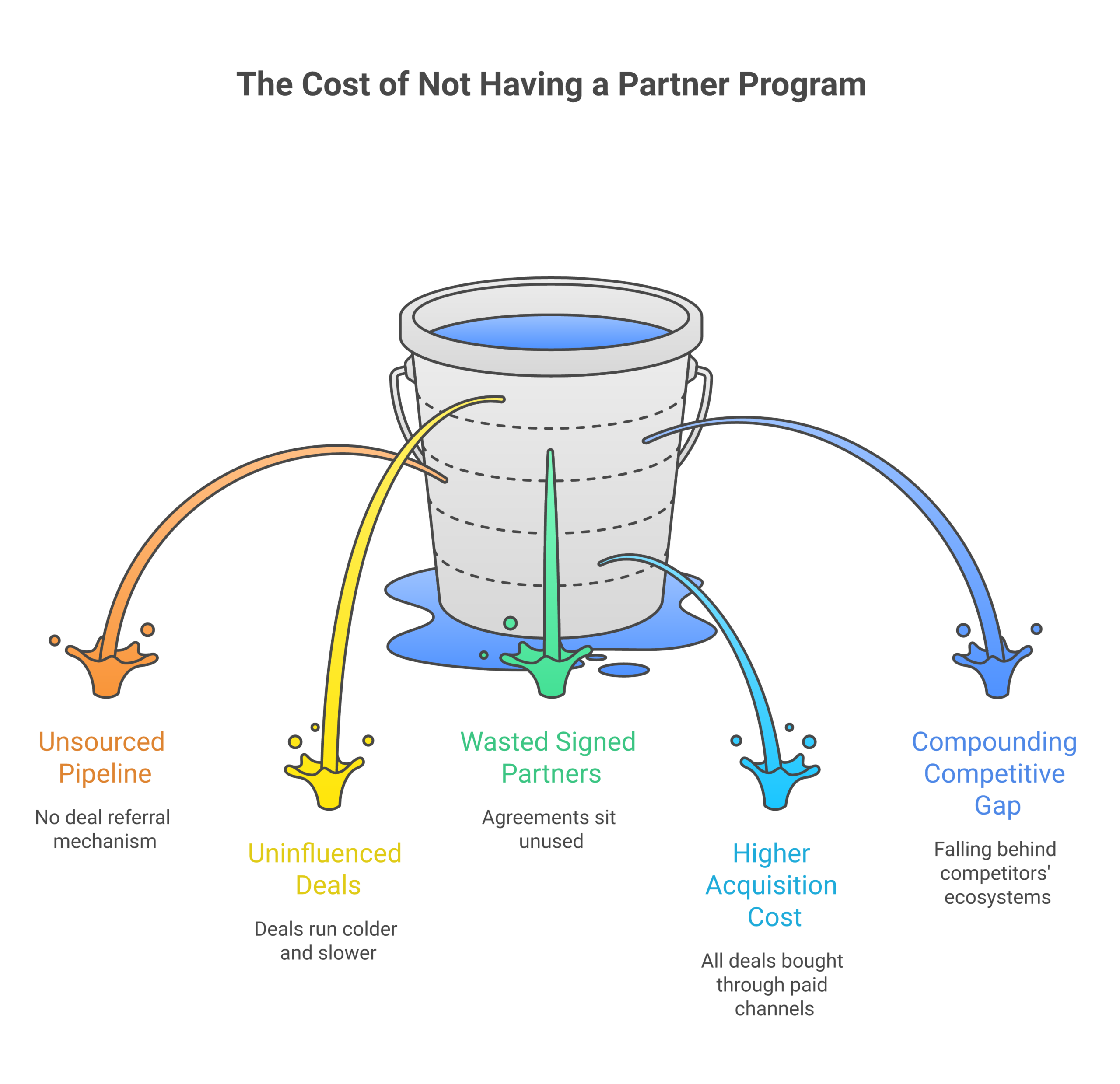
Framework diagram for The Cost of Not Having a Partner Program showing Unsourced pipeline, Uninfluenced deals, Wasted signed partners, Higher acquisition cost, and Compounding competitive gap

  1. Unsourced pipeline: Without a co-sell motion or referral path, partners who could send deals have no mechanism to do it. The pipeline a program would source never enters the funnel, and because it never existed in the CRM, nobody mourns it.
  2. Uninfluenced deals: Direct deals that a partner could have de-risked, with a reference or a warm introduction to a stakeholder, run colder and slower. The deal still closes or loses on its own merits, and the partner lift it never got is the cost.
  3. Wasted signed partners: Agreements get signed and then sit. The partner is willing, the contract exists, and with no onboarding or activation the relationship produces nothing. The cost is the opportunity in a partner who said yes and was never switched on.
  4. Higher acquisition cost: Every deal a partner could have warmed instead gets bought through paid channels and longer direct cycles. The absence of a program does not remove the cost of acquiring customers; it just routes all of it through the most expensive paths.
  5. Compounding competitive gap: A program builds a referral base that grows year over year. A company without one is not standing still relative to competitors; it is falling behind at the rate their ecosystems compound.

The point is that none of these five appear on a P&L. They are all counterfactual losses, which is why the cost of not having a partner program is the easiest large cost in a business to ignore.

Common pitfalls

Companies misjudge this cost in consistent ways, and each mistake keeps the program from getting built.

  • Reading silence as proof partnerships do not work: A few unmanaged agreements that produced nothing get treated as a verdict on the channel, when they were never a real test of it.
  • Looking only at sourced revenue: A leader checks partner-sourced pipeline, sees a small number, and stops. Influenced deals and faster cycles are the larger share of the value and go uncounted.
  • Waiting for a perfect business case: The cost is counterfactual and hard to quantify exactly, so the decision stalls forever waiting for a number that, by its nature, cannot be precise.
  • Hiring a partner manager with no program design: A company feels the gap, hires one person, gives them no system to run, and concludes a year later that the hire failed when the program was never built.
  • Assuming small means safe: Leaders treat a partner program as a scale-stage luxury. The compounding gap means the earlier a program starts, the cheaper the ground it has to make up later.

What this looks like in practice

A partner program runs on a modest stack. The point of listing it is to show the absence is a choice, not a resourcing wall.
A mid-market software company has eleven signed partners and no program. Partner-sourced pipeline is near zero, and leadership concludes the channel is dead. A review finds the opposite: nine of the eleven partners share customers with the company, none have been onboarded, and there is no co-sell motion or attribution. The company stands up a basic program, activates seven of the eleven partners, and within three quarters partner-influenced deals are a measurable, faster-closing share of new business. The partners were always capable. The cost of the prior two years was the program that did not exist to switch them on.

The contrast is a competitor that built a program early. Its referral base compounded for three years while the first company stood still, and the gap is now too wide to close in a quarter. That gap is the most expensive form the cost takes, because it cannot be bought back quickly at any price.

Forecastableโ€™s POV

The cost of not having a partner program is dangerous precisely because it is never an invoice. Every other major cost in a business announces itself: payroll, software, paid acquisition. This one is silent, counterfactual, and easy to rationalize as โ€œpartnerships are not for us.โ€ That rationalization is usually the conclusion of a test that was never actually run.

Across our client base, the companies that finally build a program almost always find the raw material was already there. Signed partners, shared customers, willing counterparts, and no system connecting them. The program does not manufacture the opportunity; it switches on an opportunity the company was already paying to leave dark.

The contrarian point is that the cost of not having a partner program is highest for the companies most certain partnerships do not work for them. That certainty almost always traces to a few unmanaged agreements that were never a fair test. The more confidently a leader has written off the channel, the more likely the channel was simply never run, and the larger the cost quietly accruing while the verdict stands.

If you cannot say what a partner could be sourcing, influencing, or accelerating for you right now, you are not avoiding the cost of a partner program. You are paying it.

Forecastable is an independent third-party professional services company. Our evaluations of partner programs and tooling are based on publicly-available information as of May 2026 and our own client experience.

Frequently asked questions

What does it cost a company to not have a partner program?
The lost partner-sourced pipeline, the uninfluenced deals, the wasted signed partners, the higher acquisition cost, and the competitive gap that compounds while the company stands still.

Why is the cost so hard to see?
Every piece of it is counterfactual. The deals a program would have sourced or influenced never entered the CRM, so the loss is real but unrecorded.

Does not having a partner program mean having no partners?
Rarely. Most companies without a program still have signed agreements, resellers, or integrations. They lack the system around them, not the partners themselves.

How do I know if the cost applies to my company?
Check whether your signed partners share customers with you and whether any motion connects them. Overlap with no motion is the cost in plain sight.

Is a partner program worth it for a small company?
Often more so, because the competitive gap compounds. The earlier a program starts, the less ground it has to make up against ecosystems that are already growing.

We tried partnerships and they did not work. Is the cost still real?
Usually yes. A few unmanaged agreements that produced nothing is not a test of the channel. The cost keeps accruing on the assumption that it was.

Next step

If partnerships feel like a channel that did not work for you, check whether it was ever actually run. Map which of your signed partners share customers with you, and whether any motion connects them. Overlap with no motion is the cost of not having a partner program, sitting in plain sight.

Talk to our team about standing up a partner program โ†’

The partner program hub holds the broader operating context, and the partner activation write-up covers how to switch on the signed partners you already have.

Uncover Your Growth Potential

Whether starting with a single sales team or a single partner, any co-sell motion can be live within 30 days.

Schedule a Discovery Call
Latest Insights
A partnerships leader presenting a partner pipeline for the CFO on a wall monitor showing sourced versus influenced revenue with conversion rates, the finance chief reviewing a printed attribution summary across the table, deep navy and warm amber palette
  • Partnerships Roles & Hiring
Alex Buckles

Partner Pipeline for the CFO: Making It Real

What is partner pipeline for the CFO? Short answer: Partner pipeline for the CFO is the view of partner-influenced and partner-sourced revenue translated into the language a finance leader uses to make budget decisions, conversion rates, attribution clarity, and a defensible return on the program’s cost. It is the difference between a partnerships team that […]

Read Article
A founder and an outsourced partnerships lead reviewing a partner-as-a-service engagement on a wall monitor showing a managed partner program with milestones and handback points, a printed scope of work on the table, deep navy and warm amber palette
  • Partnerships Roles & Hiring
Alex Buckles

Partner-as-a-Service: What It Is and When to Use It

What is partner-as-a-service? Short answer: Partner-as-a-service is a model in which a company hires an external team to run some or all of its partnership operations, recruiting, onboarding, enabling, and managing partners, rather than building that capability entirely in house. It lets a company stand up or scale a partner motion without first hiring and […]

Read Article
An account executive and a partner rep sitting on the same side of the table in front of a customer during a partner-assisted selling meeting, a shared account plan and printed proposal between them, deep navy and warm amber palette
  • Partnerships Roles & Hiring
Alex Buckles

Partner-Assisted Selling: How It Actually Works

What is partner-assisted selling? Short answer: Partner-assisted selling is a motion in which a partner actively helps your own seller win a deal, contributing trust, technical credibility, customer access, or a complementary product, rather than simply handing over a lead and stepping back. It sits between a pure referral, where the partner passes a name, […]

Read Article
A go-to-market leadership team standing at a wall monitor that maps a partner-led GTM with partners as the primary route to market, a printed coverage map showing partner territories on the table, deep navy and warm amber palette
  • Partnerships Roles & Hiring
Alex Buckles

Partner-Led GTM: A Go-to-Market Built on Partners

What is partner-led GTM? Short answer: Partner-led GTM is a go-to-market model in which partners are the primary route to reaching, selling, and serving customers, rather than a supplementary channel layered on top of a direct sales motion. It means the company designs its entire commercial engine, sales, marketing, support, and product, around partners carrying […]

Read Article
Logo โ€” Itโ€™s All AboutThe Team

Quick Links

  • Who We Serve
  • Solutions
  • Resources
  • Pricing
  • Our History

Social Media

  • Linkedin

Legal

  • Privacy Policy
  • Terms of Service
Quick Links
  • Who We Serve
  • Solutions
  • Resources
  • Pricing
  • Our History
Social Media
  • Linkedin
Legal
  • Privacy Policy
  • Terms of Service

Stay ahead on ecosystem-led growth

Logo โ€” Itโ€™s All AboutThe Team
ยฉ 2025 Forecastable. All rights reserved.
Book Your Strategy Call
Request Enrollment Details

[contact-form-7 id=”dfbeed3″ title=”Request Enrollment Details”]

Mollie Bodensteiner

Revops Advisory
  Mollie Bodensteiner is an experienced operations professional with a demonstrated track record of utilizing technology to support operational processes that drive performance and innovation. She currently is the Vice President of Operations at Sound and owns go-to-market agency, MB Solutions. Mollie has previously held operations leadership roles at Deel, Syncari, Corteva and Marketo. She has over 14 years of experience in both B2C and B2B operations and technology. When she is not working, Mollie enjoys spending time with her husband, three small children, and two large dogs. Childhood Career/Dream: Growing up in the age of Disney and Nick@Nite I always wanted to be a child actor (good thing that never was actually pursued ๐Ÿ™‚ Favorite Win: I am not sure I have a specific โ€œwinโ€ but I think I get the most joy and excitement from coaching others and watching them hit major milestones in their career. The first time you get to promote someone on your team or watch them lead a major project – are always career highlights! Personal Fun Facts: Favorite Song: If itโ€™s love, Train Favorite Movie: Good Will Hunting Favorite Meme: Disaster Girl
Forecastable resources: Co-Sell Orchestration Platform · All Use Cases · Live in 30 Days · Co-Sell Playbook

Kelsey Buckles

Director of Operations


My journey from Education to Operations has equipped me with a unique perspective and skill set that perfectly aligns with Forecastable’s mission to help businesses improve sales collaboration through partner co-selling strategies.

At Forecastable, I am passionate about empowering teams and organizations to unlock the full potential of strategic partnerships. By leveraging my expertise in communication, leadership, and operational efficiency, I contribute to creating seamless co-selling processes that align with business goals and deliver exceptional results.

The intersection of my educational foundation and operational experience fuels my dedication to fostering alignment, building trust, and enhancing collaboration between partners. I am driven by the opportunity to contribute to a platform that not only optimizes sales strategies but also strengthens relationships that lead to long-term growth.

Paul Jonhson

Chief Technology Officer (Co-founder)


Paul Johnson has 20+ years of software development and consulting experience for a variety of organizations, ranging from startups to large-enterprise organization with highly-complex needs.

Mr. Johnson has a long track record of successful technology deployments.
This, combined with his deep passion for machine learning and exceptional user experience design, allows him to lead our technical direction from the front with confidence.

Alex Buckles

Product, Partnerships, and Value Engineering (Co-founder)


After serving in The United States Marine Corps, Alex Buckles spent the next two decades as a student of revenue production and an advocate for innovation.

Along the way, he has helped numerous companies achieve double and triple-digit growth by crafting and executing high-performing go-to-market strategies, with co-selling at the center of each.

As a once-advanced technical marketer, an expert sales & partner professional, and a strong customer success advocate, Mr. Buckles understands the impact of these functions aligning not only on revenue production, but on the day-to-day execution of the go-to-market strategy. This concept of revenue-team alignment is what quickly became the foundation of Forecastable back in January of 2018.

In his free time, youโ€™ll find him spending quality time with his children, one of whom is on the autism spectrum. 1 in 36 children in the U.S. are on the spectrum and boys are four times more likely to be diagnosed than girls.

With that in mind, Mr. Buckles plans on dedicating the rest of his life serving those living with autism, through his organization Pathways for Autism. From his perspective, there must be a scalable and financially self-sustaining infrastructure established to put as many individuals with autism as possible on a path towards complete independence as adults.