AI-Native PRM: What It Is and Why It Beats Bolted-On AI

What is an AI-native PRM?
Short answer: An ai-native prm is a partner relationship management platform built from the ground up around AI capabilities rather than bolted on later. It treats the data model, the user interface, and the workflow layer as AI-first surfaces from day one.
That distinction matters because traditional PRMs were architected for portal logins, MDF approvals, and deal registration forms. Retrofitting AI on top of that schema gets you a chatbot and a few suggestion widgets. It does not get you reliable AI outputs across pipeline forecasting, partner-readiness scoring, or auto-drafted partner outreach.
A working AI-native PRM has three properties. The data model is consistent enough that an LLM can reason across partners, deals, and accounts without hallucinating. The default user interaction is conversational rather than form-driven. And automation, not human clicking, moves work between stages.
If a vendor demos AI features but the underlying records still live in inconsistent custom objects with partner names spelled three different ways, that is not AI-native. That is a traditional PRM with a marketing refresh.
Why ai-native prm matters in 2026
Three forces are pushing this shift in 2026. First, partner teams are smaller relative to ecosystem scope, and the only way to cover 50 or 500 partners with a five-person team is to let AI handle the first draft of most work. Second, CROs are demanding partner-sourced and partner-influenced pipeline numbers that hold up to board scrutiny, which requires attribution-clean data that AI can actually parse. Third, the ecosystem data layer (Crossbeam) has matured to the point that the PRM has to ingest and act on overlap signals in real time, not on a Tuesday batch import.
The operating case sits on three layers. At the data layer, an AI-native PRM enforces a schema where joint-account tags, partner-of-record fields, and influence attribution are first-class and consistent. At the workflow layer, AI generates portal content, drafts partner outreach, and routes alerts without a human in the middle for every step. At the measurement layer, predictive scoring runs continuously rather than as a quarterly QBR exercise.
The operating reality is that most partner programs in 2026 are running on PRMs that were architected between 2015 and 2020. Those platforms can layer in AI features, but the underlying data model often cannot support the outputs the marketing pages promise. That gap is the single biggest reason “AI in our PRM” initiatives stall. For broader industry context, see Crossbeam’s ecosystem-data writing.
How an ai-native prm actually works
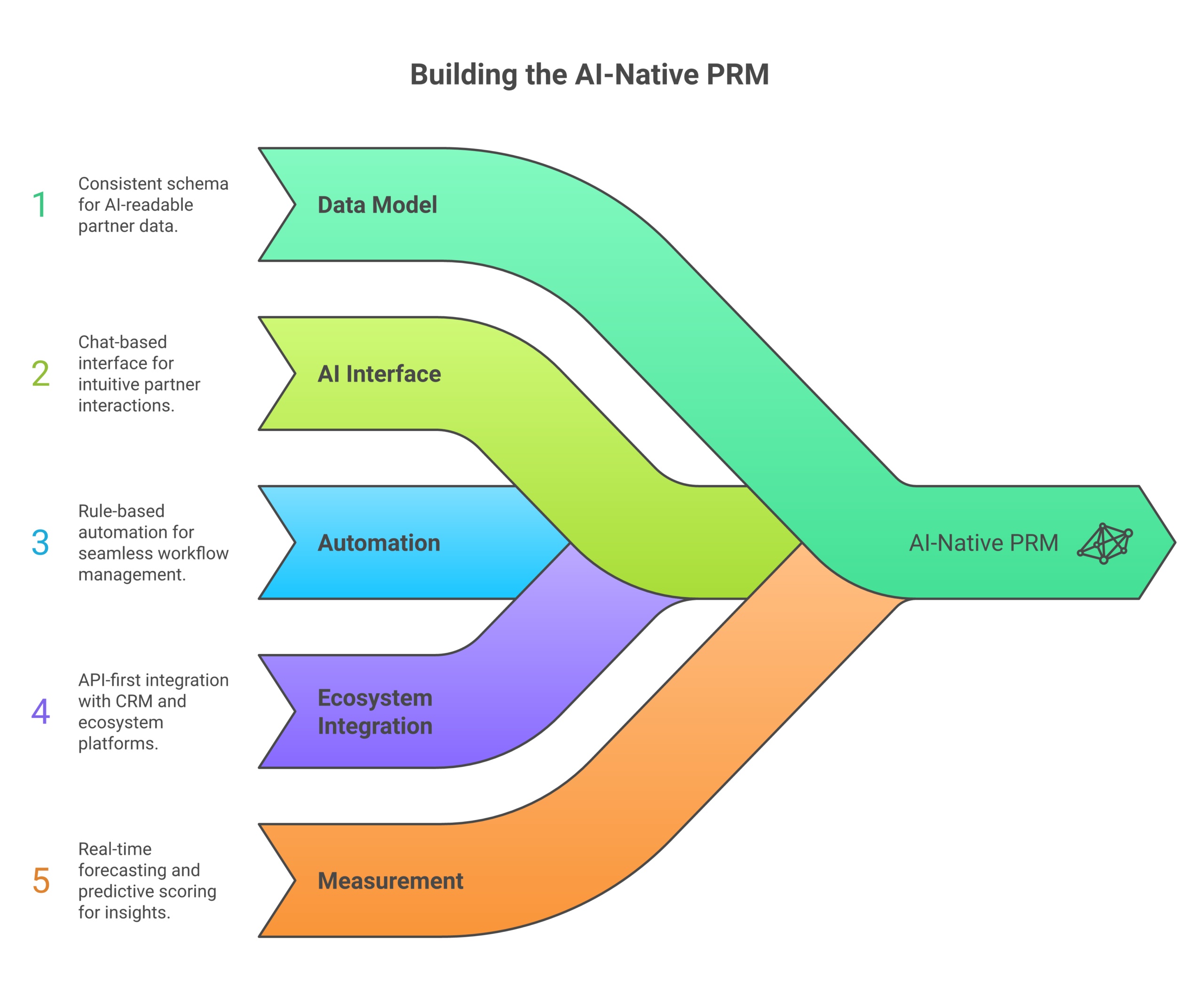
Five mechanics separate AI-native platforms from traditional PRMs with AI features bolted on. Each one shows up in the architecture, not just the demo.
- Data model built for AI-readable partner data: Consistent schema across partner records, joint-account tagging that survives ownership changes, and attribution fields that distinguish sourced from influenced from co-sold. The schema is opinionated and the platform enforces it on write, not on read.
- AI as the default user interface: Partner queries happen through chat (“show me deals where Acme is on the customer side and we have a partner overlap”), portal content is AI-generated from underlying records, and partner outreach is drafted by the system with a human approval step rather than typed by a partner manager from scratch.
- Automation as the core: Workflow automation moves leads, deals, and MDF requests between stages on rules rather than tickets. AI-triggered alerts surface stalled deals, dormant partners, and new overlap matches. Routing happens automatically based on partner tier, geography, and account ownership.
- Openness to ecosystem data: API-first integration with CRM (Salesforce, HubSpot), ecosystem platforms (Crossbeam), and marketplace ops (Tackle, AWS Marketplace, Azure Marketplace). The PRM treats those as authoritative sources rather than trying to recreate them inside its own walls.
- Measurement designed for AI insights: Real-time pipeline forecasting that updates as overlap and deal signals change, predictive partner-readiness scoring that flags which partners are likely to source in the next 90 days, and influence attribution that holds up under finance scrutiny.
A platform that ships three of these five but misses the data model layer will produce unreliable AI outputs no matter how slick the chat interface looks. The schema work is the unglamorous prerequisite that most legacy vendors have not done.
Common pitfalls
- Confusing AI features with AI-native architecture: A “draft this email” button on top of a 2017 data model is a feature. It is not an AI-native platform, and it will not unlock the workflow gains the buyer expected.
- Skipping the data hygiene phase: Even an AI-native PRM cannot reason across partner records if the migration dumped in 800 duplicate partner accounts and inconsistent stage names. Hygiene is a prerequisite, not an optional cleanup.
- Replacing the ecosystem data layer: Crossbeam feed the PRM with overlap intelligence; they are not replaced by it. Vendors that pitch their PRM as an ecosystem replacement are usually selling a closed walled garden.
- Letting the chat interface become a vanity demo: Conversational UI is a means to faster operating decisions, not an end. If the chat answers are not grounded in clean records, the chat becomes a hallucination engine and partner managers stop trusting it within two weeks.
- Treating AI-drafted outreach as send-ready: AI-native platforms draft partner outreach; they do not unilaterally send it. Programs that skip the approval gate burn partner trust fast and rarely recover it.
Tools and examples
The 2026 PRM market splits cleanly into three layers when you map it against the AI-native standard. The first layer is platforms built around AI as the architectural assumption. The second is the established PRM cohort layering AI features on top of existing platforms. The third is the ecosystem data layer that feeds whichever PRM sits above it.
| Layer | What it does for ai-native prm | Examples |
|---|---|---|
| AI-native PRMs | Schema, UI, and workflow built around AI from day one | Introw, Euler |
| Traditional PRMs adding AI features | Established PRM platforms layering AI on existing data models | Impartner, PartnerStack, Channelscaler, Magentrix |
| Ecosystem data layer | Feeds overlap and account intelligence into the PRM above | Crossbeam |
A worked example shows the gap. An ISV evaluating PRM in mid-2026 that selects an AI-native platform typically operationalizes partner-readiness scoring and AI-drafted partner outreach within 60 days of deployment. The data model is already shaped to support those outputs, and the workflows are pre-wired. The same ISV that selects a traditional PRM with AI features added on top adds those capabilities over 6 to 12 months, often via professional services engagements, and frequently never lands a working readiness model because the underlying data hygiene work was never completed.
The cost difference rarely shows up in the contract. It shows up in the calendar quarters that pass before the partner team starts trusting the system enough to use it daily.
Forecastable’s POV
Most “AI in PRM” announcements in 2025 and 2026 are bolted-on features on legacy data models. The marketing pages will not tell you that, but the implementation timelines will. When a vendor needs nine months and a six-figure services engagement to turn on partner-readiness scoring, the platform is not AI-native. It is a traditional PRM with AI ambitions.
The two firms we see operating as genuinely AI-native in 2026 are Introw and Euler. Both built the data model first and the AI surfaces second. That sequence matters because the AI surfaces are only as reliable as the records they read. Introw and Euler are not the only options for every buyer, but they are the honest reference points for what “AI-native” actually looks like in practice.
The established PRM cohort (Impartner, PartnerStack, Channelscaler, Magentrix) is not standing still. Each is shipping AI features. But adding AI to an existing platform produces different outcomes than rebuilding the platform around AI, and buyers should evaluate them as different categories rather than competing on the same line item. The questions a buyer should ask in the demo are about schema enforcement, not about which buttons trigger an LLM call.
Our recommendation in 2026 is simple. If you are replacing a PRM, evaluate the AI-native cohort seriously rather than defaulting to the brand you have heard of for a decade. If you are staying on your existing PRM, set realistic expectations about what bolted-on AI can deliver and budget the data hygiene work that has to happen before any of it produces reliable output.
Forecastable is an independent third-party professional services company. Our evaluations of AI-native PRM are based on publicly-available information as of May 2026 and our own client experience.
Frequently asked questions
What is the difference between an AI-native PRM and a traditional PRM with AI features?
An AI-native PRM was architected with AI as the assumption: the data model, the user interface, and the workflow layer are all AI-first. A traditional PRM with AI features started as a portal-and-form platform and added AI buttons on top of an existing schema. The difference shows up in reliability of outputs and in implementation timeline.
Is Introw or Euler the right AI-native PRM for me?
Both are credible AI-native options in 2026, and the right choice depends on your CRM, your partner mix, and your ecosystem data stack. Run a structured evaluation against both rather than picking on brand recognition. Neither is universally better; they have different strengths around channel motion versus alliance motion.
Where does Crossbeam fit if I have an AI-native PRM?
Crossbeam sit underneath the PRM as the ecosystem data layer. They feed overlap intelligence into the PRM, which acts on it. AI-native PRMs are designed to ingest that data via API rather than recreate it, which is the right architecture in 2026.
Can I make my existing PRM AI-native?
Not really. You can add AI features to your existing PRM and get value from them, but the underlying schema and workflow assumptions were set when the platform was designed. If those assumptions do not support AI workflows, retrofitting them is a multi-year, multi-million-dollar exercise that usually ends in a replacement anyway.
How long does AI-native PRM deployment take?
Sixty to ninety days for a focused implementation if the buyer has clean CRM data and a defined partner segmentation. Six to twelve months if either of those is missing. The AI-native architecture shortens the time-to-value once the prerequisites are in place; it does not erase the prerequisites.
Does an AI-native PRM replace my partner managers?
No. It changes what partner managers spend their time on. The first-draft work (outreach, portal content, readiness scoring) shifts to the system, and the partner manager spends more time on the human-in-the-loop work: building champions, navigating committees, closing co-sell motions. The headcount math rarely goes down; the leverage per head goes up.
What is the biggest mistake buyers make evaluating AI-native PRM?
Demoing the chat interface instead of inspecting the schema. The chat is the surface; the data model is the substance. Ask to see how partner records are structured, how joint-account tagging works, and how attribution flows from PRM to CRM and back. If the answers are vague, the AI outputs will be too.
Next step
If you are evaluating an AI-native PRM in 2026, the right starting point is a structured comparison of your current PRM against the two AI-native options and your top one or two traditional options. We help partnerships and RevOps leaders run that evaluation in a way that surfaces the schema and workflow questions vendors typically dodge in standard demos, and we map the answers to your specific partner motion rather than a generic scorecard.
Talk to our team about ai-native PRM evaluation →
The partner program hub holds the broader context on how PRM fits inside the larger partnerships operating model.
Uncover Your Growth Potential
Schedule a Discovery Call