Bridge Partners Shipped One Line That Should Reset Every Partnership-AI Vendor Pitch. Here’s the Question Buyers Should Be Asking Instead.

Short answer: Almost every partnership-AI vendor in 2026 sells automation while telling buyers they are selling impact. However, automation and orchestration are different categories. Specifically, automation delivers scale and orchestration delivers impact. Therefore, the question every buyer should put to every vendor pitch is one specific line: show me the orchestration outcome your platform produces, not the automation feature it ships.
Richard Albrecht’s post in June 2025 contains a single line that cuts to the seam of the entire 2026 partnership-AI conversation:
Therefore, “Automation delivers scale. Orchestration delivers impact.”
That’s the cleanest articulation of the distinction we have. Read it twice. It should reset every partnership-AI vendor pitch happening in 2026.
It won’t. And the reason it won’t is a structural feature of the AI-vendor unit economics that most buyers haven’t priced in.
Why the line won’t reset the vendor pitches
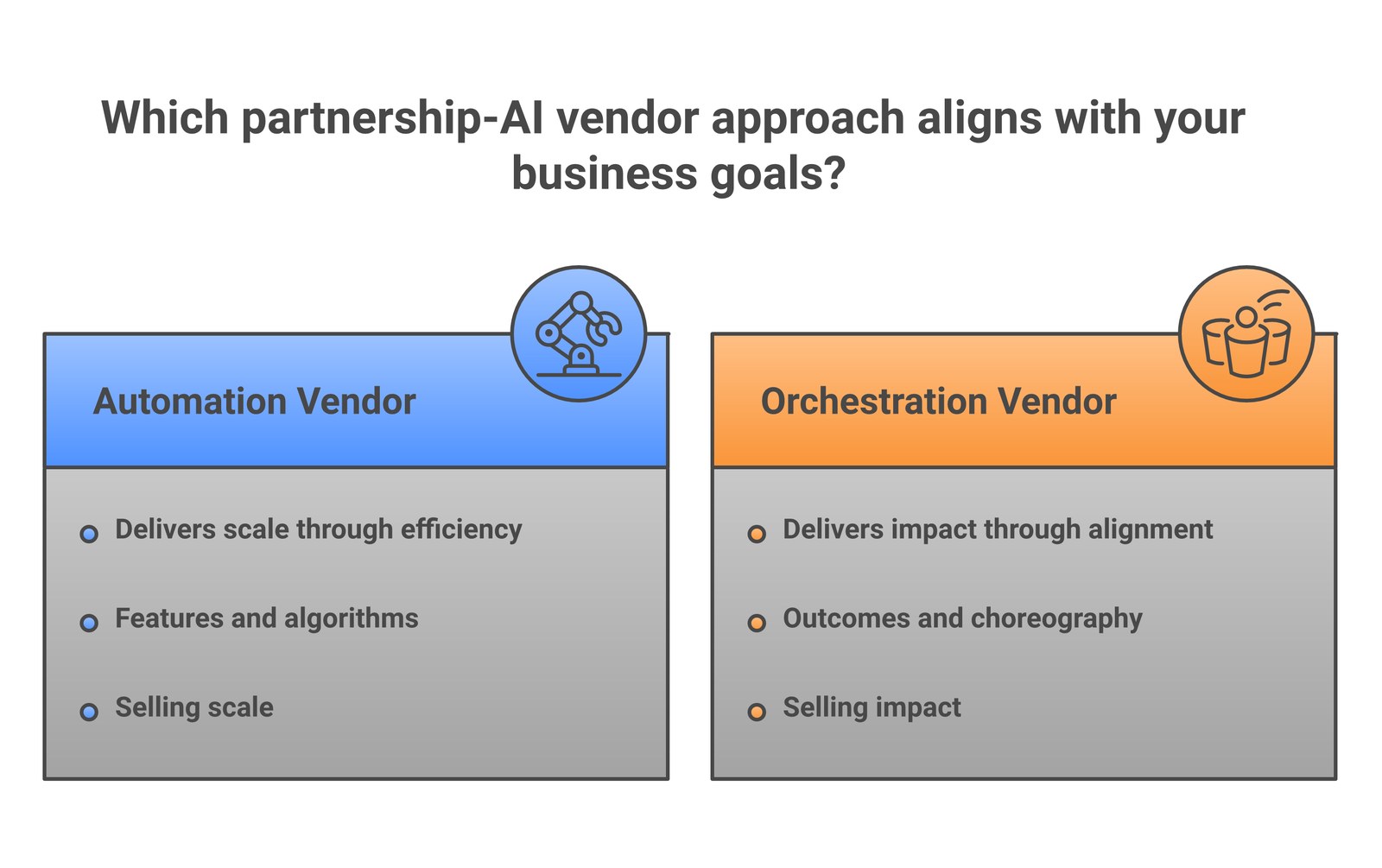
Almost every partnership-AI vendor on the market right now is selling automation. Faster matching algorithms. Smarter scoring. Better notifications. Predictive next-best-action. Conversational interfaces over the data. Auto-drafted partner-rep outreach. Auto-summarized partner-meeting notes. AI-generated overlap recommendations. All useful. All automation.
By contrast, almost none of them are selling orchestration. Because orchestration is harder to build, harder to demo, harder to package into a ten-slide vendor pitch, and harder to bill against. Orchestration requires human judgment in the loop, defined cadences across multiple companies, accountability mechanisms that survive reorgs, and context the platform can’t assume. None of that demos cleanly in a 30-minute sales call.
So the vendors compete on the easier side of the distinction, automation, while telling the buyer they’re selling impact. The buyer signs the contract expecting orchestration outcomes from an automation-shaped product. Twelve months later, the platform is producing more dashboards than deals. The buyer concludes AI didn’t work. The platform becomes a cost line. The cycle repeats with the next vendor.
In practice, this is the most common failure pattern in the partnership-AI buying conversation right now. And it is structural, not vendor-specific. Any individual partnership-AI vendor could in principle pivot to selling orchestration; the unit economics of doing so make it commercially difficult, so the category collectively defaults to selling automation and calling it impact.
What automation does well
To be clear about what we are not arguing: automation is genuinely valuable. The matching algorithms that surface overlap. The notification systems that route signal to reps. The auto-summarization features that compress an hour of partner-call review into a five-minute briefing. The chat interfaces that let analysts query partner-activity data without writing SQL. All of these compress time, reduce friction, and enable scale.
Notably, if your existing partnership program has the orchestration layer installed and working, automation will accelerate it materially. The Channelnomics 40%-faster-deal-velocity stat applies here. AI-on-top-of-good-cadence is the use case where the citations work.
The failure mode is not automation per se. The failure mode is the substitution of automation for orchestration in the buyer’s mental model.
What orchestration actually requires
Crucially, orchestration is the layer above automation. It is the cadence design that turns automation outputs into deal motion. Specifically:
- A shared mental model that every partner-side rep carries, what the joint customer outcome looks like, who owns which moment in the cycle, what “good” looks like for the deal.
- A better-together story constructed jointly between vendor and partner, that lands at the level of the customer outcome neither party can produce alone.
- Pipeline choreography sequenced deliberately at the rep-to-rep layer, who opens, who deepens, who lands across multi-partner deals.
- Mutual action plans that survive between meetings, with named owners across all partner-side counterparts and explicit dates with consequences.
- Always-on communications cadence between named contacts at every partner producing material pipeline, channel-rotated, brief, value-add, grounded in actual joint pipeline.
- Production culture in the partnership function that evaluates partner managers on output, not relationship-health metrics.
- Frontline engagement at the rep-to-rep layer between AE and partner-side AE on a weekly cadence, not via the partner manager.
These are not features. They are operating disciplines that have to be designed, installed, and maintained. The platforms can support them. The platforms cannot, by themselves, produce them.
The question every buyer should put to every vendor pitch from now on
Indeed, what buyers should ask in every partnership-AI vendor pitch from this point forward is one specific question:
Show me the orchestration outcome your platform produces, not the automation feature it ships.
Meanwhile, most demos can’t answer that question because most platforms don’t produce orchestration. The demos that can answer it usually involve a human-in-the-loop role, a Co-Sell Alignment Specialist on the operations side, a Forward-Deployed Engineer on the technical side, that the vendor positions as “implementation services” but is actually the orchestration layer doing the work the platform alone can’t.
That’s a fair admission when the vendor makes it. It also reframes the buying decision. The platform is useful, but the orchestration value comes from the human roles operating against it. The platform spend should be sized to what it actually does (automation at scale). The orchestration spend, which is bigger and more leveraged, should be allocated to the roles and the cadence design that makes the platform produce impact.
Where the orchestration investment should actually live
In fact, the reason most partnership-AI vendors won’t reset their pitch is structural, not strategic. Their unit economics push them toward selling more automation, not toward building orchestration. Which means the buyer has to make the move themselves. Stop buying automation and calling it orchestration. Start sizing the orchestration investment separately from the platform investment. Install the human roles and the cadence design that make the platform actually produce.
That work is exactly what Forecastable does, and orchestration is the category we intend to own.
Most importantly, the 9-accelerator operating system across Strategy, Story, and Selling is the orchestration layer the platforms cannot deliver. The Strategy axis (partner activation, ecosystem leverage, disproportionate advantage) sequences the multi-partner motion. The Story axis (layered value, shared mental model, pipeline choreography) constructs the better-together at the rep-to-rep layer where deals actually close. The Selling axis (production culture, discipline and accountability, frontline engagement) installs the cadence that survives reorgs and hand-offs.
Co-Sell Alignment Specialists run that layer as senior team members embedded in the partnership function. Forward-Deployed Engineers do the same on the technical side, sitting between the platforms and the cadence. Together they are the named owners of the orchestration outputs that no platform alone produces. The platform spend should be sized to what it actually does (automation at scale). The orchestration spend, which is bigger and more leveraged, belongs with the people and the cadence design, not with another seat license.
Then the platform actually produces.
What this means for your team this quarter
Two diagnostics worth running.
Diagnostic one, the platform-vs-cadence audit
However, for your three largest partnership-AI investments (current or planned), score each one as automation-shaped or orchestration-shaped based on what the platform actually does versus what the cadence around it does. Most will score automation-shaped. The orchestration layer underneath each one is what determines whether the investment closes the ROI loop.
Diagnostic two, the role-design audit
For each automation-shaped platform you have or are evaluating, identify the human role that has to exist to extract orchestration value from it. If no such role exists in your org chart today, that’s the missing variable. The platform investment without the role is sized for the wrong outcome.
Therefore, the fix isn’t to stop buying platforms. The fix is to size the platform investment for what it actually does, allocate the orchestration investment separately, install the human roles (Co-Sell Alignment Specialist on operations, Forward-Deployed Engineer on technical, named cadence-owners across each material partner motion), and let the platform accelerate a cadence that’s already producing.
Closing
The BridgeIQ launch named the distinction cleanly. Automation delivers scale. Orchestration delivers impact.
Specifically, the buyer’s response should be the question that flows from it: show me the orchestration outcome, not the automation feature. Vendors that can answer it have done the harder work and earned the spend. Vendors that can’t have built an automation product wrapped in orchestration marketing.
Related reading
- The data-trust prerequisite layer that has to land first
- The five-to-eight-partners shift driving multi-partner deals
Sources
Uncover Your Growth Potential
Schedule a Discovery Call