Alex Buckles
Your PRM Logs Deals. Who Makes Them Happen?

Short answer: A PRM records partner activity. So it logs deal registrations, hosts portal content and tracks MDF claims. That’s useful, but logging a deal isn’t the same as creating one. Pipeline comes from people running GTM motions with partners and holding both sides to what they agreed. That’s the gap Forecastable fills with partner-sourced pipeline as a service, and no PRM is required.
What a PRM is built to do
PRM stands for partner relationship management. Because of that, it’s the system of record for a partner program, the way a CRM is the system of record for sales.
In practice, a good PRM handles the program’s structure. Think partner onboarding, tiers, a portal with content and training, deal registration, commissions and MDF requests. Those jobs matter, and the leading PRMs keep getting better at them.
- Introw shipped a Claude connector in March 2026, so teams can work with partner data from an AI assistant.
- Euler positions itself as an AI-native PRM, with AI that turns emails into deal registrations.
- Zinfi offers deal management, partner co-selling and MDF modules in one AI-driven platform.
- Impartner launched partner marketing automation with ad tech and AI in March 2026.
So if you need program structure, buy a good PRM. My point isn’t that PRMs are bad. It’s that they solve a different problem than the one most partner leaders actually have.
Why logging deals doesn’t create them
Here’s the position I take with every partner leader. PRMs don’t drive pipeline. They’re usually a historical record of things that already happened.
For example, a deal registration tells you a partner found an opportunity. It doesn’t tell you why there weren’t five more. And it doesn’t qualify the deal, either. Deal registration isn’t qualification.
Partners don’t live in your portal
Even the PRM vendors say this now. Introw put it plainly in its own marketing: “Your partners don’t log into your portal. They never did.” That’s why the category is moving toward Slack, CRM and AI assistants instead of portals.
And the data points the same way. Mindmatrix reports that fewer than 12% of channel partners engage with portals more than once a quarter. That’s a vendor’s figure, not an analyst’s. But it matches what I see in the field.
Your best partners need a GTM motion, not a login
So for your top partners, I’d avoid just putting them in the PRM. The fastest path to production is a joint GTM motion and a short list of accounts: “Let’s go after these accounts together.”
In one program we looked at, only about two of six top-tier partners had done anything in the PRM. The portal wasn’t the problem. Nobody had given those partners a reason, a target or a deadline.
So the order I recommend is simple:
- Map accounts first: Find the customers and open opportunities you share.
- Build the joint GTM motion: Agree who does what, to whom, and when.
- Add PRM structure later: Once partners are producing, the portal has something to support.
Who actually makes partner deals happen
Instead, deals happen when someone runs the motion and holds both sides to it. That’s an operating job, not a software feature.
When I rely on busy partner professionals to do everything themselves, it usually doesn’t get done. I’ve seen programs drift for six to eight months that way. Nobody is lazy. But they have day jobs.
So someone has to own three things:
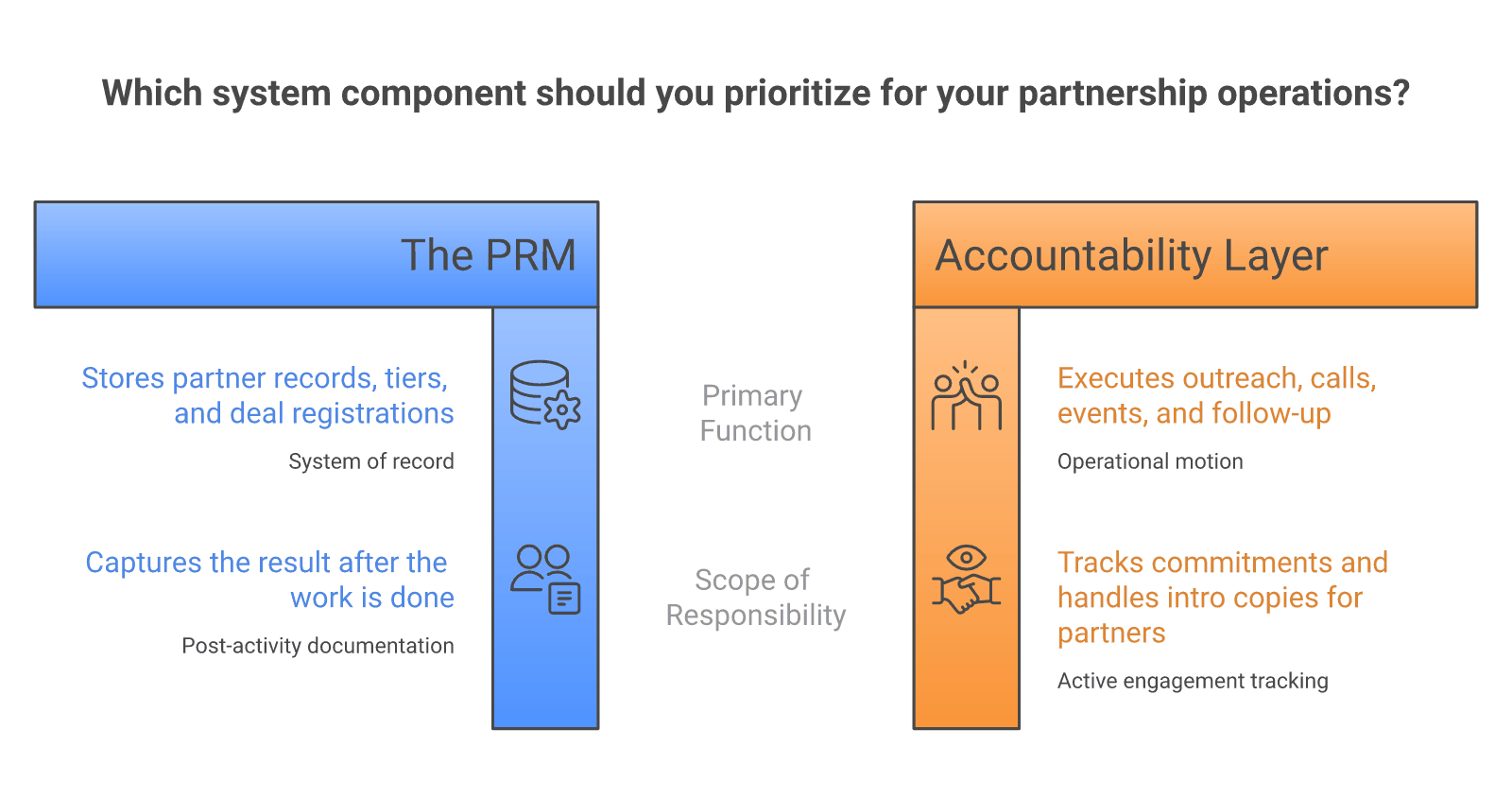
- The motion: Outreach, calls, events and follow-up into target accounts, run on a schedule.
- The commitments: Who said they’d do what, on both sides, and whether they did.
- The record: Deal registration, logging the lead and intro copies, handled for the partner so attribution is clean.
So that’s the accountability layer. A PRM can store the result. But it can’t do the work.
PRM vs. partner-sourced pipeline as a service
The two aren’t rivals. They answer different questions.
| PRM | Forecastable | |
|---|---|---|
| What it is | Software for program structure | Partner-sourced pipeline as a service |
| Main job | Log and manage partner activity | Make partner pipeline happen |
| Who does the work | Your team and your partners | Our team runs it with you or for you |
| What you pay for | Software licenses | Outcomes, measured on pipeline and revenue |
| Partner portal | Usually central | Not required |
Forecastable isn’t a PRM. We’re not about logging deals and deal registration. That’s what PRMs are for. We drive the right behaviors with complete accountability, so attribution is right, forecasts hold and next year is planned from what actually happened.
Do you need a PRM at all?
Often, the answer is not yet. Plenty of programs produce well without one.
If you don’t have a PRM
If so, you can run deal registration natively in your CRM, off a lead source and referring partner field. That’s enough to start, and it keeps partners out of yet another portal. Most partners would rather not log in anyway.
If you already have a PRM
Then keep it, and get more out of it. I rarely recommend waiting out a rip-and-replace, because deal registration alone won’t materially move the business. And Forecastable shouldn’t become a second PRM in any way. We learn how yours is set up and work alongside it, so nobody duplicates effort.
Either way, our people and AI agents can operate your partner tech stack, from the PRM to everything else in it. For an outside view, Impartner’s pre-purchase checklist is a useful way to judge whether a platform fits your program.
How Forecastable works with or without a PRM
At Forecastable, we deliver partner-sourced pipeline as a service. We build your partner program and run it with you or for you, and we’re measured on pipeline and revenue.
There’s no new tech to buy and no seats. Why pay for seats when you can pay for outcomes? We run on your CRM, your PRM and your AI tools when you have them, and we still run when you don’t. We have native Salesforce and HubSpot integrations, and AI agents can push data into any system that connects through MCP.
Co-sell automation is included in every program, running on your Crossbeam data and the AI tools you already own. And partners can fund or co-fund the program through MDF, so it can cost you $0. See how it fits together on our co-sell orchestration platform page.
FAQ
What is the difference between a PRM and Forecastable?
A PRM is software that manages partner program structure, like portals, tiers and deal registration. Forecastable is a service that builds and runs your partner program to produce pipeline, measured on pipeline and revenue.
Do I need a PRM to run a partner program?
No. Many programs start with deal registration in the CRM and add a PRM later. Forecastable runs with or without one.
Does deal registration create partner-sourced pipeline?
No. It records an opportunity a partner found. Pipeline comes from GTM motions that someone runs and tracks.
Does Forecastable replace my PRM?
No. We work alongside your PRM and help you get more out of it. We don’t duplicate what it already does.
Why don’t partners use partner portals?
Because partners work in their own CRM, email and Slack, a portal is one more login, so most partners only visit when they must.
The bottom line
Your PRM tells you what happened. It can’t make it happen. If your partner pipeline depends on partners logging in, you’re waiting on the wrong thing. Put a team on the motions and the commitments, and let the PRM keep score.
Forecastable is an independent third-party professional services company. Our evaluations of other vendors are based on publicly-available information as of October 2026 and our own client experience.
Book a Program Fit Analysis to see what your program needs, with or without a PRM →
Related reading:
Uncover Your Growth Potential
Schedule a Discovery Call