Crossbeam Alternatives: What to Compare in 2026

Short answer
Short answer: Crossbeam alternatives fall into two different layers that buyers constantly confuse, so the first job is deciding which layer you actually need before you compare a single feature. Most teams shopping for a Crossbeam replacement are, in practice, shopping for one of two things: partner-overlap and ecosystem data, or a partner relationship management system, and those are separate categories with separate winners.
Here is the trap. People type “crossbeam alternatives” wanting a cheaper Crossbeam, then buy a PRM that does not map accounts, or an overlap tool that does not register deals. Name the job first.
What are Crossbeam alternatives?
Crossbeam alternatives are the tools you would evaluate instead of Crossbeam to answer the question Crossbeam was built for: which of my accounts and prospects overlap with my partners’ accounts, and where can we co-sell. That is the overlap-and-ecosystem-data layer, and the direct alternatives in it are Pocus and Common Room.
The confusion starts because “partner tech” gets used as one word. Crossbeam sits in the ecosystem-data layer, where the job is account mapping and co-sell signal. A partner relationship management (PRM) platform sits in a different layer, where the job is deal registration, partner portals, tiering, and incentive tracking. Both are partner tech. They do not replace each other. Crossbeam has also consolidated the overlap-data category through acquisition, so the field of pure-play overlap vendors is smaller than it looks. So when a team asks me for Crossbeam alternatives, my first question is which layer broke, because the answer changes the shortlist completely.
Why choosing the right Crossbeam alternative matters in 2026
Crossbeam alternatives matter more now because partner overlap has become an input to real pipeline, not a curiosity. When partner-influenced deals are a large share of the funnel, as Crossbeam and its peers have reported for many B2B companies, the overlap data feeding your co-sell motion is load-bearing. Pick the wrong layer and you install a tool that produces a dashboard nobody acts on.
The second reason is cost discipline. Overlap-data platforms and PRM platforms are priced differently and adopted differently, and buying the wrong one means paying for a category you will not use. A team that needed deal registration and bought an overlap tool ends up back in spreadsheets for the part that actually mattered.
The catch, whichever tool you pick: the data layer shows you where the overlap is, but someone still has to run the motion that turns it into a closed deal, and no overlap tool does that part.
How to evaluate Crossbeam alternatives
Crossbeam alternatives are best compared with a five-part model, so you judge them on the job to be done rather than on a feature checklist. Run every candidate through these five and the shortlist sorts itself.
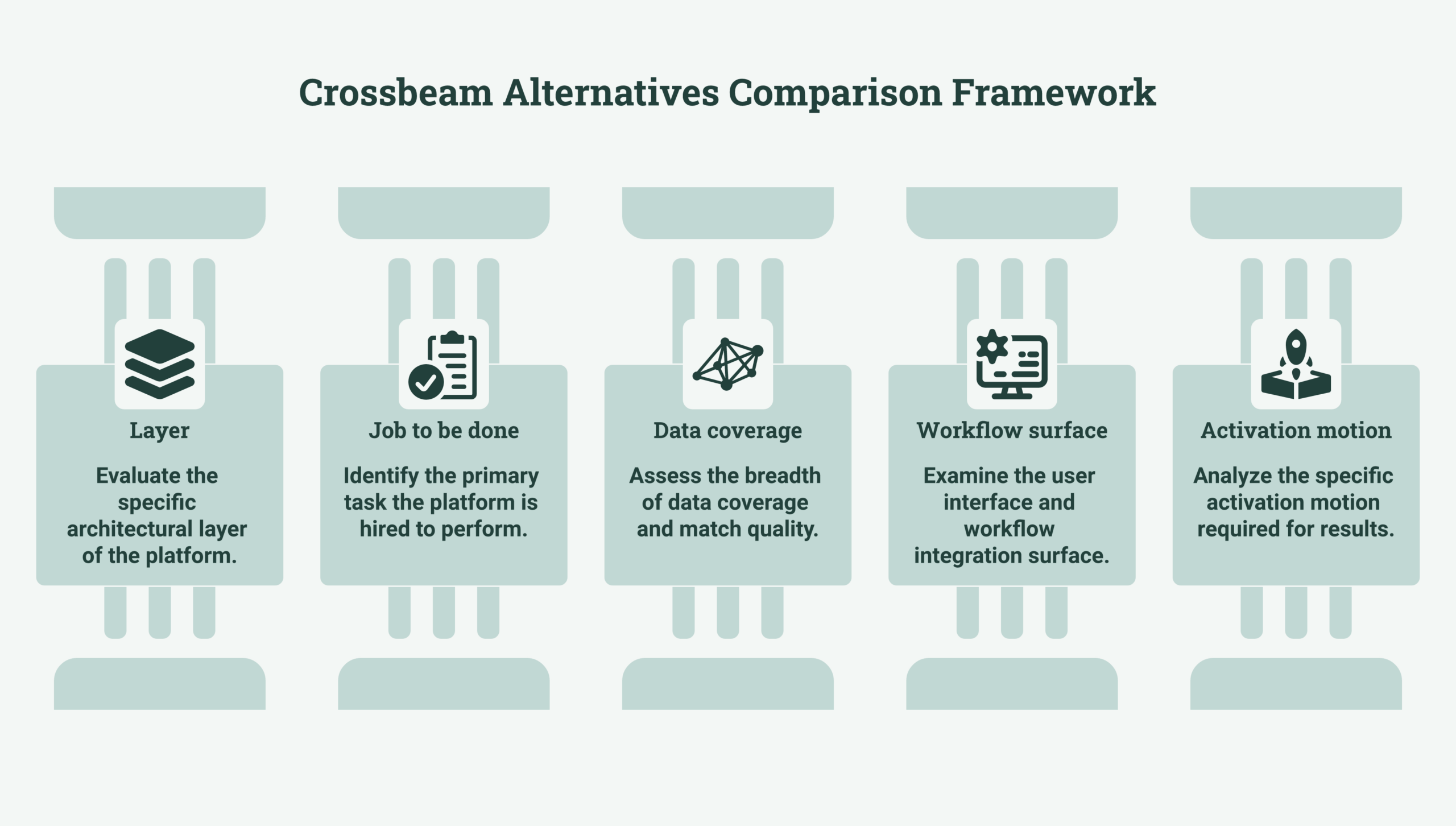
- Layer: decide first whether you need overlap and ecosystem data or a PRM. This single decision removes half the market from your list and stops you comparing tools that do different jobs.
- Job to be done: name the specific outcome, account mapping, co-sell signal, partner-data sync into CRM, or deal registration and portal. The narrower the job, the clearer the winner.
- Data coverage and match quality: for the overlap layer, how many of your partners are in the network, and how clean are the account matches. A tool with thin coverage of your partners is a thin tool for you, whatever its logo count.
- Workflow surface: where the data lands and whether a rep ever sees it. Overlap that lives in a separate portal gets ignored. Overlap that lands in the CRM, or in the rep’s inbox, gets used.
- The activation motion: what actually happens after the overlap is known. This is the part no data tool supplies, and the part that decides whether any of this produces pipeline.
The through-line is that the first two components decide the category and the last three decide the vendor. Skip the layer question and you will compare the wrong tools well.
Common pitfalls
- Shopping for a cheaper Crossbeam without naming the layer: comparing overlap tools when the real gap is PRM, so you buy a capable tool for a job you did not have.
- Judging overlap tools by logo count, not your coverage: picking the biggest network when what matters is how many of your partners are in it and how clean the matches are.
- Buying overlap data that never reaches a rep: choosing a tool whose data lives in a separate portal, so the overlap is visible to the partnerships team and invisible to the people who could act on it.
- Treating the data purchase as the strategy: mapping the ecosystem and installing no motion, so the overlap sits in a dashboard and produces no pipeline.
Tools and examples
The direct alternatives to Crossbeam live in the overlap-and-ecosystem-data layer. If what you actually need is PRM, that is a different table, and any PRM evaluation should include Introw and Euler alongside the established platforms.
| Tool | What it is | Best for |
|---|---|---|
| Pocus | An overlap and signal platform that blends partner data with product and intent signals | Teams that want ecosystem overlap fused with go-to-market signal in one view |
| Common Room | A signal and ecosystem platform that unifies community, product, and partner data | Teams treating partner overlap as one signal among many for account prioritization |
| Introw | An AI-native PRM covering deal registration, partner portals, and attribution | Teams whose real gap is PRM, not overlap data, and who want a light administrative footprint |
| Euler | An AI-native PRM focused on partner data, registration, and reporting in the revenue stack | Teams standardizing partner data and attribution alongside their CRM |
A worked example makes the layer point concrete. A partnerships leader told me she was evaluating Crossbeam alternatives to cut cost. Two questions in, the real problem was that her partners had nowhere to register a deal, so deals were dying in email. She did not need an overlap tool at all. She needed PRM, and a cheaper overlap platform would have solved nothing. We put her onto a PRM shortlist and kept her overlap coverage where it was.
Forecastable’s POV
Crossbeam alternatives is a search where the buyer is usually one layer off from what they need, and the tool-first instinct makes it worse. The overlap-data category is genuinely useful. It tells you where you and your partners share accounts, and that is a real input to co-sell. What it does not do, in any vendor, is run the motion that converts overlap into revenue.
The pattern I coach against is buying the data layer and treating the purchase as the strategy. A perfectly mapped ecosystem with no motion behind it produces a beautiful overlap report and no pipeline. The win is installing the tool and the motion together, so the overlap lands in front of a rep with a targeted account, a joint offer, and a cadence to work it.
At Forecastable we sit above the data layer, not inside it. We are a partnerships operating platform focused on connecting partner conversations and actions to CRM pipeline and revenue, the flywheel that runs from conversations to actions to pipeline to revenue. Crossbeam and its alternatives map the overlap. Our Co-Sell Alignment Specialist is delivered as part of the service and uses the platform to run the motion that works it. We are not on this comparison list because we are not an overlap-data vendor, and we do not resell the ones that are.
My bet: the teams that get value from any Crossbeam alternative are the ones who picked the right layer first, then paired the data with a motion. The tool decision is the easy half.
Forecastable is an independent third-party. Any tools or vendors named here are described from public information for the reader’s own evaluation, not as paid placements, and Forecastable does not resell them.
Frequently asked questions
What is the best Crossbeam alternative? There is no single best one, because Crossbeam alternatives span two layers. For overlap and ecosystem data, Pocus and Common Room are the direct alternatives. If your real gap is partner relationship management, the comparison shifts to PRM platforms like Introw and Euler, which is a different decision.
Is Crossbeam a PRM? No. Crossbeam is an overlap and ecosystem-data platform, built to show where your accounts and your partners’ accounts intersect. A PRM handles deal registration, partner portals, tiering, and incentives. They are complementary layers, not substitutes.
Do I need an overlap tool or a PRM? Name the pain. If you cannot see where you and your partners share accounts, you need the overlap layer. If your partners have no way to register deals and no portal, you need a PRM. Many mature programs run one of each.
Are there free Crossbeam alternatives? Some overlap and signal tools offer limited free tiers, and a small program can start with a shared spreadsheet of mutual accounts. The limit is coverage and workflow: free and manual approaches break down once partner count and deal volume grow.
Why does partner-overlap data fail to produce revenue? Usually because the team buys the data and skips the motion. Overlap tells you where to co-sell. It does not run the co-sell. Without an activation cadence putting that overlap in front of a rep, the data sits in a dashboard and nothing closes.
Next step
Before you compare a single Crossbeam alternative, answer the layer question: is the broken thing account mapping, or is it deal registration and partner workflow. Get that right and the shortlist is short. Get it wrong and you will buy a capable tool for a job you did not have.
If your overlap data is already good and the pipeline still is not moving, the gap is the motion, not the tool. That is what we do. Start your growth journey with Forecastable and we will run the co-sell motion on top of whatever overlap layer you choose. Our PRM and partner tech guide covers where the data layer ends and the operating motion begins.
Uncover Your Growth Potential
Schedule a Discovery Call