Alex Buckles
AI vs PRM: When to Replace and When to Layer

The “AI vs PRM” framing in 2026 is misleading because it collapses three different things into a binary. There are AI-native PRMs (Introw and Euler, purpose-built around AI agents and CRM-native architecture), traditional PRMs that have added AI features (Impartner, PartnerStack, ZINFI, MindMatrix’s Bamboo AI), and AI-native co-sell orchestration platforms that sit above the PRM layer entirely (Forecastable). Picking the right combination depends on the dominant partner motion you actually run. The teams getting hurt right now are the ones who bought heavy traditional PRMs expecting AI to retrofit later, and the ones who replaced their PRM with an AI-native co-sell platform that doesn’t handle deal registration, MDF, or certification at the depth a channel program needs.
I get the “should we replace our PRM with AI” question every week. The honest answer is more nuanced than the vendor pitches suggest. Some PRM functions are genuinely being absorbed by AI. Others aren’t. Knowing which is which is the difference between a stack that compounds and a stack that produces operational gaps.
The three layers people are confusing
| Layer | What it does | 2026 leaders |
|---|---|---|
| Traditional PRM | Structured channel program functions: deal registration, MDF, partner portal, certification, commissions, channel reporting. | Impartner (enterprise), PartnerStack (multi-program), ZINFI (comprehensive), Kiflo (SMB) |
| AI-native PRM | Same functional surface as traditional PRM but built around AI agents, CRM-native architecture, and modern UX. | Introw (CRM-native, 24-month shipping streak, Claude MCP), Euler (AI Partner Account Manager, DealFlow AI) |
| AI-native co-sell orchestration | Operational layer above the PRM. Co-sell motion design, attribution capture, conversation intelligence, executive reporting in CRO/CFO vocabulary. | Forecastable |
What traditional PRMs are still good at
Despite AI compression, traditional PRMs remain the best fit for specific motion types. Impartner anchors enterprise channel programs with VARs, distributors, MSPs, and OEMs (named customers include Palo Alto Networks, Visa, Siemens, T-Mobile, Honeywell, Xerox, Zebra, Zscaler, 24+ enterprise logos). The TCMA wedge, Partner Marketing Automation depth, and analyst alignment (Jay McBain, Forrester, Canalys) make Impartner the right pick for traditional channel motion. PartnerStack dominates multi-program affiliate plus referral plus reseller plus agency programs (600+ B2B SaaS customers, 100,000+ partners, $1B partner-sourced revenue milestone in 2026). ZINFI’s 26-module Unified Partner Management surface fits complex multi-tier programs. Kiflo’s lightweight, fast-onboarding posture fits SMB and first-time partner programs.
Where AI-native PRMs are eating traditional PRM share
AI-native PRMs (Introw and Euler) are growing fastest in the mid-market B2B SaaS segment where the dominant motion is co-sell with technology partners and the buyer values feature velocity over enterprise reference logos.
Introw ships product updates monthly and has done so for 24 consecutive months. Recent ships include the Claude MCP connector (March 2026), AI Deal Coaching (April 2026), AI Channel Conflict Resolution with 360-degree CRM context, segment-based access control, and an AI Course Builder with SCORM and conversational quizzes. The CRM-native architecture (Salesforce-native and HubSpot-native, with workflow actions and timeline events) is materially deeper than what most traditional PRMs offer. Named customers: Factorial, Xelix, Zenity, Epiphan Video, Sedai, QuotaPath, Coder, Opus Clip.
Euler (“when it comes to a PRM, you don’t need features, you need results”) leads on operational automation. The AI Partner Account Manager runs as a 24/7 per-partner AI agent. DealFlow AI converts inbound emails into deal registrations automatically. The AI Communications Hub handles partner communications across channels. Euler is bootstrapped, profitable, growing 100 percent QoQ, with 7 open hires across AE, Engineering, CS, QA, PM, Design, and Onboarding. The flagship customer story (RollWorks, Lizzie Chapman VP Partnerships): 200 percent agency partner revenue growth, 74 percent deal size increase, 66 percent referral volume increase.
What AI-native co-sell orchestration platforms are good at (and what they don’t replace)
AI-native co-sell orchestration platforms (a category Forecastable is part of) are built around the operational and orchestration layer that traditional PRMs miss and that AI-native PRMs handle inside their own walls.
Activity tracking across systems. AI-native orchestration watches partner-related activity across Slack, email, calendar, CRM, account mapping data (Crossbeam, PartnerTap), and conversation intelligence. Traditional PRMs see only what happens in the partner portal. AI-native PRMs see what happens in their own product and the connected CRM.
Attribution capture in workflow. Orchestration platforms capture attribution events as they happen (intro email sent, joint call scheduled, partner CSM joined a customer conversation). PRMs require manual deal registration after the fact.
Co-sell opportunity surfacing. Orchestration platforms cross-reference data across systems to surface specific co-sell opportunities. Traditional PRMs don’t do this. Some AI-native PRMs (Introw with its CRM-native deal coaching, Euler with DealFlow AI) do partial versions inside their own product.
Executive reporting in CRO and CFO vocabulary. Orchestration platforms produce partner pipeline reports with confidence bands, velocity lift, and attribution that match how CROs and CFOs evaluate direct sales pipeline. Traditional PRMs produce channel-program reports that don’t translate. AI-native PRMs are improving here but typically focus on operational metrics over CRO-grade reporting.
What AI-native co-sell orchestration platforms don’t replace: deal registration with conflict detection, MDF workflow with proof-of-execution, partner portal content delivery, certification tracking, commission processing. Those are still PRM functions and will remain PRM functions for the foreseeable future. Gartner research on revenue technology evolution consistently shows category compression follows AI integration but doesn’t eliminate the structured workflow functions of underlying systems.
The hybrid stack that actually works
Most B2B SaaS partnerships teams need both layers. The pattern: AI-native PRM (Introw or Euler) or traditional PRM (Impartner for enterprise, PartnerStack for multi-program) for the structured channel program functions, plus AI-native co-sell orchestration (Forecastable) for the operational motion layer that turns partner activity into pipeline. The two layers integrate around the CRM as the source of truth.
Forrester research on partner technology stacks consistently shows hybrid stacks outperform single-platform deployments for teams running multiple motion types.
How to pick the right combination
Three questions in order.
What’s the dominant partner motion? Co-sell with technology partners on Salesforce or HubSpot → AI-native PRM (Introw or Euler) plus AI-native orchestration (Forecastable). Enterprise channel program with VARs, distributors, MSPs → Traditional enterprise PRM (Impartner) plus AI-native orchestration. Multi-program affiliate plus referral plus reseller → PartnerStack plus AI-native orchestration. SMB or first program → Kiflo plus light orchestration.
What’s the team’s appetite for tooling? Small team that needs one tool to handle most of the work → AI-native PRM (Introw or Euler) covers more operational surface area than traditional PRM. Larger team with partnerships ops capability → run hybrid stack with best-of-breed in each layer.
Where is the operational gap right now? Can’t capture partner attribution → AI-native orchestration. Can’t manage MDF requests → PRM. Can’t produce executive-grade reporting → AI-native orchestration. Can’t track certification → PRM. Pick the layer that solves the gap your team feels first.
How Forecastable approaches AI vs PRM
Forecastable’s co-sell orchestration platform is AI-native and focuses on the operational and orchestration layer of co-sell motions. We don’t try to replace traditional PRMs (Impartner, PartnerStack, ZINFI) for structured channel program functions. We don’t try to replace AI-native PRMs (Introw, Euler) for partner portal, deal registration, certification, or commissions. We work with all of them. The orchestration layer is where the partnerships function either earns budget or loses it, and that’s where we focus.
The bigger picture for partnerships leaders
Stop framing this as AI vs PRM. The two categories solve different problems for different motion types, and there’s a third category (AI-native co-sell orchestration) that sits above both. Pick the right tool for your dominant motion in each layer your motion type requires, and prioritize integration depth over feature breadth in each tool. Run the two-year total cost of ownership math before signing anything. Done correctly, the stack matches the motion mix and produces compounding pipeline. Done wrong (forcing one tool to do all three jobs), the stack produces operational friction and pipeline plateau.
Frequently Asked Questions
What’s the difference between AI-native PRMs and traditional PRMs?
Traditional PRMs (Impartner, PartnerStack, ZINFI) are built around structured channel program functions and have added AI features. AI-native PRMs (Introw, Euler) are built from the ground up around AI agents, CRM-native architecture, and modern UX. The functional surface is similar; the architecture and feature velocity are very different.
Will AI replace PRMs?
AI is compressing the PRM category over the next 5 years. Most PRM functionality is replaceable by AI plus a lightweight workflow tool. The structured channel program functions PRMs do well aren’t going away, but they’re going to live in lighter, less expensive tools because AI handles most of the heavy lifting. Introw and Euler are the early signals of this shift.
What’s an AI-native co-sell orchestration platform?
An AI-native co-sell orchestration platform handles the operational layer of modern partner motions: attribution capture, co-sell opportunity surfacing, conversation intelligence, executive reporting in CRO and CFO vocabulary. It sits on top of account mapping platforms (Crossbeam, PartnerTap) and PRMs (Introw, Euler, Impartner, PartnerStack) and turns their data into actionable pipeline.
Should I replace my traditional PRM with an AI-native one?
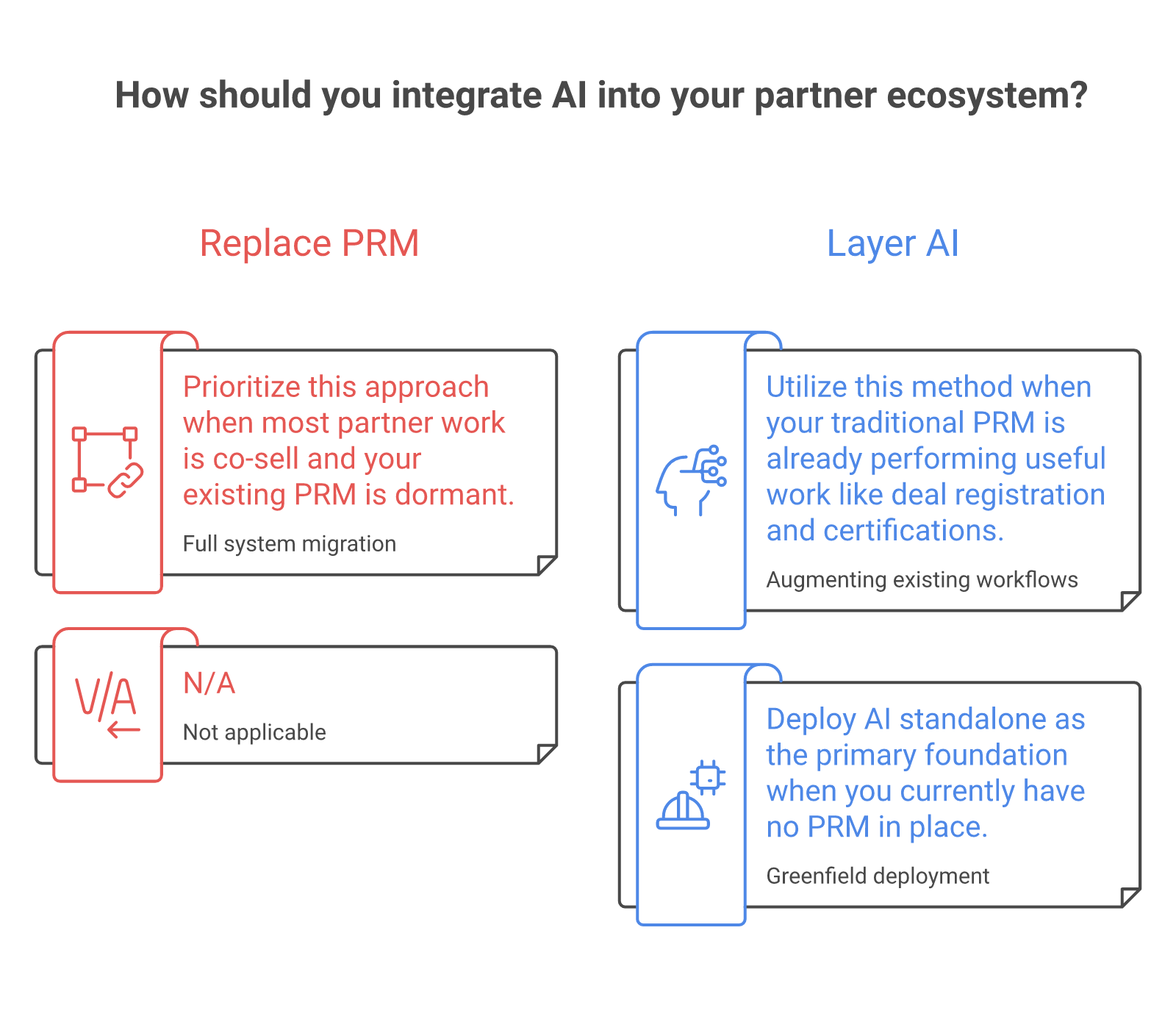
Depends on your dominant motion. Co-sell with technology partners on Salesforce or HubSpot → AI-native PRM (Introw or Euler) usually wins. Enterprise channel program with VARs, distributors, MSPs → traditional enterprise PRM (Impartner) is still the better fit. Multi-program affiliate plus referral → PartnerStack network reach matters.
What does the right hybrid stack look like?
Account mapping platform (Crossbeam or PartnerTap) for the data layer, plus PRM (AI-native or traditional based on motion type) for structured program functions, plus AI-native co-sell orchestration (Forecastable) for the operational motion layer. The three layers integrate around the CRM as source of truth.
Can an AI-native PRM replace an account mapping platform?
Partially. Introw integrates with Crossbeam for overlap data. Euler does some lightweight account mapping inside its own product. For deep account mapping (multi-partner, real-time, network-wide), purpose-built platforms (Crossbeam, PartnerTap) still win.
How does Forecastable approach AI vs PRM?
Forecastable is AI-native and focuses on the operational and orchestration layer of co-sell motions. We work with traditional PRMs (Impartner, PartnerStack, ZINFI), AI-native PRMs (Introw, Euler), and account-mapping platforms (Crossbeam, PartnerTap). Each tool focuses on what it does best.
Forecastable is an independent third-party professional services company. Our evaluations of other vendors are based on publicly-available information as of May 2026 and our own client experience.
Forecastable turns scattered partner relationships into predictable, forecastable pipeline. See the platform or start your growth journey.
Uncover Your Growth Potential
Schedule a Discovery Call