


 Alex Buckles
Partner Success Plans and Relationship Maps: The Accountability Layer Partner Programs Are Missing

Short answer: A partner success plan is a mutual action plan for one partner. It sets goals, milestones and tasks, with an owner and a date on both sides. A relationship map is an org chart of that partner, showing who supports you, who doesn’t, and where new relationships need activating. Together they’re the accountability layer most partner programs are missing. And because each partner’s goals roll up to company goals, they let you forecast partner pipeline instead of hoping for it.
Why partner programs lack accountability
Most partner leaders I talk to don’t have a partner problem. They have a control problem.
They can’t say, month by month, how many sales-qualified opportunities (SQOs) each partner will bring. So they can’t forecast, and they’re not in control. An SQO is an opportunity your sales team has accepted as real pipeline.
The cause is almost always the same. Action items float without dates, so they become perpetual and lose urgency. Nobody is sure who owns what between you and the partner. And the plan, if there is one, was written once and never opened again.
A partner success plan fixes the first two. A relationship map fixes what comes next: knowing who at the partner can make the plan happen.
What a partner success plan includes
Think of it as the mutual action plan you’d use on a big deal, applied to a partner. Every activated partner team should have one.
Goals, milestones and tasks
The structure is strict, because loose structure is how plans die:
- Goals are quantifiable: For example, 10 SQOs and 3 closed-won deals from one partner in a quarter.
- Milestones lead to goals: “Run a team presentation for the partner’s sellers” is a milestone, not a goal.
- Tasks make milestones happen: Each task has one owner, on one side, with one date.
That last rule matters most. If a task belongs to “both teams,” it belongs to nobody.
Owners on both sides
A partner success plan isn’t your plan about the partner. It’s a shared plan with the partner. So the partner’s people carry tasks and dates too, and they can see them.
When dates arrive, the plan should nudge the owner automatically. Then a person follows up on anything still open.
How partner plans roll up to company goals
Here’s the part most programs skip. Each partner’s goals should roll up into company goals. Each team member’s partner goals roll up into their personal goals.
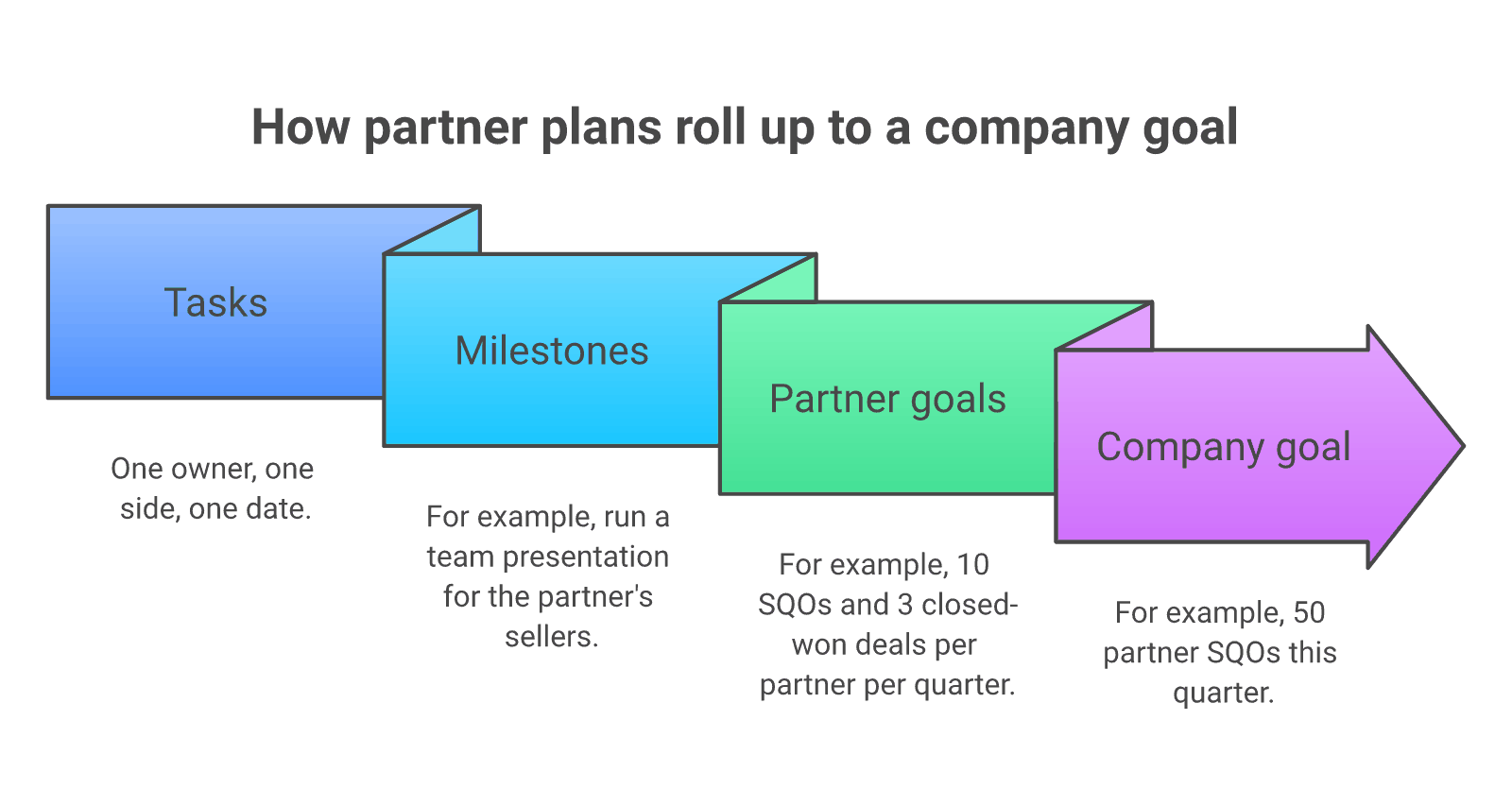
That roll-up is what turns plans into a forecast. Ask the question both ways: if we do everything in our partner plans, will we hit our company goals?
Find the gap before the quarter ends
Often the answer is no, and that’s fine, as long as you find out early. Picture a company goal of 50 SQOs from partners. If the partner plans only add up to 30, you’ll miss by 20. Now you know in week one, not week twelve.
So you either add partners, raise targets with the partners you have, or reset the company goal. Every option beats a surprise.
Start with one quarter
Don’t wait for a perfect metrics framework. Get company goals for one quarter, even roughly, so you bite off something you can chew. Then build the monthly habit: every month, each partner has targets, and they either hit them or they don’t.
What a relationship map shows
A relationship map is an org chart of a partner’s organization, seen through a partnerships lens. It shows where you have active relationships, who supports you, who works against you, and where new relationships need activating.
It works like the buying committee view a good seller keeps on an enterprise deal. When I work an enterprise deal, I always map the committee: who’s a supporter, who’s a detractor, where I have executive alignment, and who I still need to reach. A partner deserves the same view.
Supporters, detractors and gaps
A simple color code does most of the work:
- Green for supporters: People actively helping you at the partner.
- Red for detractors: People who block or slow you down.
- Blue for executive alignment: Senior leaders who back the relationship.
- No color for gaps: People who matter but haven’t been reached yet.
Where the map tells you to invest
The map isn’t decoration. It tells you where to spend time.
Leave the supporters who already produce alone. Instead, focus on contacts who came to a session but never sourced a deal. Turning them into producing supporters is the growth. So the measure that matters is net-new producers activated, not meetings held.
Coverage is a health signal too. If 10 people matter at a partner and three are activated, you know exactly where the work is.
Running the accountability layer every week
Plans and maps only work if someone runs them. That’s a weekly job, not a quarterly one.
A steady cadence
Hold weekly or biweekly check-ins on each active plan. Escalate when commitments slip. Then review each partner manager’s plans monthly, against targets.
A neutral party to do the chasing
Partner managers hate chasing partners, and partners hate being chased by them. It strains the relationship. So a neutral third party should do the follow-up. We play the “bad guy,” so the partner manager can stay the partner’s friend.
Maps and plans that update themselves
Nobody keeps these documents current by hand. So relationship maps should fill in from real engagement: email, calendar, Slack and call recorders. And plan progress should update from the CRM, not from someone typing actuals into a spreadsheet.
That’s also what makes reporting fast. Instead of hours of business-review prep, you get a monthly read like “behind plan on three of seven partners, two overperforming.”
Common mistakes with partner success plans
I see the same mistakes again and again:
- Writing it once: A plan is a living document. If nobody opened it this month, it’s already stale.
- Calling milestones goals: “Host a training” isn’t a goal. Pipeline is.
- Mapping only your champion: One friend at a partner is a single point of failure. Map the whole team.
Partner programs at every stage use these tools. If you want the outside view, PartnerStack’s guide to enterprise partnership KPIs is a useful reference. And Partnership Mastermind on partner QBRs that move pipeline covers how to use the plan in a business review.
How Forecastable runs the accountability layer
At Forecastable, we deliver partner-sourced pipeline as a service. We build your partner program and run it with you or for you, and we’re measured on pipeline and revenue.
In Accelerate My Partner Program, partner success plans and relationship maps are the backbone. Partner-level goals roll up to company goals in our platform. Goals, milestones and tasks live together per partner. And our team does the follow-up, so both sides do what they said they would.
You never have to log in if you don’t want to. Everything can run through AI apps like Claude via our MCP, while our team manages the platform. There are no seats to buy and no PRM required. Co-sell automation is included, running on your Crossbeam data and your own AI tools. Partners can fund or co-fund the program through MDF, so it can cost you $0. See how it works on the Accelerate My Partner Program page.
FAQ
What is a partner success plan?
A partner success plan is a mutual action plan for one partner. It sets quantifiable goals, the milestones and tasks that lead to them, and an owner and date for each task on both sides.
What is a partner relationship map?
It’s an org chart of a partner’s organization that shows supporters, detractors, executive alignment and gaps, so you know where to invest.
How often should partner success plans be reviewed?
Check active plans weekly or biweekly, review each partner manager’s plans monthly, and reset targets each quarter.
How do partner goals roll up to company goals?
Each partner’s goals add up to a company total. Comparing that total with the company goal shows any gap early, so you can act before the quarter ends.
Who should chase partner commitments?
Ideally a neutral third party. It keeps the partner manager’s relationship clean while commitments still get followed up.
The bottom line
Partner programs don’t fail for lack of partners. They fail for lack of accountability. Give every active partner a plan with owners and dates, map the people who can make it happen, and roll it all up to the number you’ve promised. Then you’re forecasting, not hoping.
Book a Program Fit Analysis to see what an accountability layer would look like for your partners →
Related reading:
Uncover Your Growth Potential
Schedule a Discovery Call


