Appointment Setting Services Through Your Partners: B2B Meetings That Count

Short answer: Most appointment setting services book cold meetings in your name. Forecastable books B2B meetings through your partners instead. We run partner GTM motions where our SDRs call as the partner, under the partner’s name and with its approval. So the meeting lands with a trusted introduction, and it counts as partner-sourced. That’s the honest difference. We aren’t a generic cold-calling shop. If you only want cold meetings in your own name, a traditional agency is the better fit.
What are appointment setting services?
Appointment setting services book sales meetings with target buyers for your account executives. The provider builds a list, runs outreach by email, phone and LinkedIn, qualifies lightly and puts meetings on your calendar. You add booking capacity without hiring and ramping a team.
Quality ranges widely, though. Some providers book qualified meetings into accounts that fit. Others are meeting mills paid per booking. They fill your calendar with anyone who’ll say yes. Pricing models vary: a monthly retainer, a fee per meeting, or a mix of the two. So the name on the contract tells you little. Instead, the pricing model and the qualification standard tell you almost everything.
Why is B2B appointment setting harder in 2026?
Buyers are hard to reach, and they’re rarely in market. Research from Professor John Dawes at the Ehrenberg-Bass Institute found only about 5% of B2B buyers are in market right now. The other 95% won’t buy for months or even years.
And when they do buy, you’re barely in the room. According to Gartner’s B2B buying journey research, buyers spend only 17% of their buying time meeting potential suppliers. And a complex buying group has six to 10 decision makers. As I put it earlier this year, the other 83% is shaped by people like consultants, advisors and integrators.
Meanwhile, budgets changed. After the 2023 bank collapse, companies couldn’t keep spending endless money on pipeline. Now cost per sale is what matters, so teams want cheaper deals from their partners. A cold call from a stranger has the opposite problem. Usually the timing is wrong, and the trust isn’t there yet.
What’s different about appointment setting through partners?
Your partners already have what cold outreach tries to buy: the buyer’s trust. In fact, they’re the consultants, advisors and integrators shaping that other 83%. The catch is that partners are typically bad at outbound, and few have the budget for top sales talent. That only changes when the partner program behind it is built to produce pipeline.
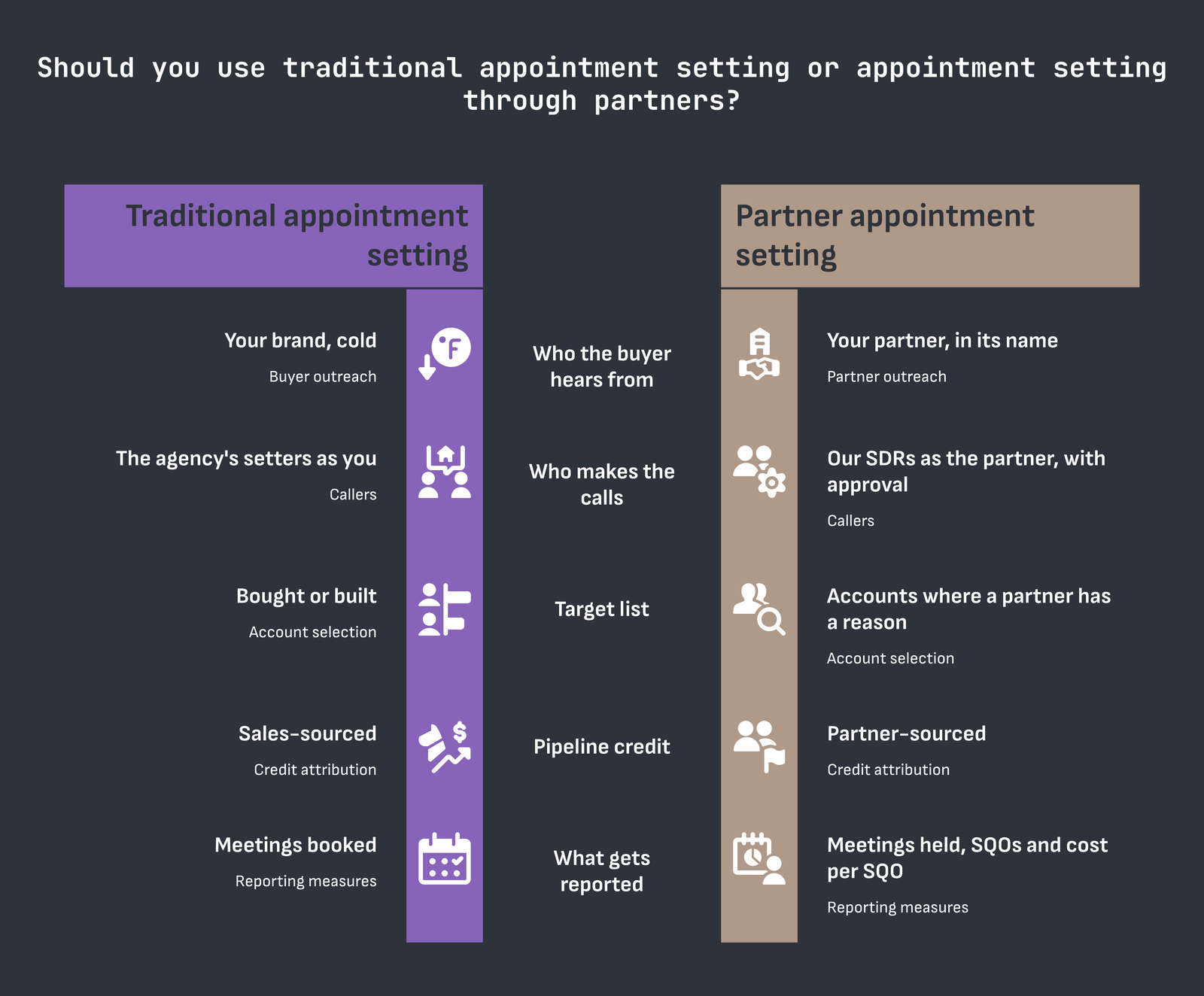
When that partner opens the door, the meeting starts with trust. So we run appointment setting as partner GTM motions. A GTM motion is a priced, workshopped campaign run with one partner or several, into accounts you both care about. Here’s how it compares:
| Traditional appointment setting service | Appointment setting through partners (Forecastable) | |
|---|---|---|
| Who the buyer hears from | Your brand, cold | Your partner, in its name, often alongside you |
| Who makes the calls | The agency’s setters, as you | Our SDRs, as the partner, with its approval |
| Target list | Bought or built from scratch | Accounts where a partner has a customer, a deal or a reason |
| Pipeline credit | Sales-sourced or marketing-sourced | Partner-sourced, per each platform’s attribution policy |
| Who often pays | Your sales budget | Often your partners, through MDF and co-funding |
| What gets reported | Often meetings booked | Meetings held, SQOs, pipeline and cost per SQO, by partner |
The rule that changes the math
Here’s the rule I give teams: if your SDR team books it, it isn’t partner-sourced. That’s true even when the target came from partner data. After all, your partner didn’t open the door, so most programs won’t count it.
But run the same outreach with the partner, under the partner relationship, and it counts as partner-sourced. That’s the whole reason we call as the partner. If the terms are new, here’s how partner-sourced and partner-influenced pipeline differ.
How does partner appointment setting work?
Every motion follows the same path:
- Program-Fit Analysis. It’s a 30-minute call with a senior partnerships leader. We figure out which program fits, who needs to be involved and which partners could fund it. If nothing fits, we’ll tell you.
- Workshop. Next, we learn where you need to win, such as net-new logos, a vertical or a rip-and-replace. Then we pick the partners who should produce.
- Set the accounts. We pull a named list from partner overlap. Each account is one where the partner has a real reason to make the introduction.
- Write one joint story. It answers one question: why these two firms, for this buyer, right now?
- Run the outreach. Campaign operations specialists run email and LinkedIn as the partner. Meanwhile, a real human SDR, not AI, makes the cold calls.
- Book and hand off. Booked meetings go to whoever owns the deal, with the partner’s context attached. Then the partner registers the deal.
- Report every result. You see every send, reply and meeting as it happens.
Typically, a working motion is ready about two weeks after the workshop. It goes live in two to three weeks, depending on calendars. Then it runs for two full months.
Who actually books the meeting
Real people do the work. One SDR makes about 1,000 cold calls a month. When a program runs three to five motions, we prioritize which motions get calling, or add a second SDR for more calls. By default, each contact gets one call plus a live voicemail. Priority contacts get up to five tries. Replies and follow-up are handled by people, never AI agents. Here’s how our outsourced SDRs fit into a program and how their month runs.
Also, sends can go out as you, the partner, both, or a group of partners. They go from each sender’s own domain, or from warmed domains we buy. Eva, our AI partner ops agent, watches the data in the background. You see everything through the Forecastable MCP in the AI tools you already use.
When is Forecastable the wrong appointment setting service?
I’d rather tell you now than after you sign. We’re not a fit for every meeting-booking need. Hire a traditional appointment setting agency instead if any of these are true:
- You want cold meetings in your own name. We run motions with partners. Without a partner in the motion, we don’t book the meeting.
- You have no B2B partners yet. We work only with B2B partners, such as resellers, VARs, distributors, OEMs, technology and ISV partners, agencies and consultancies, SIs, GSIs and other implementation partners, MSPs, hyperscalers, and the list goes on. If that list is empty today, start there.
- You want affiliate, influencer or ambassador programs. Those are out of our scope.
- Your value story isn’t proven. Use us to scale what already works through partners. We’re not the place to test a brand-new pitch.
Here’s how we compare with an outbound agency in more detail. For a wider partner-led program, see our demand generation agency built on partners.
How should you measure appointment setting services?
Measure them on pipeline, not activity, because a booked meeting is a promise. By contrast, a meeting held is a fact.
Here’s what we report for every motion, partner by partner:
- Meetings held and accepted, not just meetings booked.
- SQOs created from each motion.
- Pipeline by partner and by quarter.
- Cost per SQO, so every dollar competes on the same number.
Of those, the SQO is the number I trust most. After all, sales has reviewed it and logged it as a real opportunity, so it carries scrutiny a booked meeting doesn’t.
Watch out for pay-per-meeting pricing anywhere you buy. It rewards volume over fit, so the provider books anyone who says yes. That’s true of any provider, including us. So define a qualified meeting up front and hold everyone to it. Also ask where the email sends from. Cold email from your primary domain puts it at risk, so good providers buy and warm separate domains.
How much do appointment setting services through partners cost?
Our appointment setting runs inside the Partner-Sourced Pipeline program. It starts at $50,000 a quarter. That activates a dedicated team: a campaign operations specialist, one SDR and the platform, with Eva and full MCP access. It’s the floor, not a cap.
Here’s how the pricing breaks down:
| Item | Price |
|---|---|
| Partner-Sourced Pipeline program | From $50,000 a quarter |
| GTM motion (planning price) | About $12,500 each, so four fill the $50,000 |
| Second SDR | $10,000 a month |
| Enrichment | Always its own line |
We contract a quarter at a time, with no long-term lock-in. You can model it on our published pricing page.
Your partners can fund it
Partners fund programs, not tools. Ask a partner to pay for your software, and they’ll say no. But ask them to fund a motion that puts SQOs in front of their sellers, and the answer changes. So programs are often funded by partners through market development funds (MDF) or co-funding. Partners can cover all or part of a motion, so it could cost you $0. For the full picture, read our MDF guide.
Related reading
- B2B Appointment Setting Services: A Buyer’s Guide
- Outbound Lead Generation Services: A Buyer’s Guide
- Outsourced SDR Services: A Buyer’s Guide for 2026
- Professional Services in SaaS: A 2026 Playbook
- Sales Managers: Winning Partner-Involved Deals Through Situational Tag Teaming
Frequently asked questions
What are appointment setting services?
They’re providers that prospect target accounts, run outreach and book sales meetings for your closers. They add booking capacity without the time it takes to hire and ramp a team.
What is B2B appointment setting?
B2B appointment setting is booking qualified meetings between your sales team and business buyers. A setter opens the conversation, qualifies lightly and schedules the meeting an account executive runs.
Does a meeting booked by my own SDR count as partner-sourced?
Usually not. If your SDR team books it, it isn’t partner-sourced, even when the account came from partner data. Run it with the partner, under the partner relationship, and it counts.
Who answers when a buyer replies?
Real people on our campaign operations team, never AI agents. Replies reach the partner within minutes, and the partner registers the deal.
Are you a cold-calling agency?
No. We call inside partner GTM motions, into accounts where a partner has a reason to open the door. If you want cold meetings in your own name, a traditional agency is a better fit.
How fast can partner appointment setting start?
Typically, a working motion is ready about two weeks after the workshop. It goes live in two to three weeks, depending on calendars, then runs for two full months.
Do I need a PRM or new software?
No. We run with or without a PRM. You don’t log into anything new, and you see everything through the Forecastable MCP in Claude, ChatGPT or Microsoft 365 Copilot.
Which partners do you book meetings through?
Only B2B partners: resellers, VARs, distributors, OEMs, technology and ISV partners, agencies and consultancies, SIs, GSIs and other implementation partners, MSPs, hyperscalers, and the list goes on.
What’s the bottom line?
Cold appointment setting services fill calendars. Partner appointment setting fills pipeline that counts as partner-sourced. As a B2B partnerships agency, we book meetings through the partners your buyers already trust. And when that isn’t the right fit, we’ll say so.
Want meetings that count as partner-sourced? Book a Program-Fit Analysis
Uncover Your Growth Potential
Schedule a Discovery Call