Outsourced SDR Services: A Buyer’s Guide for 2026

Short answer
Short answer: Outsourced SDR services are third-party firms that run sales development on your behalf, supplying the people, tooling, and process to book meetings and hand qualified opportunities to your closers. They can genuinely accelerate a thin pipeline, and they can just as easily fill it with meetings that never convert, so the model you buy matters more than the logo.
Here is the position. Outsourcing the SDR function is a reasonable decision for a specific set of situations, and the pricing model you choose quietly decides whether you get pipeline or theater.
What are outsourced SDR services?
Outsourced SDR services hand the sales development function, the top-of-pipeline work of prospecting and booking meetings, to an outside provider. The provider typically supplies trained reps, a sending and dialing stack, a data source, and a managed process, then books meetings or qualified opportunities into your calendar and CRM.
The reason teams consider them is capacity and speed. Hiring, ramping, and managing SDRs in-house takes months and real management attention. A provider promises a running motion in weeks. The catch is that they are renting you a function that only works when the targeting, messaging, and qualification bar are tight, and those are the parts a provider has the least incentive to get right if they are paid by volume.
Why outsourced SDR services matter in 2026
Outsourced SDR services matter in 2026 because outbound got harder and more expensive at the same time budgets tightened. Building an in-house SDR team is a large fixed cost with a long ramp, and a lot of leaders would rather rent the capability than carry it. That demand created a crowded provider market with wildly different quality.
The stakes rose because the easy version of this service, pay per meeting, aligns the provider against you. A provider paid per booked meeting is paid to book meetings, not to book the right ones, and the gap between those two is where buyers waste a quarter of closer time on prospects who were never going to buy. Knowing how the models differ is now the difference between buying pipeline and buying activity.
How to evaluate outsourced SDR services
Evaluating outsourced SDR services works as a sequence, where you settle the economic model before you ever look at a logo.
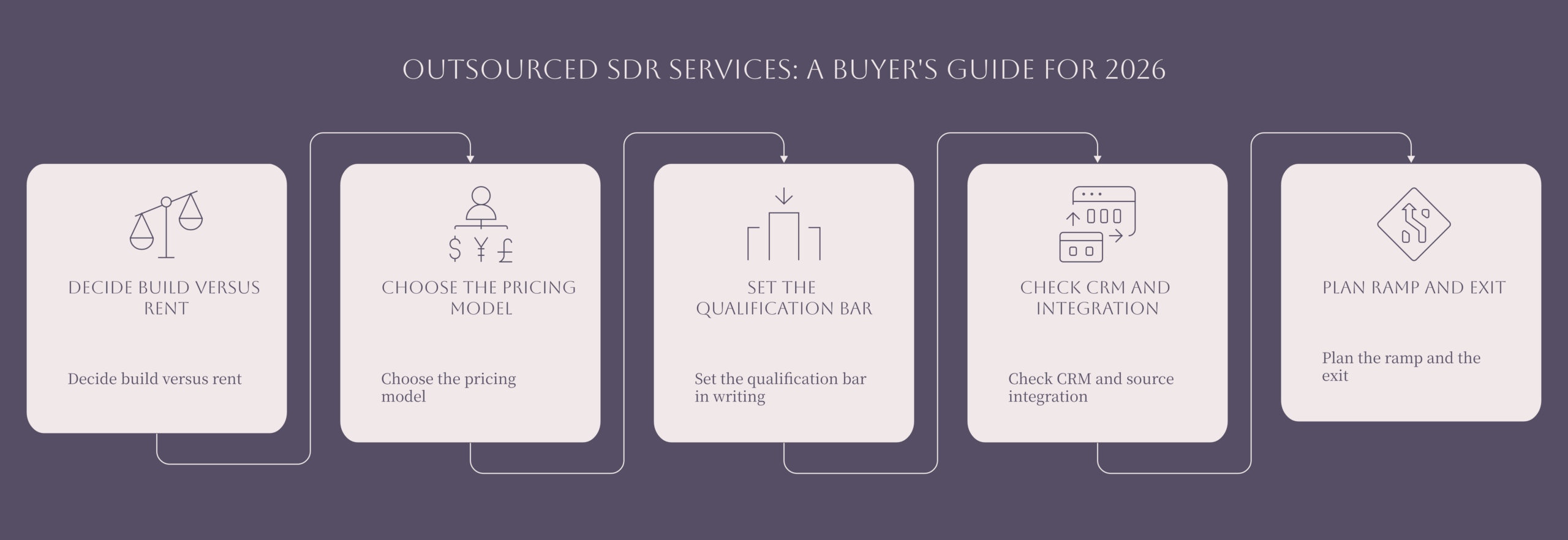
- Decide build versus rent: confirm outsourcing fits your situation, because a new market test or a capacity gap suits a provider, while a core, repeatable motion usually belongs in-house where the learning compounds.
- Choose the pricing model: pick the model before the vendor, since pay-per-meeting rewards volume, retainer rewards effort, and a hybrid tied to qualified opportunities is the only one that rewards the outcome you actually want.
- Set the qualification bar in writing: define what counts as a qualified meeting in the contract, because an undefined bar means the provider gets to define it, and they will define it low.
- Check CRM and source integration: require that every meeting and its source land in your CRM, so you can measure the provider the same way you measure every other channel.
- Plan the ramp and the exit: agree on how long before results are fair to judge and how you take the motion back, because a provider you cannot leave is one you cannot hold accountable.
The through-line is that the economics come first. A provider paid for qualified pipeline is an ally; a provider paid per meeting is optimizing a number you do not care about.
How the pricing models compare
| Model | What you pay for | What it rewards | Best when |
|---|---|---|---|
| Pay per meeting | Each booked meeting | Volume of meetings, regardless of fit | You can tightly define and enforce qualification |
| Monthly retainer | A team’s time and effort | Activity and coverage | You own targeting and want control of the motion |
| Qualified-opportunity or hybrid | Meetings that become real pipeline | The outcome you actually want | You can agree on a shared qualified-opportunity definition |
Common pitfalls
- Buying pay-per-meeting with a loose bar: paying for booked meetings without a written qualification standard, which guarantees volume and wastes closer time.
- Skipping the source data: letting meetings arrive without a channel tag, so you cannot compare the provider against inbound or partner-sourced pipeline.
- Renting a core motion: outsourcing the repeatable heart of your pipeline where the learning should compound in-house.
- No exit plan: signing without a way to take the motion back, which removes your ability to hold quality accountable.
- Overlooking the warm channel: paying to generate cold meetings while never mining the warm introductions your existing partners could make for free.
What this looks like in practice
A team rents an outsourced SDR provider on a pay-per-meeting deal to fill a thin quarter. Meetings arrive on schedule and the top of the pipeline looks full. Three months later the closers push back: the meetings are with people who fit the firmographics but have no budget and no project, and win rate on them sits near 5 percent. The team renegotiates to a qualified-opportunity model with a written bar, and meeting volume drops by half while pipeline that actually converts rises. In parallel they audit their partner relationships and find that a handful of existing partners could introduce them to warmer accounts than the provider ever cold-booked. The provider was not useless; the pay-per-meeting model had simply pointed it at the wrong target.
That is the difference between renting activity and renting pipeline. The provider did what it was paid to do; changing what it was paid for changed what the team got.
Forecastable’s POV
Outsourced SDR services are a fair tool for a narrow set of jobs: testing a new segment, covering a capacity gap, or buying time while you build. They are a poor substitute for owning a core motion, and the pay-per-meeting model that dominates the market is designed to sell you the one thing you should not buy, which is meetings decoupled from outcomes.
Before renting cold capacity, I would look at the warm capacity you already have and ignore. Most teams have partners whose relationships overlap their target accounts, and a partner introduction outconverts a cold booked meeting by a wide margin. At Forecastable we are a partnerships operating platform that connects partner conversations and actions to CRM pipeline and revenue, so the warm paths your partners can open are visible and measurable, and partner-sourced meetings sit in the same pipeline metrics as anything an SDR provider books.
My bet: the teams that define the qualified-opportunity bar in writing and mine their partner relationships first buy far less outsourced SDR capacity than they think they need.
Forecastable is an independent third-party. Any tools, vendors, or third-party figures referenced here are described from public information for the reader’s own evaluation, not as paid placements.
Frequently asked questions
What are outsourced SDR services? They are third-party firms that run your sales development function, supplying reps, tooling, data, and process to prospect and book qualified meetings for your closers. You rent the top-of-pipeline motion rather than building it in-house.
How much do outsourced SDR services cost? Pricing runs on three models: pay per meeting, a monthly retainer for a team, or a qualified-opportunity or hybrid model. The headline price matters less than what it rewards, since pay-per-meeting optimizes volume and hybrid models optimize pipeline.
Is the pay-per-meeting model a good idea? Only when you can define and enforce a tight qualification bar in writing. Otherwise the provider is paid to book meetings regardless of fit, and you spend closer time on prospects who will not buy.
When should I outsource SDRs versus hire? Outsource to test a new segment or cover a capacity gap, where speed matters and the learning does not need to compound. Hire when the motion is core and repeatable, because that learning belongs in-house.
How do I measure an outsourced SDR provider? Require every meeting and its source to land in your CRM, then measure the provider on qualified opportunities and win rate, the same way you measure inbound and partner-sourced pipeline.
What is a cheaper alternative to outsourced SDRs? Mining the warm introductions your existing partners can make. A partner-sourced meeting usually converts several times better than a cold booked one and costs far less to generate.
Next step
Before you sign a provider, write down your qualified-opportunity definition and your exit terms. If a vendor resists putting either in the contract, that tells you what the relationship will be.
Then check the warm capacity you already own. Start your growth journey with Forecastable and we will surface the partner introductions hiding in your target accounts. Our B2B outbound sales guide covers the broader motion, and the partner-sourced pipeline guide covers the warm channel most teams leave on the table.
Uncover Your Growth Potential
Schedule a Discovery Call