Partnership Pipeline Forecasting: Make Partners Predictable

Short answer
Short answer: Partnership pipeline forecasting is the practice of predicting the revenue your partner channel will produce in a period, using the same stage, conversion, and velocity discipline you apply to direct sales. Done right, it turns partner-sourced pipeline from a hopeful line item into a number a leader can commit to the board.
Here is the position. Most companies forecast direct pipeline rigorously and treat partner pipeline as a pleasant surprise. The partner channel is forecastable; it is just rarely instrumented well enough to forecast.
What is partnership pipeline forecasting?
Partnership pipeline forecasting is the application of normal forecasting mechanics to partner-sourced and partner-influenced opportunities. It answers how much partner-driven revenue will close this quarter, with what confidence, by reading the partner pipeline through stages, historical conversion by partner and deal type, and velocity, exactly as a sales leader reads direct pipeline.
The reason it is treated as different is data, not nature. A partner deal moves through stages and converts at a rate you can measure, the same as any deal. What makes it feel unpredictable is that the partner origin is usually lost in the CRM, the stages are tracked loosely, and the conversion history is never assembled, so the channel looks random when it is simply unmeasured.
Why partnership pipeline forecasting matters in 2026
Partnership pipeline forecasting matters because partner-sourced revenue became too large to leave out of the forecast and too unmeasured to put in it with confidence. As the partner channel grows into a meaningful share of pipeline, a forecast that excludes it understates the business and a forecast that includes it as a guess undermines trust in the whole number.
The second reason is accountability. Partnerships teams are increasingly asked to carry a number, and you cannot own a number you cannot forecast. A partnerships leader who can produce a committed partner-sourced forecast, with bands and assumptions, earns a seat in the revenue conversation. One who can only report what already closed stays a cost center.
In my work with revenue teams, the moment the partner channel becomes credible to a CRO is the moment it gets forecast like everything else, with a commit, a best case, and a stated set of assumptions, rather than described as relationships that sometimes produce deals.
How partnership pipeline forecasting actually works
Partnership pipeline forecasting works by giving the partner channel the same forecasting backbone as direct sales, where each step converts relationship activity into a defensible number.
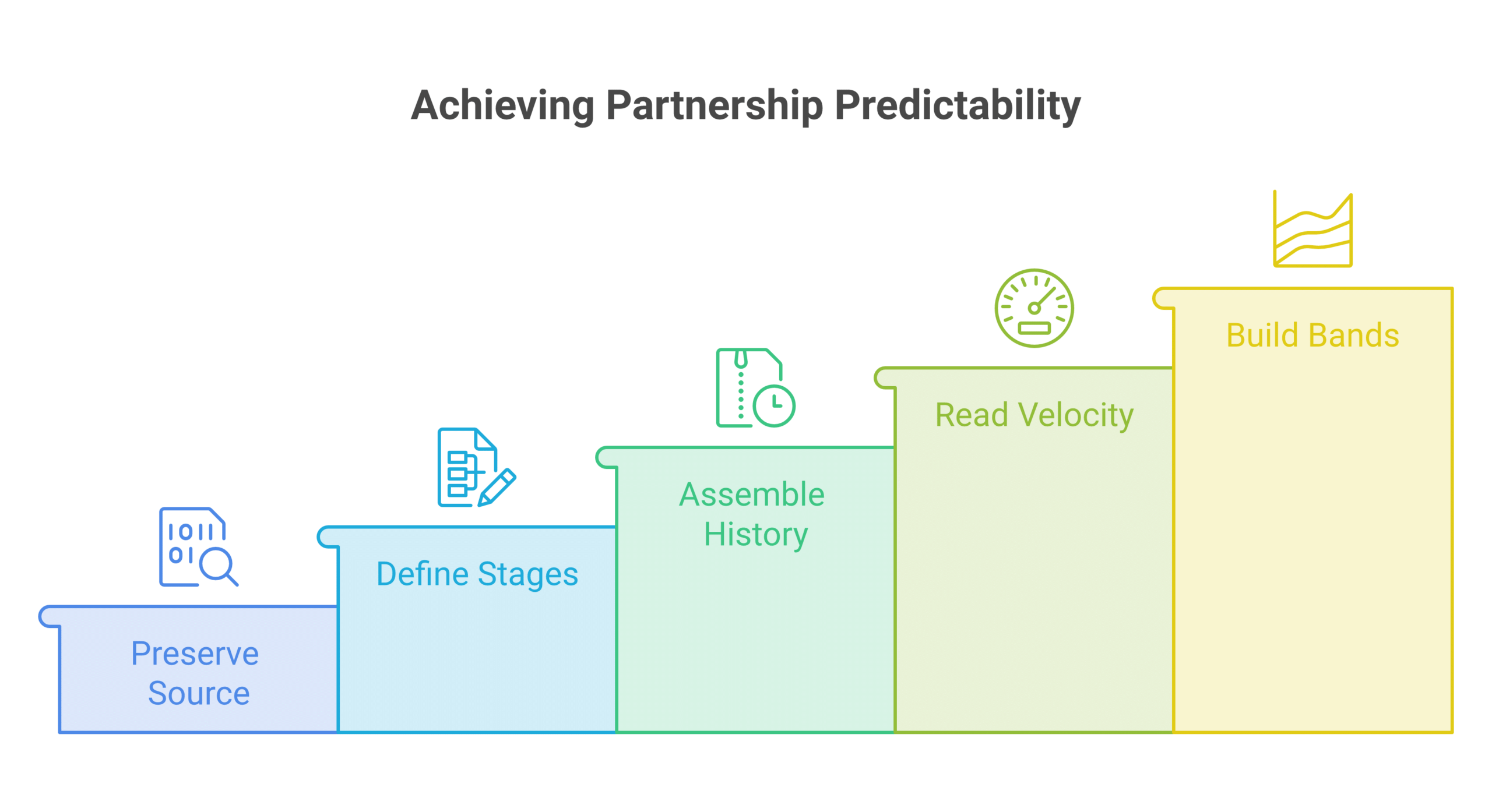
- Preserve the source: tag every opportunity to its partner origin and keep it tagged through the deal, because a forecast of a channel whose deals are mislabeled as direct is a forecast of nothing, and this is where most partner forecasting fails before it starts.
- Define partner-level stages: track partner deals through clear stages from introduction to close, since a forecast needs a pipeline with structure, and partner deals logged as a loose pile of maybes cannot be weighted.
- Assemble conversion history: measure how often partner deals convert at each stage, split by partner and deal type, because the conversion rates are the probabilities that turn open pipeline into a forecast and they differ sharply by partner.
- Read velocity: track how long partner deals take to move, as cycle time sets when the pipeline will land and flags the stalled deals that inflate the raw total without ever closing in the period.
- Build confidence bands: roll the stage-weighted, conversion-weighted partner pipeline into commit, best-case, and worst-case numbers with stated assumptions, so the partner forecast carries the same rigor and credibility as the direct one.
The through-line is that nothing here is special to partnerships. It is ordinary forecasting discipline applied to a channel that rarely receives it, and the reason the channel seems unpredictable is that the discipline, starting with preserving the source, was never applied.
Common pitfalls
- Lost source data: letting the CRM overwrite the partner origin with the last rep activity, which makes the channel unforecastable because its deals are no longer identifiable.
- No partner stages: tracking partner deals as a loose list instead of a staged pipeline, so there is nothing to weight and the forecast collapses into a guess.
- One blended conversion rate: applying a single conversion assumption across all partners when a strategic partner and a marginal one convert completely differently, which produces a confident and wrong number.
- Forecasting on relationships, not deals: predicting partner revenue from how good the relationships feel rather than from staged pipeline and conversion history, which is how partner forecasts miss in both directions.
- Excluding the channel entirely: leaving partner pipeline out of the forecast because it is hard to measure, which understates the business and tells the partnerships team its work does not count toward the number.
What this looks like in practice
A partnerships leader is asked, for the first time, to commit a partner-sourced number for the quarter. The instinct is to estimate from relationship health. Instead they build it properly. They pull every opportunity tagged to a partner, confirm the tags survived, and lay the deals out by stage. They apply conversion rates measured per partner, because the strategic partner converts at 40 percent and a newer one at 12 percent, and a blended rate would have been wrong for both. They apply cycle time to see what lands this quarter versus next. The result is a commit number, a best case, and the assumptions behind each.
When the CRO pressure-tests it, the forecast holds, because every number traces to staged pipeline and measured conversion rather than optimism. The partner channel stops being the line nobody trusts and becomes a forecast the leader can defend, which is the moment it starts getting resourced like a real channel.
Forecastable’s POV
The partner channel is not inherently less predictable than direct sales; it is less instrumented, and the two get confused constantly. Every ingredient a forecast needs, staged pipeline, conversion history, velocity, exists for partner deals as much as for direct ones. The reason partner forecasting feels like fortune-telling is that companies lose the source data at the first rep touch and never assemble the conversion history, so there is nothing to forecast from.
This is the problem we care most about, because forecasting is where the partner channel earns its standing. A partnerships team that can forecast its pipeline can carry a number, sit in the revenue meeting, and defend its budget. The prerequisite is instrumentation: the partner origin preserved end to end and the pipeline staged and measured. At Forecastable we are a partnerships operating platform that connects partner conversations and actions to CRM pipeline and revenue, so partner-sourced pipeline is staged, measured, and forecastable with the same rigor as direct sales.
My bet: the partnerships teams that forecast their pipeline like a real channel, with commit bands and stated assumptions, are the ones that stop being treated as a cost center and start being resourced like the revenue engine they are.
Forecastable is an independent third-party. Any tools, vendors, or third-party figures referenced here are described from public information for the reader’s own evaluation, not as paid placements.
Frequently asked questions
What is partnership pipeline forecasting? It is predicting the revenue the partner channel will produce in a period using the same stage, conversion, and velocity discipline applied to direct sales. It turns partner-sourced pipeline from a hopeful estimate into a committed number with stated confidence.
Why is partner pipeline hard to forecast? Because the partner origin is usually lost in the CRM, partner deals are tracked loosely, and conversion history is never assembled. The channel is not inherently unpredictable; it is unmeasured, and those are different problems with the same appearance.
How do you forecast partner-sourced revenue? Preserve the partner source tag, stage the partner pipeline, measure conversion by partner and deal type, apply velocity, and roll it into commit and best-case bands with explicit assumptions. It is ordinary forecasting discipline applied to a channel that rarely gets it.
Should partner pipeline be in the company forecast? Yes, once it is instrumented. Excluding it understates the business and sidelines the partnerships team, while including it as a guess undermines the whole forecast. The answer is to measure it well enough to include it with confidence.
Why use per-partner conversion rates? Because partners convert at sharply different rates; a strategic partner and a marginal one can differ several-fold. A single blended rate produces a number that is wrong for every partner, so conversion history has to be split by partner and deal type.
What does accurate partner forecasting change? It lets the partnerships team carry a number and defend it, which moves the function from cost center to accountable revenue channel. A leader who can commit a partner-sourced forecast earns a seat in the revenue conversation and the budget that comes with it.
Next step
Pull every partner-tagged opportunity this week, confirm the tags survived, stage them, and apply conversion rates split by partner. Produce a commit and a best case with the assumptions written down.
If the source tags are gone and you cannot assemble the history, that is the gap we close. Start your growth journey with Forecastable and we will make partner pipeline staged, measured, and forecastable. Our partner influenced pipeline guide covers how the channel compounds, and the partner attribution guide covers keeping the source honest.
Uncover Your Growth Potential
Schedule a Discovery Call