Outsourced SDR: A Buyer’s Guide to Getting It Right

Short answer
Short answer: An outsourced SDR is a sales development rep you contract from a provider instead of hiring in-house, to open conversations and book qualified meetings into your account executives’ calendars. It is the right call when you need coverage faster than you can hire, and the wrong call when the role is core to your motion and you need deep control of the message and the account knowledge.
Here is the position. Outsourcing the SDR role buys speed and flexibility. It costs you control and institutional knowledge, and whether that trade is worth it depends entirely on how central the opening motion is to your business.
What is an outsourced SDR?
An outsourced SDR is a sales development representative provided by an agency who works your top of funnel: researching accounts, running outreach across email, phone, and LinkedIn, and booking qualified meetings for your closers. The provider handles hiring, training, tooling, and management, and you get the output, meetings or qualified leads, without carrying the headcount.
The appeal is speed. Hiring, ramping, and managing an in-house SDR takes months, and an outsourced SDR can be producing in weeks. The cost is distance: a rented rep knows your product and your accounts less deeply than someone on your team, and the provider’s incentives may not match yours. Both things are true at once, and the buying decision is about which one dominates for your motion.
Why the outsourced SDR decision matters in 2026
The SDR role is under more pressure than it has been in years. Cold outreach is harder, response rates are down, and automated sequences have trained buyers to ignore generic messages. That raises the stakes on the outsourced SDR decision, because a provider still running high-volume, low-relevance outreach will burn your domain reputation and your target list at the same time.
The incentive question is sharper too. If the provider is paid on meetings, you get meetings, including the low-qualified ones. In my work with revenue teams, the outsourced SDR engagements that worked were the ones held to qualified pipeline and given a sharp, narrow list. The ones that failed were paid on activity and pointed at the whole market. The model you buy on determines what you get.
How an outsourced SDR engagement actually works
An outsourced SDR engagement works through a four-part motion from onboarding to booked, qualified meetings.
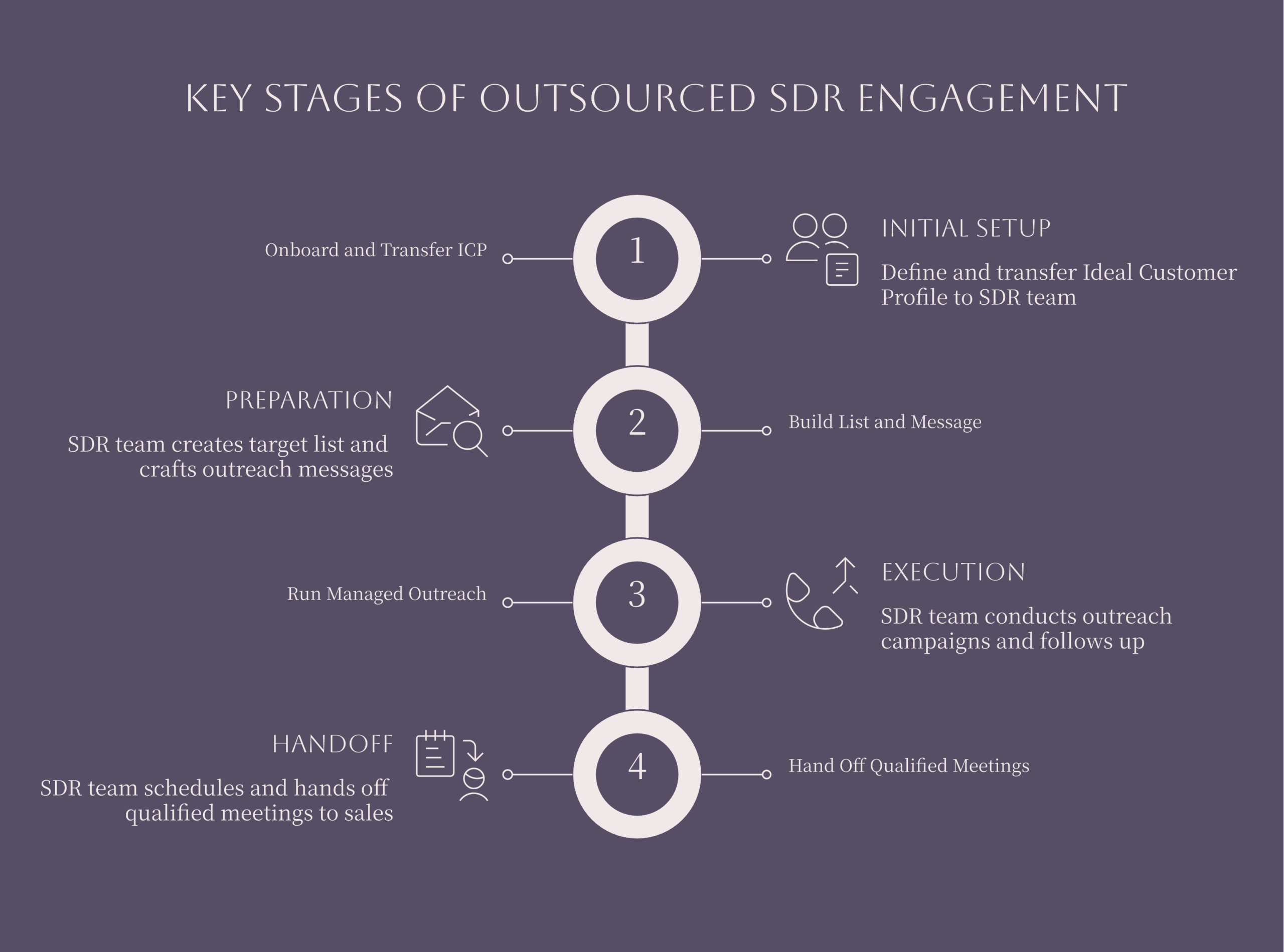
- Onboard and transfer the ICP: bring the provider up to speed on your product, profile, and disqualification rules, because a rented rep starts with none of your context. The quality of onboarding caps the quality of the output.
- Build the list and message: the provider assembles a profile-matched list and a message with a real reason to call, so outreach starts from fit rather than volume. A generic list makes the whole engagement generic.
- Run managed outreach: the SDR sequences email, phone, and LinkedIn under the provider’s management, with your qualification bar in place. The bar is yours to set and enforce.
- Hand off qualified meetings: the SDR books qualified meetings into your AEs’ calendars with notes and context, so your closers inherit pipeline, not names. The handoff quality is what your team feels.
The through-line is that onboarding and the qualification bar, both your responsibility, decide whether a rented rep produces pipeline or noise.
Common pitfalls
- Paying on activity or meetings: buying on calls made or meetings booked, which rewards volume and produces meetings your AEs will not keep.
- Thin onboarding: handing over a vague brief and expecting on-message outreach, when a rented rep can only reflect the context you gave.
- Outsourcing a core motion: renting the SDR role when opening conversations is central to your differentiation, so you lose the control that mattered.
- Ignoring domain and list health: letting a high-volume provider burn your sending reputation and exhaust your target list.
- Skipping the warm path: running cold through accounts where a partner could introduce you, instead of routing those through the warm channel.
Tools and examples
The real decision is usually among three ways to cover the opening motion. Compare them on control versus speed.
| Option | Best for | Watch for |
|---|---|---|
| In-house SDR hire | Deep product and account knowledge, full control | Months to hire and ramp; management overhead |
| Outsourced SDR provider | Fast coverage, flexible capacity | Less context and control; activity or per-meeting incentives |
| Partner-sourced introductions | Warmest meetings, highest conversion | Needs a managed partner motion; not a volume lever |
A quick worked example shows the trade. A company needs pipeline coverage now and hires an outsourced SDR provider paid per meeting. Meetings arrive, but AEs qualify few, because the rep lacks context and the incentive favors volume. The company fixes it by switching to a qualified-pipeline model, tightening onboarding, and routing its warmest target accounts through partner introductions instead of cold outreach. The outsourced SDR still covers breadth; the partner path covers the accounts where trust matters. Speed and quality both improve, because each channel is doing the job it is suited for.
Forecastable’s POV
Outsourcing the SDR role is a reasonable way to buy speed, as long as you buy on qualified pipeline and keep onboarding tight. The moment you pay on activity, you have optimized for the wrong thing, and no provider will save you from your own incentive design.
For the accounts that matter most, the warm introduction beats any rented rep, and it is the channel most teams never build. At Forecastable we are a partnerships operating platform that connects partner conversations and actions to CRM pipeline and revenue, so partner introductions become a tracked source of warm meetings alongside whatever outbound coverage you rent. Our Co-Sell Alignment Specialist is delivered as part of the service and uses the platform to run that warm path on your priority accounts.
My bet: the teams that use an outsourced SDR for breadth and a managed partner motion for the accounts that matter get better pipeline than the teams renting volume alone.
Forecastable is an independent third-party. Any tools, vendors, or third-party figures referenced here are described from public information for the reader’s own evaluation, not as paid placements.
Frequently asked questions
What does an outsourced SDR do? An outsourced SDR runs your top of funnel on contract, researching accounts, running outreach, and booking qualified meetings for your closers. The provider handles hiring, training, and management, and you get the output without the headcount.
Is an outsourced SDR cheaper than hiring one? Sometimes on paper, but the real comparison is cost per qualified meeting, not headcount cost. A cheaper rented rep that books low-qualified meetings can cost more per closed deal than an in-house hire who knows the product.
When should you outsource the SDR role? When you need coverage faster than you can hire, or you want flexible capacity without carrying headcount. Keep it in-house when the opening motion is core to your differentiation and needs deep product and account knowledge.
How do you measure an outsourced SDR provider? On qualified pipeline created, not calls made or meetings booked. Define a qualified meeting up front and report the provider on pipeline that progresses, so the incentive matches your outcome.
What is the alternative to an outsourced SDR? Hiring in-house for control, or running partner-sourced introductions for the warmest meetings. Many teams blend a rented SDR for breadth with a managed partner motion for the accounts where trust decides the deal.
Next step
If you are weighing an outsourced SDR, decide what the role is worth to you first. If opening conversations is core to how you win, keep control; if you need coverage fast, rent it, but buy on qualified pipeline.
For the accounts where trust decides the deal, build the warm path. Start your growth journey with Forecastable and we will run partner introductions as a tracked source. Our outbound sales guide covers the full motion, and our guide to outsourced sales development weighs building the function versus buying it.
Uncover Your Growth Potential
Schedule a Discovery Call