How to Reduce Cost Per Lead Without Buying Cheaper

Short answer
Short answer: How to reduce cost per lead comes down to four levers: sharpen targeting so you pay for fewer wasted impressions, lift conversion so the same spend yields more leads, retire the channels with weak unit economics, and grow the warm sources that cost little to begin with. Buying cheaper traffic is the one lever that usually backfires.
Here is the position. Most teams try to cut cost per lead by chasing cheaper clicks, which lowers lead quality and raises cost per customer. The durable way to reduce it is to make each dollar work harder, not to spend it on worse traffic.
What is cost per lead and why reduce it?
Cost per lead is a channel’s loaded spend divided by the leads it produced. Reducing it means getting more qualified leads from the same budget, or the same leads from less, without degrading what happens after the lead arrives. That last clause is the whole game, because it is easy to cut cost per lead and quietly wreck conversion at the same time.
The reason to reduce it is efficiency, but the reason to be careful is that cost per lead is a top-of-funnel number. Cut it the wrong way and you win the metric and lose the revenue. Cut it the right way and both cost per lead and cost per customer fall together.
Why reducing cost per lead matters in 2026
Reducing cost per lead matters because the inputs got more expensive. Ad auctions tightened, outbound reply rates fell, and the same campaign that worked two years ago now costs more to produce the same lead. Standing still means watching cost per lead drift up on its own.
The second reason is margin pressure. When budgets are flat and targets are not, the only way to hold pipeline is to make each marketing dollar more efficient. That forces a real question most teams avoid: which channels actually deserve the money, and which have been coasting on a cheap cost per lead while converting almost nobody.
In my work with revenue teams, the fastest, most durable reduction in blended cost per lead never comes from a cheaper ad buy. It comes from moving budget out of a low-converting cold channel and into a warm one that was already producing leads at a fraction of the cost and was never funded because nobody measured it.
How to reduce cost per lead actually works
Reducing cost per lead works through four levers applied in order, from the ones that protect quality to the one that ends the engine cheaper than it started.
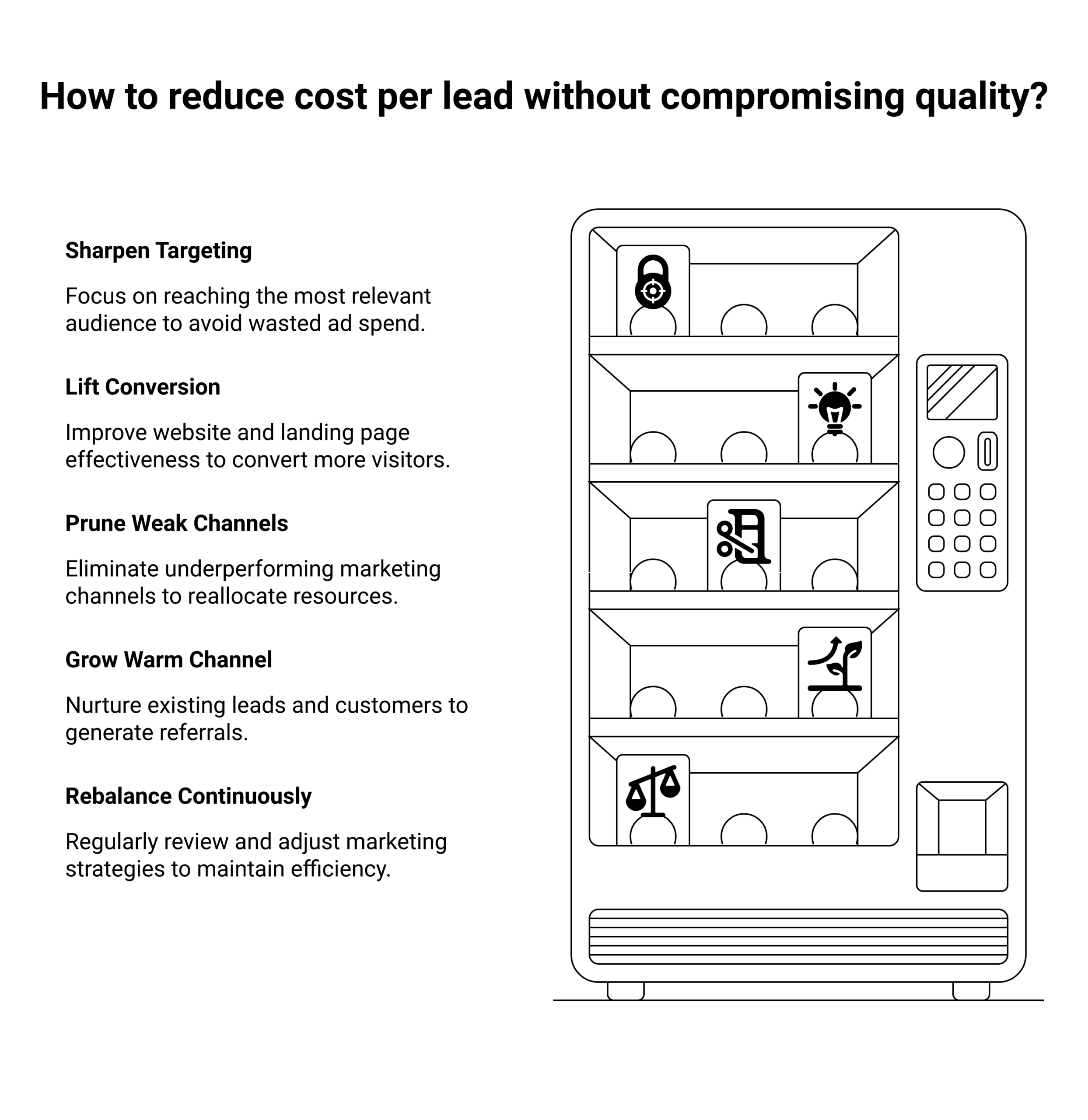
- Sharpen targeting: narrow audiences, exclusions, and messaging to fit the buyer, because paying to reach people who will never qualify is the largest hidden cost in most programs and the cheapest to fix.
- Lift conversion before buying traffic: improve the landing page, the offer, and the form so the same spend yields more leads, since a conversion gain lowers cost per lead without touching media budget or lead quality.
- Prune weak channels: cut the sources with poor cost per customer rather than the ones with high cost per lead, because the goal is efficient customers, and a channel with a high cost per lead that converts well may be your best one.
- Grow the warm channel: scale partner-sourced and referral leads, which arrive with trust and cost little to produce, so adding them to the mix pulls the blended cost per lead down while raising conversion at the same time.
- Rebalance continuously: review the channel mix each quarter and move budget toward the best cost-per-customer sources, because cost per lead creeps back up the moment the mix drifts toward cheap, low-converting volume again.
The through-line is sequence and restraint. The first two levers make existing spend work harder, the third removes the spend that was never working, and the fourth replaces expensive leads with warm ones. Cheaper traffic is not on the list, because it trades a lower cost per lead for a higher cost per customer every time.
Common pitfalls
- Chasing cheaper clicks: lowering cost per lead by buying lower-quality traffic, which cuts conversion and raises cost per customer while the top-line metric improves.
- Cutting the wrong channel: killing a channel for a high cost per lead when it has the best cost per customer, removing your most efficient source to flatter a surface metric.
- Ignoring conversion: pouring effort into media efficiency while the landing page and offer leak, so the biggest available gain sits untouched.
- Leaving the warm channel uncounted: running partner referrals without a source tag, so the cheapest leads you already get never factor into the blended number or the budget.
- Optimizing the metric, not the economics: treating a lower cost per lead as the win regardless of what happens downstream, which is how teams celebrate a number while their acquisition cost climbs.
What this looks like in practice
A growth lead is told to cut cost per lead by a quarter. The reflex is to shift budget to the cheapest-click channel, which would hit the target and tank conversion. Instead they work the levers. Tightening audience exclusions removes a chunk of wasted spend. A rebuilt landing page lifts form conversion by a third, which lowers cost per lead with no change in media. They cut one channel that looked cheap per lead and converted at under 1 percent. Then they fund a partner-sourced referral motion that produces leads at a fraction of the cost and converts at 30 percent.
Blended cost per lead falls by more than the target, and this time cost per customer falls with it, because none of the moves traded quality for a cheaper number. The team did not buy cheaper leads. It made the engine more efficient and added a warm source that was cheap all along.
Forecastable’s POV
The cost-per-lead problem is a channel-mix problem wearing a metric’s clothes. Teams try to solve it inside the paid channels, tuning bids and buying cheaper inventory, when the largest lever is the mix itself, specifically how much of the pipeline comes from warm sources versus cold. Cheap traffic will always look like the answer and almost never is.
Partner-sourced leads are the lever most teams never pull, because the leads arrive uncounted and a channel you cannot see is a channel you cannot grow on purpose. A partner introduction costs a fraction of a paid lead and converts several times higher, so every one of them pulls the blended cost per lead down and the conversion rate up. At Forecastable we are a partnerships operating platform that connects partner conversations and actions to CRM pipeline and revenue, so partner-sourced leads become measurable and fundable next to every paid channel.
My bet: the teams that reduce cost per lead by growing the warm channel, not by buying cheaper traffic, are the only ones whose cost per customer falls at the same time.
Forecastable is an independent third-party. Any tools, vendors, or third-party figures referenced here are described from public information for the reader’s own evaluation, not as paid placements.
Frequently asked questions
What is the fastest way to reduce cost per lead? Lift conversion on the traffic you already pay for by fixing targeting, the offer, and the landing page. A conversion gain lowers cost per lead immediately without touching media budget or degrading lead quality, which buying cheaper traffic cannot claim.
Does buying cheaper traffic lower cost per lead? It lowers the headline number and usually raises cost per customer, because cheaper traffic tends to be lower intent and converts worse. It optimizes the surface metric at the expense of the one that matters.
Which channels should I cut to reduce cost per lead? Cut the channels with the worst cost per customer, not the worst cost per lead. A channel can have a high cost per lead and still be your most efficient source of actual customers, so cutting on cost per lead alone can remove your best channel.
How does improving conversion reduce cost per lead? If the same spend produces more leads because a higher share of visitors convert, the cost divided by leads falls. Conversion improvements lower cost per lead and, unlike cheaper traffic, tend to lower cost per customer too.
How much can partner-sourced leads lower blended cost per lead? It depends on the mix, but because partner-sourced leads cost little to produce and convert high, every point of pipeline they add pulls the blended figure down. Teams that build the channel usually see both cost per lead and cost per customer improve together.
Why measure cost per customer while reducing cost per lead? Because it is the guardrail. Cost per customer tells you whether a cost-per-lead reduction was real efficiency or just cheaper, worse leads, and it is the only way to know you did not win the metric while losing the revenue.
Next step
Pick the two levers you have not pulled, usually conversion and the warm channel, and work them before you touch your media bids. Track cost per customer alongside cost per lead so you can prove the reduction was real.
If the warm channel you are missing is partner-sourced, that is the one we help you measure and grow. Start your growth journey with Forecastable and we will make partner-sourced leads fundable next to your paid channels. Our B2B cost per lead guide covers the metric itself, and the partner influenced pipeline guide covers how warm leads compound.
Uncover Your Growth Potential
Schedule a Discovery Call