Alex Buckles
How Your Partners Can Fund Your Partner Program (It Could Cost You $0)

Short answer: Your partners can fund your partner program, and most of them already have the money set aside. It comes from three places: market development funds (MDF), direct co-investment, and a cost split across every partner that benefits from the same GTM motion. When enough partners chip in, the program can cost you $0. But partners don’t fund software or vague plans. They fund programs that produce pipeline for them too.
Why the partnerships budget is the wrong place to look
Most partnerships leaders start by asking their own department for money. That’s the slowest path I know.
Very rarely does a partner program get funded from the partnerships budget. It usually comes from market development funds, because a partner program is a pipeline-generating activity. So the question isn’t “do we have budget?” The real question is “which pool is this sitting in, and who else benefits if it works?”
And the answer is almost never just you. When a GTM motion runs into shared target accounts, the partner wins deals too. If the partner wins, the partner should pay. That’s the whole idea.
If MDF is new to you, start with my primer on what market development funds are. The short version: the M stands for market, not marketing. So any partner activity that produces pipeline can qualify.
Three ways your partners can fund your partner program
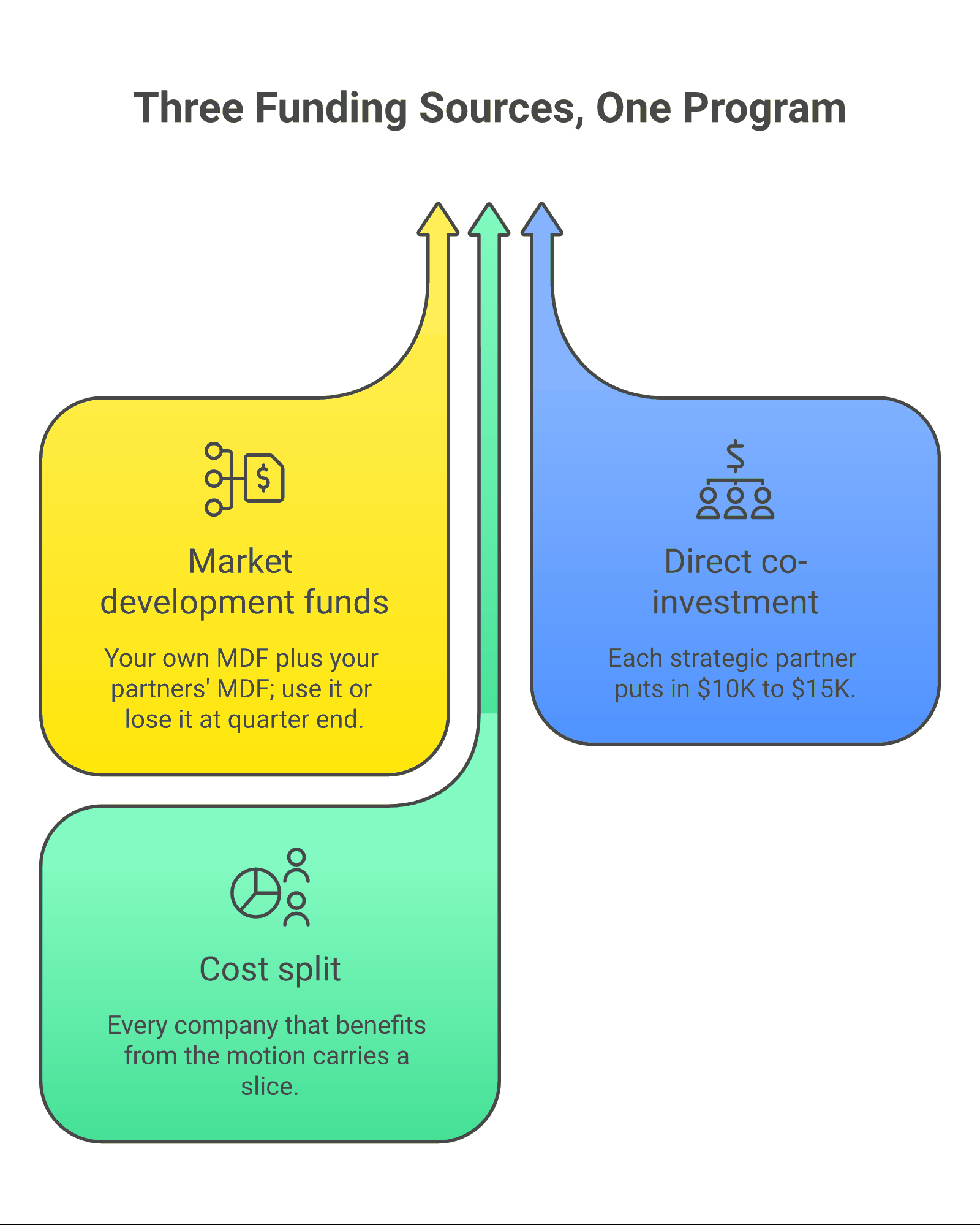
There are three funding sources. Most programs we build use at least two of them.
1. Market development funds (yours and theirs)
MDF is money a vendor sets aside to help partners create demand. Large platforms, hyperscalers and distributors usually carry more of it than they can use. AWS partner funding programs are a well-known example of how big vendors package it.
Look in two places:
- Your own MDF: It’s often owned by marketing or the CRO, not partnerships. In big companies it’s frequently a forgotten line item.
- Your partners’ MDF: Platforms and large partners often have funds tied to partner tiers or specific programs. Many split MDF with their own partners, sometimes 50-50.
Most MDF pools are use it or lose it. That’s why timing matters. At quarter end or year end, someone is always looking for a pipeline-producing place to put unspent funds.
2. Direct co-investment
Co-investment is simpler than it sounds. You go to a strategic partner and say, “We’re going to market in a new way. We want to invest in you, and we want you to co-invest in the GTM motion with us.”
For example, a common pattern is going to a GSI and a couple of favorite tech partners. Then you ask each to put in $10K to $15K so the investment isn’t all yours. Each ask is small. Together they fund real work.
3. A cost split across every beneficiary
The third source is the one most teams miss. When a GTM motion benefits several parties, every one of them should carry a slice.
So picture a motion that touches your company, a platform and two services partners. Each one chips in. Then you combine the funds into one tight program that produces for all of them. Everybody has skin in the game, and everybody wins on success.
This also removes an awkward internal conversation. You’re no longer asking leadership to fund an outside vendor. Instead, you’re showing them a program your partners are already paying into.
How a partner program can cost you $0
Here’s what $0 actually looks like. Most programs aren’t fully partner-funded on day one. But some are, and the path is repeatable.
- Start with the motions, not the money: Pick the GTM motions you’d run anyway, tied to your top priorities. Partners fund specific motions. They don’t fund a general wish to “do more with partners.”
- Name every party that benefits: For each motion, list the partners whose deals move if it works. Those are your funders.
- Make each ask a simple yes or no: “Could you contribute MDF to run this motion with us?” A small, clear ask gets a fast answer.
- Use a big name as the anchor: Most partners say yes to co-funding when a marquee brand is at the table. One strong anchor partner makes the next three yeses easier.
- Pool the contributions: Three partners at $10K to $15K each is real program cash. Add your own MDF and you can often run several motions without touching your operating budget.
Then let the results do the selling. When real pipeline starts showing up, everybody pays attention fast. That’s when you go back for more.
This is a live pattern, not a theory. One enterprise software company we work with had no budget until its next fiscal year. Instead of waiting, it asked its strategic partners to each chip in a small amount to fund the work now. The vendor didn’t front the cost alone.
What partners need before they’ll say yes
Partners aren’t charities. They fund what’s good for them. So the motion has to be built that way from the start.
A real “what’s in it for me” for the partner
Every GTM motion needs a strong answer to “what’s in it for me?” for every party. When a motion succeeds, everybody should win. If that’s not true, the motion wasn’t built properly.
In practice, we root this out in a short workshop with each partner. We validate the GTM motion, the target accounts and the price before they commit. And if the partner’s upside is thin, we add something to sweeten it. Partners never fill out forms or launch packets. The motion comes ready, and the only ask is a quick working session.
A program, not a technology purchase
Never pitch MDF as money for software. Partners won’t fund your tools. They will fund a program that produces pipeline.
So frame it the way they already judge spend. Every company runs funded programs with a known cost per qualified opportunity. If your partner program meets or beats that number, you’re a funded program, not a tech purchase. And funded programs move faster. I walked through that test in how to justify MDF on cost per SQO.
Proof it ran, and proof of what it produced
Partners want to see what their money did. That means sends, replies, meetings and sales-qualified opportunities (SQOs) they can see in real time. An SQO is an opportunity your sales team has accepted as real pipeline, not just a lead.
So reporting can’t be an afterthought. If you can’t show a partner exactly what their contribution produced, the second check never comes.
Where most teams get partner funding wrong
I see the same three mistakes again and again.
- Asking too early at the top: Don’t burn your executive relationship on the first ask. Save the big MDF conversation for after the first proof point.
- Funding one motion: A single motion is fragile. Priorities change, partner teams get laid off, and the motion dies. So we try to have as many irons in the fire as possible, ideally partner-funded.
- Wasting year-end MDF: Unspent funds usually go to dinners and swag. Instead, leftover MDF at month, quarter or year end can buy GTM credits, dollar for dollar. Those credits then fund motions later in the year.
How Forecastable runs partner-funded programs
At Forecastable, we deliver partner-sourced pipeline as a service. We build your partner program and run it with you or for you. And we’re measured on pipeline and revenue, not on activity.
Funding is part of the design, not an afterthought. While we scope your GTM motions, we also map who can fund them. That includes your MDF, your partners’ MDF, direct co-investment and a cost split across partners. Partners can join as collaborators and see their motion’s activity and results as they happen.
There’s no new tech to buy and no seats to license. You don’t need a PRM. Co-sell automation is included in every program, and it runs on your Crossbeam data and the AI tools you already own. Why pay for seats when you can pay for outcomes? See how programs are priced and funded on our pricing page.
Analysts see the same shift. Forrester on partner incentives beyond MDF describes partner funding moving from reimbursement toward strategic investment. A co-funded program is that shift in practice.
FAQ
Can partners fund my entire partner program?
Yes, sometimes. When several partners each co-fund the GTM motions they benefit from, the program can cost you $0. More often, partners cover part of it and your own MDF covers the rest.
What is partner co-investment?
Partner co-investment is when a partner puts its own money into a joint GTM motion. It usually comes from the partner’s MDF or field marketing budget, and it’s tied to specific motions and target accounts.
Will partners use MDF to pay for my software?
No, and you shouldn’t ask. Partners fund programs that produce pipeline. Position the spend as a funded program with a clear cost per SQO.
Who owns MDF inside my company?
Usually marketing, the CRO or a channel marketing leader, not the partnerships team. Find the person who owns it, because they can see how much is sitting unused.
What happens to unused MDF at year end?
In most companies it expires. With Forecastable, leftover MDF can buy GTM credits dollar for dollar, and those credits fund motions later.
The bottom line
Stop asking whether you have budget for a partner program. Start asking which partners win when it works, and how much each one will put in. Build the motions so everybody wins, prove the first one, and let your partners fund the rest.
Related reading:
Uncover Your Growth Potential
Schedule a Discovery Call