Post-Acquisition Cross-Sell: Live in the First 100 Days

Short answer: Post-acquisition cross-sell means selling the acquired company’s products to the acquirer’s customers, and the other way around. The window is short. Buyers pay attention while the acquisition is news, so the first GTM motion should be live within weeks, not quarters. Treat it like a co-sell between two sales teams and two partner ecosystems: map the shared accounts, set rules on who calls whom, and run it with tracking from day one. Done right, you’re in market within weeks, and you should plan on reporting pipeline at day 100.
Why the post-acquisition cross-sell window closes fast
When a deal closes, it comes with a promise of revenue synergies. Most of that promise is cross-sell. And most companies miss it.
McKinsey’s research on capturing cross-selling synergies in M&A found that most acquirers fall short of their cross-sell targets. It also found that early progress builds momentum. That matches what I see.
The best moment to cross-sell is while the press release is still hot. Customers on both sides are curious. They’re asking what the deal means for them. That window lasts weeks, not quarters.
So post-acquisition cross-sell should jump the queue. It’s leadership-driven, it’s time-boxed, and it beats steady-state work like competitive displacement for attention. If you wait for systems integration to finish, the curiosity is gone.
Treat the two sales teams like co-sell partners
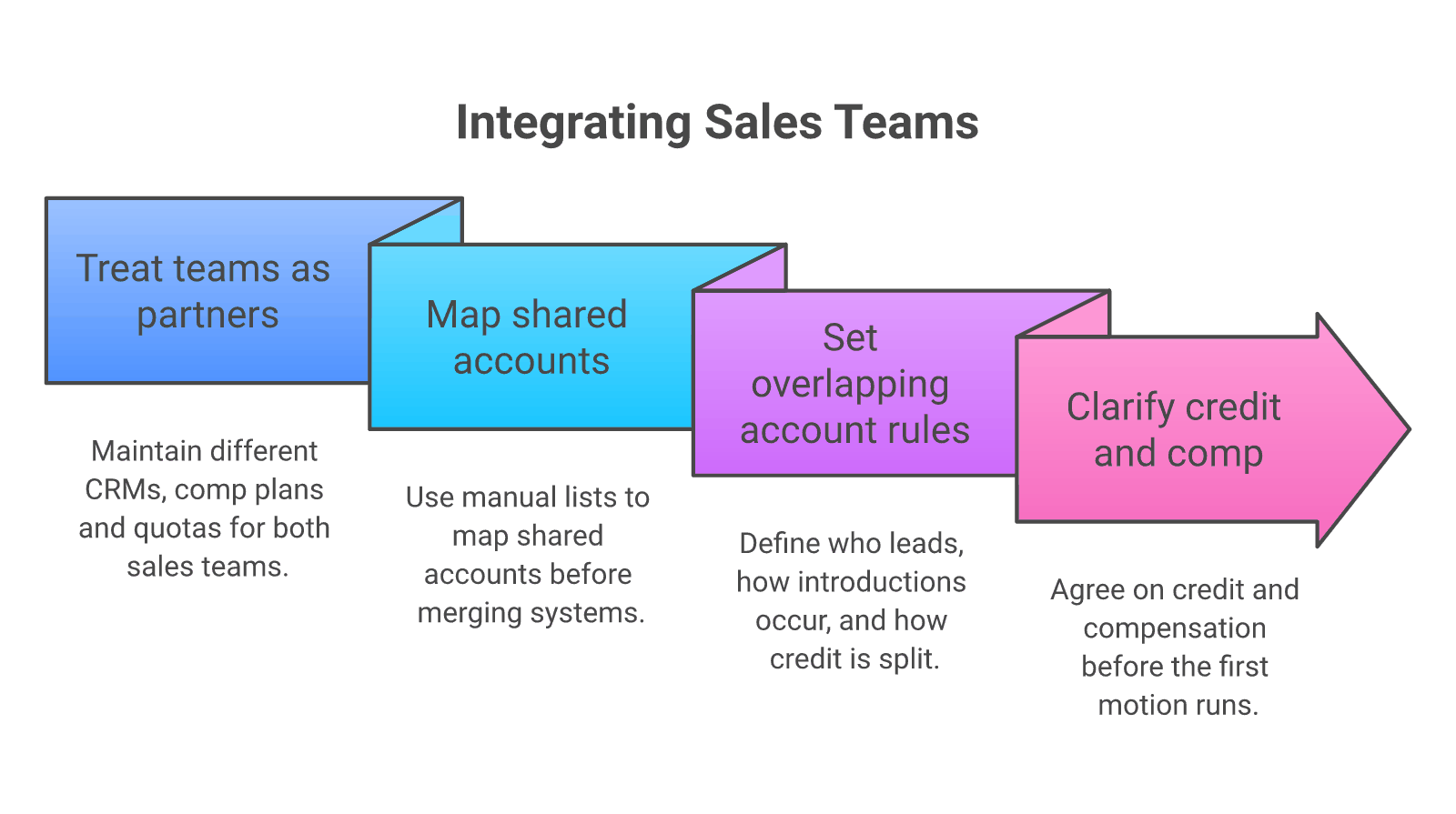
Here’s the reframe that makes this work. Right after an acquisition, the two sales teams behave like two partner companies.
They have different CRMs, comp plans and quotas. Often the sellers don’t even know each other. And they both worry about losing accounts to the other side.
That’s a co-sell problem, and it has a co-sell answer.
Map the shared accounts before the systems merge
But you don’t need one CRM to start. Map the two customer bases against each other, the same way you’d map accounts with a partner. That shows which customers of one company fit the other’s product today.
This works even when the CRM data is messy, which it usually is after an acquisition. Manual lists are enough to start.
Set rules on who approaches overlapping accounts
Next, decide who owns the conversation on accounts both teams touch. Without that rule, two sellers call the same customer in the same week, and the customer wonders who’s in charge.
So write down three things: who leads on shared accounts, how introductions get made, and how credit gets split.
Make credit and comp clear
Sellers don’t cross-sell for free. If cross-selling hurts their number, they won’t do it. McKinsey makes the same point: incentives have to make cross-selling worth it next to existing quotas. Agree on credit before the first motion runs, not after the first dispute.
Bring both partner ecosystems in
Most acquirers forget that they also bought a partner ecosystem. Post-acquisition expansion often works best when it combines partners from both sides.
The acquired company’s partners already know its product and its customers. The acquirer’s partners know a much bigger customer base. Put them together on a GTM motion, and each side opens doors the other can’t.
There’s a bonus, too. Partners of a company going through change are often more willing to share account data, because they’re unsure what’s coming. That makes the first account mapping easier than you’d expect.
What the cross-sell message should sound like
First, the message should come from the acquirer. It’s more powerful that way. The acquirer’s brand carries the weight, and the acquisition is the reason to reach out.
And lead with a point of view, not a request for a discovery call. Tell the customer why the combination matters to them, specifically. Then ask for the meeting.
Keep the target list small
So start narrow. Pick accounts with a clear trigger, like a customer of one company running a known gap the other company fills. As few accounts as possible, at first. A small list run well beats a big list run badly.
A 100-day plan for post-acquisition cross-sell
Here’s how the first 100 days can run. The timing comes from how we build and launch GTM motions.
- Days 1 to 15: map and prioritize. Map both customer bases, pick the first motion and agree on ownership and credit rules.
- Days 15 to 30: build and launch. The first GTM motion is built in about two weeks: messaging, target accounts, owners and order of operations. It goes live in about three weeks.
- Days 30 to 100: run and build pipeline. A full quarter of execution in market, with outreach, calls and joint events into the target accounts. Pipeline builds through this stretch, so set leadership’s expectation on day 100, not day 30.
- Throughout: track everything. Every send, meeting and opportunity flows back into the CRM, so leadership can see the synergy number take shape.
By day 100, you’re not presenting a cross-sell plan. You’re reporting pipeline.
Common post-acquisition cross-sell mistakes
I see the same few mistakes over and over:
- Waiting for the CRM merge: It can take a year. The window closes in weeks.
- Announcing instead of selling: A press release isn’t a GTM motion. Someone has to reach out.
- Leaving credit vague: Unclear credit means sellers protect their accounts instead of sharing them.
- Ignoring the partners: Two ecosystems are worth more than two sales teams.
How Forecastable runs post-acquisition cross-sell
At Forecastable, we deliver partner-sourced pipeline as a service. We build your partner program and run it with you or for you, and we’re measured on pipeline and revenue.
Post-acquisition cross-sell is one of the GTM motions we run. We map the two customer bases and both partner ecosystems, build the first motion, set the order of operations and run the outreach. Then we track every result so leadership sees the synergy number take shape. For private equity firms, the same motion can run across portfolio companies.
There’s no new tech to buy, no seats and no PRM required. Co-sell automation is included, running on your Crossbeam data and the AI tools you already own. Partners can fund or co-fund motions through MDF. Learn more on our mergers and acquisitions page, and see the private equity angle in BlueThread’s ISV and PE partnership playbook.
FAQ
What is post-acquisition cross-sell?
It’s selling the acquired company’s products to the acquirer’s customers, and the acquirer’s products to the acquired company’s customers, after a deal closes.
How fast should post-acquisition cross-sell start?
Within weeks. The first GTM motion can be live in about three weeks, with a full quarter in market inside the first 100 days.
Do we need to merge CRMs before cross-selling?
No. Map the two customer bases against each other and start with shared accounts. The systems can merge later.
Who should get credit for a cross-sell deal?
Agree before the first motion runs. Decide who leads on shared accounts and how credit splits between the two sales teams.
When does post-acquisition cross-sell produce pipeline?
Plan on about 100 days. The motion goes live in weeks, then needs a quarter in market to build pipeline you can report.
Should partners be part of post-acquisition cross-sell?
Yes. Combining partners from both ecosystems opens accounts neither sales team could reach alone.
The bottom line
Revenue synergies don’t happen because two companies combined. They happen because someone ran the first motion while customers were still paying attention. Map the accounts, set the rules, bring in both partner ecosystems and get live in weeks. Then give it 100 days to prove the number.
Forecastable is an independent third-party professional services company. Our evaluations of other vendors are based on publicly-available information as of October 2026 and our own client experience.
Book a Program Fit Analysis to plan your first 100 days of cross-sell →
Related reading:
Uncover Your Growth Potential
Schedule a Discovery Call