Alex Buckles
Why Your SDRs Calling Isn’t Partner-Sourced

Short answer: When your own SDRs call into a partner’s accounts, the pipeline they create is yours, not the partner’s. It isn’t partner-sourced, because the partner didn’t originate it. But leaving the calls to the partner’s busy team usually means they never happen. So the calls should come from a neutral third party working in the partner’s name, with every call tracked. That’s why a third party like Forecastable exists.
What partner-sourced actually means
Let’s get the definitions straight first, because most credit fights start here.
- Partner-sourced: The partner originated a new opportunity for you, before it became a sales-qualified opportunity (SQO).
- Partner-influenced: The partner helped move an opportunity that already existed.
An SQO is an opportunity your sales team has accepted as real pipeline. Timing only matters for the sourced label. If a partner helps after the SQO, that’s real value, but it’s influence, not sourcing.
So the test for partner-sourced is simple. Did the opportunity originate through the partner? If your SDR found the account, called it and booked the meeting, the honest answer is no.
The two traps every partner team falls into
Here’s the pattern I see at companies with lots of partners and plenty of MDF, but weak partner-sourced numbers. You build a good GTM motion with a partner. Then you have to decide who runs the outreach.
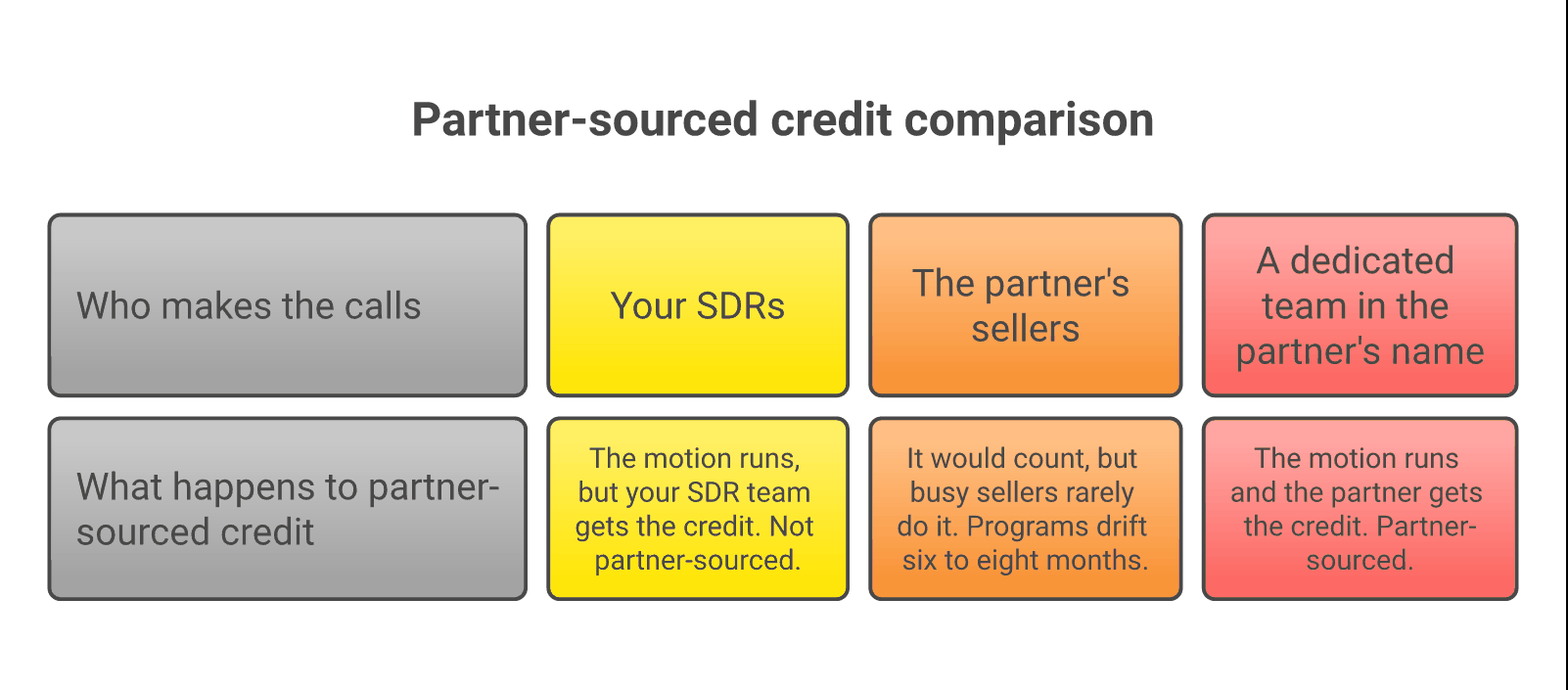
If you hand it to your internal SDR team, the partner team doesn’t get credit. If you hand it to your partners and expect them to do the right things, they usually don’t. So either the motion runs and the credit goes to the wrong team, or it doesn’t run at all.
Trap one: your SDRs make the calls
Your SDRs are good at calling. That’s the problem. When they call into a partner’s accounts, the buyer hears your brand, your SDR books the meeting, and your SDR team gets the credit.
The partner did nothing new. So it isn’t partner-sourced, and your partner-sourced number never moves, even though the GTM motion worked. Over time, leadership concludes partners don’t produce. In fact, the partner team just never got credit for the work.
Trap two: the partner’s team makes the calls
The other option sounds better. Let the partner call, in their own name. But partner sellers are busy with their own quotas and their own customers.
When I rely on busy partner professionals to do everything themselves, it usually doesn’t get done. I’ve seen programs drift for six to eight months that way. And because you can’t see their outreach, you don’t even know it’s not happening.
So who should make the calls?
Neither of those. The calls should come from a neutral third party working in the partner’s name.
A third party calling on the partner’s behalf
That’s how we run it. We staff every engagement with an SDR. Our SDRs make calls on the partner’s behalf by default, in the partner’s name, into the accounts the GTM motion targets. Because the outreach originates through the partner, the opportunities it creates are partner-sourced. And because one team does it, it actually happens.
Calling also stands out. Most people don’t call in partnerships. Calling feels like a direct-sales activity, so a well-timed call in a partner’s name gets noticed. We run it as a step inside the motion’s sequence, alongside email, LinkedIn and events.
When the partner’s own team should call
Sometimes a step needs expertise we can’t train on, like a deep technical conversation. In that case, the partner’s own people make that call. But they call through our tech stack, so every call is still tracked, made or not made.
Why your SDRs shouldn’t run partner calls
This isn’t a knock on SDRs. Your SDR team is built for direct pipeline, and it should keep doing that. But when your SDRs work partner accounts, the activity breaks partner-sourced credit. Keep the two motions separate and both numbers stay honest.
The tracking rules that keep credit clean
We don’t approve a GTM motion until there’s a reliable way to pull the results in automatically. If we can’t see the sends, calls, replies and meetings, attribution is lost.
So if a partner insists on running outreach with its own team, agree on tracking up front:
- Sends: How will we know when sends and calls went out?
- Proof: How will we confirm they actually happened?
- Replies: How will we track replies and call outcomes?
- Meetings: How will we track meetings booked and opportunities created?
Without those answers, the program goes dark, and nobody can prove what the partner sourced. Crossbeam’s documentation on automated attribution to Salesforce shows how partner data can feed that record.
How to fund partner calling
Partner calling doesn’t have to come from your operating budget. Whatever you do to develop markets and pipeline can qualify for market development funds (MDF), including outbound and calling. So your MDF, or your partner’s, can fund it.
And partners often co-fund the GTM motions they benefit from. More companies are turning to managed co-sell services for this reason. Tackle explains why companies are turning to co-sell managed services. Our own take on outsourced SDR work covers the direct-sales side.
How Forecastable runs partner-sourced calling
At Forecastable, we deliver partner-sourced pipeline as a service. We build your partner program and run it with you or for you. We act like an SDR agency and a marketing agency combined, with partnerships and partner data at the center. And we’re measured on pipeline and revenue.
Real people run every send and every call. AI monitors in the background, suggests next steps and drafts, but a human is always in the loop. Partners can join as collaborators and see their motion’s activity as it happens.
There’s no new tech to buy and no seats. No PRM required. Co-sell automation is included, running on your Crossbeam data and the AI tools you already own. Partners can fund or co-fund the program through MDF, so it can cost you $0. Learn more on our Produce My Pipeline page.
FAQ
Is pipeline from my SDRs calling partner accounts partner-sourced?
No. If your SDR found the account and booked the meeting, your team sourced it. The partner may have influenced it, but it didn’t originate it.
What is the difference between partner-sourced and partner-influenced?
Partner-sourced means the partner originated a new opportunity before it became an SQO. Partner-influenced means the partner helped move an opportunity that already existed.
Who should make calls in a partner GTM motion?
A neutral third party working in the partner’s name, with every call tracked. The partner’s own team should call only when a step needs its expertise.
Can MDF pay for calling on a partner’s behalf?
Often, yes. MDF is meant to develop markets, and pipeline-generating outbound and calling can qualify.
Why not let partners make the calls themselves?
Partner sellers are busy with their own quotas. Without someone running the motion, the calls usually don’t happen, and you can’t see whether they did.
The bottom line
Partner-sourced is a claim about where pipeline came from. Your SDRs can’t make that claim for a partner, and a partner too busy to call can’t either. Put the calls in the partner’s name, run them through one team, and track every one. Then the number is real.
Forecastable is an independent third-party professional services company. Our evaluations of other vendors are based on publicly-available information as of October 2026 and our own client experience.
Book a Program Fit Analysis to see how much partner-sourced pipeline calling could add →
Related reading:
Uncover Your Growth Potential
Schedule a Discovery Call