Co-Sell Reporting: Metrics Finance Will Fund

What is co-sell reporting?
Short answer: Co-sell reporting is the practice of measuring joint selling so finance can fund and forecast it. It captures what a co-sell motion sources, influences, and closes, in the same fields and with the same rigor as direct-sales reporting, so partner pipeline becomes a number a chief financial officer trusts.
Reporting is the part of co-sell most teams treat as an afterthought and finance treats as the whole story. A program can run a flawless motion and still lose its budget, because the results were never captured in a form finance recognizes. Co-sell reporting closes that gap.
The standard to aim for is direct-sales parity. Finance already trusts how direct pipeline is measured. Co-sell reporting earns the same trust by using the same discipline: tagged at creation, defined consistently, reconciled regularly. Anything looser gets discounted.
This post lays out co-sell reporting as five layers, the order they build in, and why a report missing any one of them gets ignored in the budget conversation.
Why co-sell reporting matters in 2026
Three shifts have made reporting the part of co-sell that decides funding. Ecosystem-led growth has made co-sell a primary pipeline source, so its reporting now sits on the revenue-forecasting path. Buying committees have grown past seven stakeholders, and longer joint deals need reporting just to stay visible. And finance now expects partner revenue forecast with direct-sales rigor, which means co-sell without real reporting is treated as anecdote, not pipeline.
The case for finance-grade reporting has three layers. At the strategy layer, reporting is what proves co-sell deserves continued investment, because a budget conversation runs on numbers. At the operating layer, reporting tells a partnerships leader which partnerships are producing, so effort can be reallocated. At the credibility layer, consistent reporting is what moves co-sell from a partnerships claim to a finance-owned line.
The reality most teams live is co-sell reporting built from memory after deals close. Someone tags joint deals retroactively, the numbers are approximate, and finance discounts them on sight. Co-sell reporting done right is captured at creation, not reconstructed at quarter-end.
How co-sell reporting actually works
Co-sell reporting has five layers. They build in order, and each layer depends on the one before it.
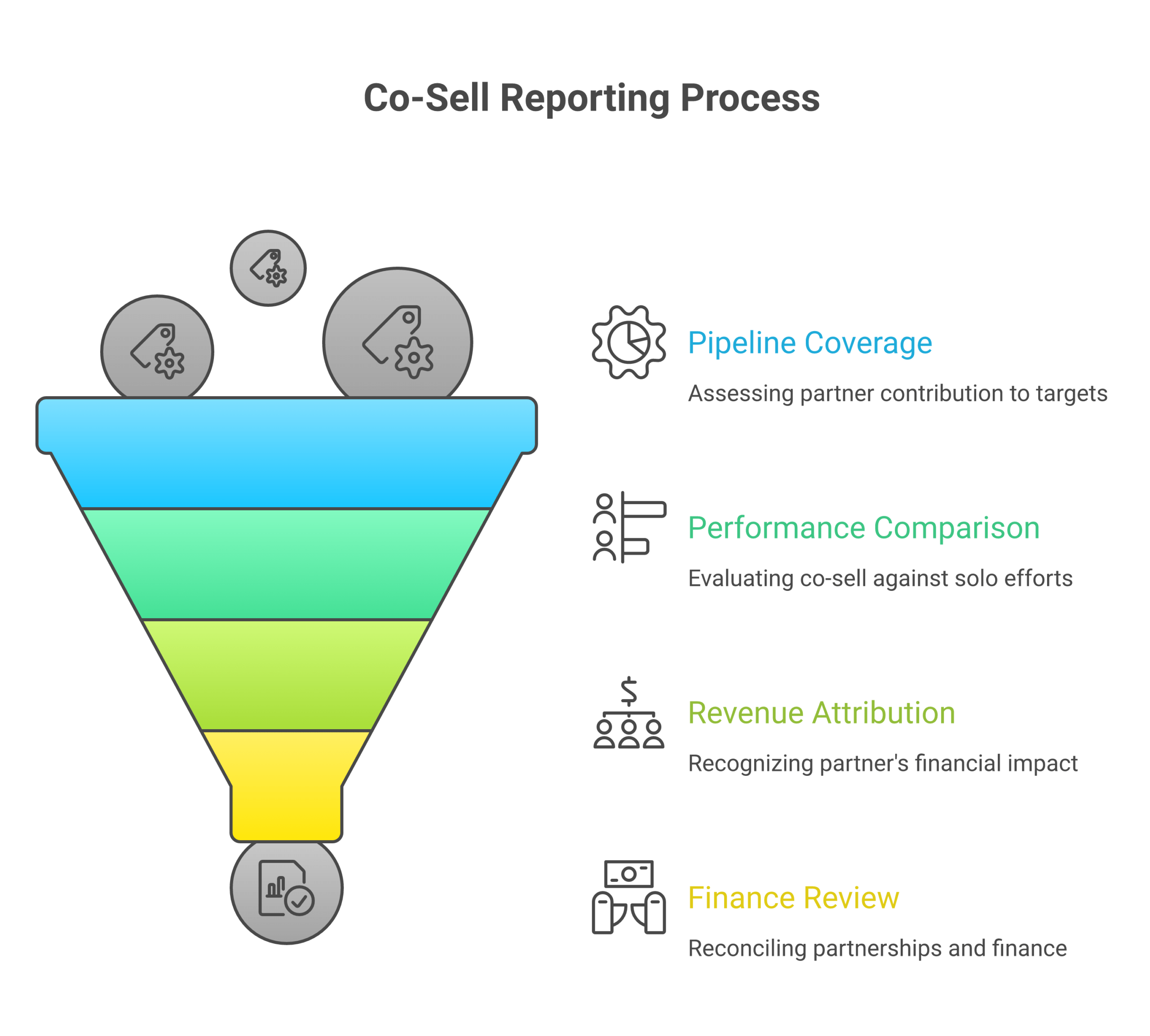
- Sourced and influenced tagging: Every joint opportunity is tagged at creation as partner-sourced or partner-influenced, with the partner named. This is the foundation; reporting built on tags applied later is reporting nobody trusts.
- Joint pipeline coverage: The report shows how much partner-attributed pipeline exists against the co-sell target, broken out by partner. This layer answers whether the motion is generating enough to matter.
- Cycle time and win rate: The report compares joint deals to solo deals on how long they take and how often they close. This layer is where co-sell usually proves its case, because joint deals often close faster and at a higher rate.
- Partner-attributed revenue: The report shows closed-won revenue tied to partner-sourced and partner-influenced deals, in dollars finance recognizes. This is the layer the budget conversation actually turns on.
- The finance-grade review: Partnerships and finance review the numbers together on a fixed cadence, reconcile attribution, and agree what counts. This layer is what converts a partnerships report into a number finance will defend.
The closing point is that the five layers are a sequence, not a menu. Pipeline coverage built on missing tags is unreliable. Win rate with no revenue layer is interesting but not fundable. Revenue with no finance review is a partnerships claim. Co-sell reporting earns funding only when all five layers are in place.
Common pitfalls
Co-sell reporting fails in consistent ways, and every failure is a reporting layer skipped or run weakly.
- Retroactive tagging: Joint deals are tagged at quarter-end from memory. The numbers are approximate and finance discounts them.
- Sourced and influenced blurred: The report mixes the two, or defines them differently each quarter. Finance cannot compare period to period and stops trusting the trend.
- Pipeline without revenue: The report shows joint pipeline and never closes the loop to closed-won dollars. The budget conversation needs the revenue layer.
- No solo comparison: Co-sell numbers are reported in isolation. Without a direct-sales benchmark, finance cannot tell whether co-sell is actually better.
- No finance review: Partnerships builds the report alone. Finance never co-signs the definitions, so the numbers never become a trusted line.
What this looks like in practice
Co-sell reporting runs on a three-layer stack. Each layer supports specific reporting layers.
A software company rebuilds co-sell reporting from the tag up. Every joint opportunity is tagged sourced or influenced at creation, with the partner named, enforced in the CRM. The monthly report shows joint pipeline against target by partner, joint win rate against solo win rate, and partner-attributed closed-won revenue in dollars. Partnerships and finance review it together on the first of each month and reconcile any disputed deals. After two quarters, finance forecasts co-sell revenue the same way it forecasts direct revenue, and the program’s budget conversation stops being a debate.
The contrast is a company that reports co-sell from a spreadsheet built at quarter-end. The numbers are large but soft, finance has never co-signed the definitions, and every budget cycle the co-sell line gets discounted by half. The motion may be working; the reporting cannot prove it.
Forecastable’s POV
The hardest truth about co-sell is that a motion which produces revenue but cannot report it will still lose its funding. Finance does not fund effort; it funds numbers it trusts. We have watched genuinely effective co-sell programs get cut because the reporting was built from memory, and we have watched mediocre programs survive because their reporting was clean. That is not fair, but it is how budgets work, and the lesson is to treat reporting as part of the motion, not a chore after it.
Across our client base, the layer that decides everything is tagging at creation. Every other reporting layer inherits the quality of the tags. A deal tagged sourced or influenced the day the opportunity is created, by the seller who knows, produces reporting finance trusts. A deal tagged at quarter-end by someone reconstructing the cycle produces reporting finance discounts. The discipline is small and the payoff is the entire program’s credibility.
The contrarian point is that co-sell reporting should be owned with finance, not just shown to finance. Partnerships teams build a report and present it, hoping for agreement. The teams whose numbers actually get funded brought finance into the definitions early, let finance co-sign what sourced and influenced mean, and run the review jointly. A number finance helped define is a number finance will defend.
If your co-sell motion is working but your budget keeps shrinking, the gap is reporting. Tag at creation, build the five layers, and run the review with finance in the room.
Forecastable is an independent third-party professional services company. Our evaluations of co-sell reporting and tooling are based on publicly-available information as of May 2026 and our own client experience.
Frequently asked questions
What is co-sell reporting?
The practice of measuring joint selling with direct-sales rigor, so finance can fund and forecast partner pipeline. It captures what co-sell sources, influences, and closes.
What is the difference between sourced and influenced co-sell deals?
A sourced deal originated with the partner. An influenced deal existed but the partner materially advanced it. Reporting must define both consistently and never blur them.
What are the layers of co-sell reporting?
Five: sourced and influenced tagging, joint pipeline coverage, cycle time and win rate, partner-attributed revenue, and the finance-grade review.
Why does co-sell reporting need finance involved?
Because a number finance helped define is a number finance will defend. Reporting built by partnerships alone gets discounted; reporting co-signed by finance becomes a trusted line.
When should co-sell deals be tagged?
At creation, by the seller who knows. Tags applied at quarter-end from memory produce reporting nobody trusts.
What metric proves co-sell is working?
Joint win rate and cycle time against the solo benchmark, closed to partner-attributed revenue. Joint deals that close faster and at a higher rate make the case finance funds.
Next step
If your co-sell motion produces but your budget keeps getting cut, the problem is the reporting. Tag every joint deal at creation, build the five reporting layers, and run the review with finance in the room.
Talk to our team about your co-sell reporting →
The co-sell hub holds the broader operating context, and the co-sell programs write-up covers the program layer that reporting funds.
Uncover Your Growth Potential
Schedule a Discovery Call