Alex Buckles
Co-Selling Enterprise Deals Across Different CRMs

Short answer: In an enterprise co-sell, three or four companies can work one deal, and each runs its own CRM and forecast. You don’t fix that by forcing everyone into one system. You fix it with one joint mutual action plan, one shared view of the buying committee, clear rules on who talks to whom and when, and authorized access so both sides know where the deal stands. That keeps different CRMs from turning into different stories.
Why co-selling across different CRMs breaks deals
Here’s what happens on most multi-partner enterprise deals. Three companies means three CRMs. And three CRMs means three different close dates reported to three leadership teams.
Nobody is lying. Each seller updates their own system with what they know. But nobody sees the whole deal, so the deal fractures or stalls.
The buyer feels it first. They get a discovery call from one company, a demo request from another and a pricing email from a third, all in the same week. To the buyer, that doesn’t look like a coordinated team. It looks like three vendors who don’t talk.
Build one joint mutual action plan
A mutual action plan is a shared, dated list of the steps to close a deal. In co-sell, I call it the co-sell plan. Every party works from the same one.
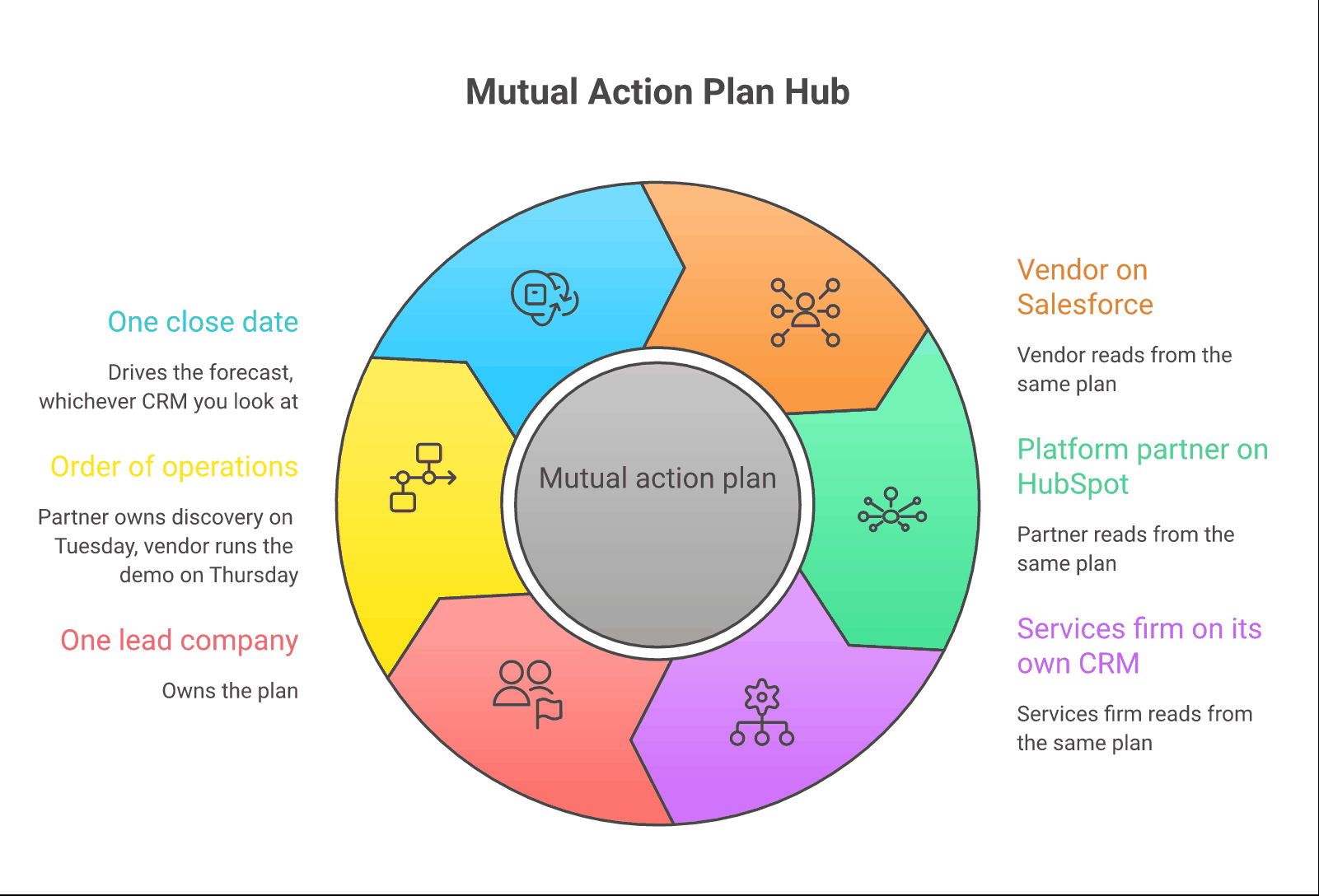
One party leads the plan
First, pick one company to own it. Then fold in the timelines and touchpoints from every partner involved. The diagnostic question I ask on any stuck deal is simple: is everybody working from one mutual action plan?
Set the order of operations
The plan’s real job is sequence. Who does discovery? When does the demo happen? Who tells the buyer what?
For example: the partner owns discovery on Tuesday, and the vendor runs the demo on Thursday. That one line prevents out-of-turn messages from multiple companies to the same buyer.
Use it to forecast, not just to coordinate
Close plans make a real difference to win rates. But they matter even more for forecasting. They answer the question every leader asks: will this deal close on time, as forecasted? When every partner’s close date comes from the same plan, the forecast stops depending on which CRM you look at.
Fair warning, though. Co-sell plans take discipline. Reps often skip them in favor of speed. So someone has to own keeping the plan current.
Map one buying committee across every company
Because every company on the deal has its own contacts at the buyer, put them all on one relationship map.
That map shows each person at the buyer and their role:
- Economic buyer: The person who signs.
- Champion: The person selling for you inside the account.
- Supporters: People who help.
- Opponents: People who block.
I feel blind when I don’t have a picture of every person in the buying committee. It’s just how I sell. And in co-sell, the picture has to include who each partner already knows. Often a partner has the executive relationship you’ve been trying to reach for months.
How to avoid co-sell landmines
The most common way a co-sell deal blows up is simple. Someone acts out of turn.
The out-of-turn outreach
Picture this. You’ve built a senior relationship at the buyer and invited a partner in. Then a partner rep, acting on instinct, cold-emails another senior stakeholder. That can step on a senior conversation already in motion and spend the credibility you walked in with.
Invite the partner rep into the plan
So don’t just hand a partner an introduction. Bring the partner rep into the deal and hand them the plan. Then enforce the sequence: don’t jump from step one to step four. If you’re on step two, do step two, and tell everyone when it’s done.
Reps learn co-selling by doing it inside a guided deal. After one or two, they get it.
Pre-communicate every introduction
Before a partner introduces anyone on the buying committee, say so in the shared plan. Surprises are what create landmines.
Gate shared engagement data
Shared data can cause its own problems. When reps see engagement on an account, some jump the gun and start their own sales cycle. That can also take partner-sourced credit away from the partner who earned it. So put sensitive engagement data behind a simple request and approval step.
Keep both sides informed without merging CRMs
You’ll never get every company onto one CRM, and you don’t need to.
Authorized opportunity access
Instead, decide access per GTM motion. With authorized access, both sides see where the sales cycle stands. And each partner sees only its own motion’s deals, nothing more.
A shared communication feed
Then keep one feed of everything said between the companies about the deal: email, Slack, Teams and call notes. That’s the record everyone can trust, regardless of which CRM they live in.
AI keeps it current across separate CRMs
This is where AI earns its keep. AI agents can keep the relationship map, the plan and the qualification current across separate CRMs, from calls, emails and messages. Crossbeam’s Deal Navigator is a good example of how partner data now supports work on a single deal.
When competing partners share the same deal
Sometimes two partners who compete with each other both touch your deal. Stay neutral on the outcome, but lean in on effort.
Put your subject-matter experts in the room with whichever partner is working it. And teach each partner to bring you in early, instead of playing a game of telephone through requirements documents. The buyer wins either way, and so do you. Crossbeam’s piece on multi-partner selling in the AI era shows how common these deals have become.
How Forecastable runs co-sell across different CRMs
At Forecastable, we deliver partner-sourced pipeline as a service. We build your partner program and run it with you or for you, and we’re measured on pipeline and revenue.
On enterprise co-sell deals, our team keeps the joint plan, the buying committee map and the shared communication record current. With authorized opportunity access, decided per motion, we keep both you and your partner informed on where the deal stands. Partners join as collaborators with only the visibility you share.
There’s no new tech to buy, no seats and no PRM required. We have native Salesforce and HubSpot integrations, and AI agents can push data through our MCP into any system that connects. Co-sell automation is included, running on your Crossbeam data and the AI tools you already own. Partners can fund or co-fund the program through MDF, so it can cost you $0. Learn more on our co-sell orchestration platform page.
FAQ
How do you co-sell when partners use different CRMs?
Use one joint mutual action plan, one shared buying committee map and authorized access to opportunity status. Each company keeps its own CRM.
What is a joint mutual action plan?
It’s one dated plan of the steps to close a deal, shared by every company involved. It sets who does discovery, demos and follow-up, and in what order.
Who should own the co-sell plan?
One party, usually the company with the strongest relationship at the buyer. Every other partner’s steps get folded into it.
How do you stop partners from stepping on each other in a deal?
Bring each partner rep into the plan, enforce the sequence of steps and pre-communicate every introduction.
Can partners see our opportunities?
Only with authorized access, decided per GTM motion. Each partner sees only its own motion’s deals.
The bottom line
Different CRMs aren’t the real problem. Different plans are. Put every company on one mutual action plan and one buying committee map, enforce the order of operations, and let authorized access keep everyone current. Then your forecast tells one story, no matter whose CRM you open.
Forecastable is an independent third-party professional services company. Our evaluations of other vendors are based on publicly-available information as of October 2026 and our own client experience.
Book a Program Fit Analysis to see how we’d run co-sell on your enterprise deals →
Related reading:
Uncover Your Growth Potential
Schedule a Discovery Call