Co-Selling Platform: What It Is and How to Pick

What is a co-selling platform?
Short answer: A co-selling platform is software that helps two companies sell together by finding where their customers and prospects overlap, sharing that account data securely, and coordinating the reps who work the joint deals. It replaces the spreadsheet swap and the guesswork about who knows whom, and its pitch is that co-sell moves faster when both sides can see the overlap and act on it in one place instead of trading lists over email.
No single tool owns the whole motion. Some platforms find overlap, some coordinate the selling, and some run the marketplace transaction, so the category is several layers that a program assembles.
The useful question is not which platform is best, it is which layer you actually need for the co-sell motion you are running.
Why a co-selling platform matters in 2026
The reason a co-selling platform matters in 2026 is that co-sell has moved from a nice-to-have to a measured revenue channel, and you cannot measure or scale a motion that runs on emailed spreadsheets. When partnerships is accountable for partner-sourced and partner-influenced pipeline, the account overlap has to be discoverable, the introductions have to be tracked, and the joint deals have to be visible in the CRM. A platform makes that repeatable; manual list-trading does not.
That matters more now because the volume of partners and accounts has outgrown manual coordination. A rep cannot keep in their head which of fifty partners knows which of a thousand target accounts. Overlap data surfaces the answer, and the introductions and joint deals that follow become countable. Without a platform, co-sell stays anecdotal and stalls the moment it needs to scale past a few close relationships.
The reframe is that a co-selling platform does not create the relationships or the trust, it makes the overlap visible and the motion measurable. The selling is still human; the platform removes the friction that used to cap how much of it could happen.
How a co-selling platform actually works
A co-selling platform works across a few layers: it finds account overlap between two companies, shares that data securely, coordinates the reps and introductions, and connects the resulting deals back to the CRM. Some products cover one layer deeply and others span several, so understanding the layers is how you pick. The parts below are the functions to map against your motion.
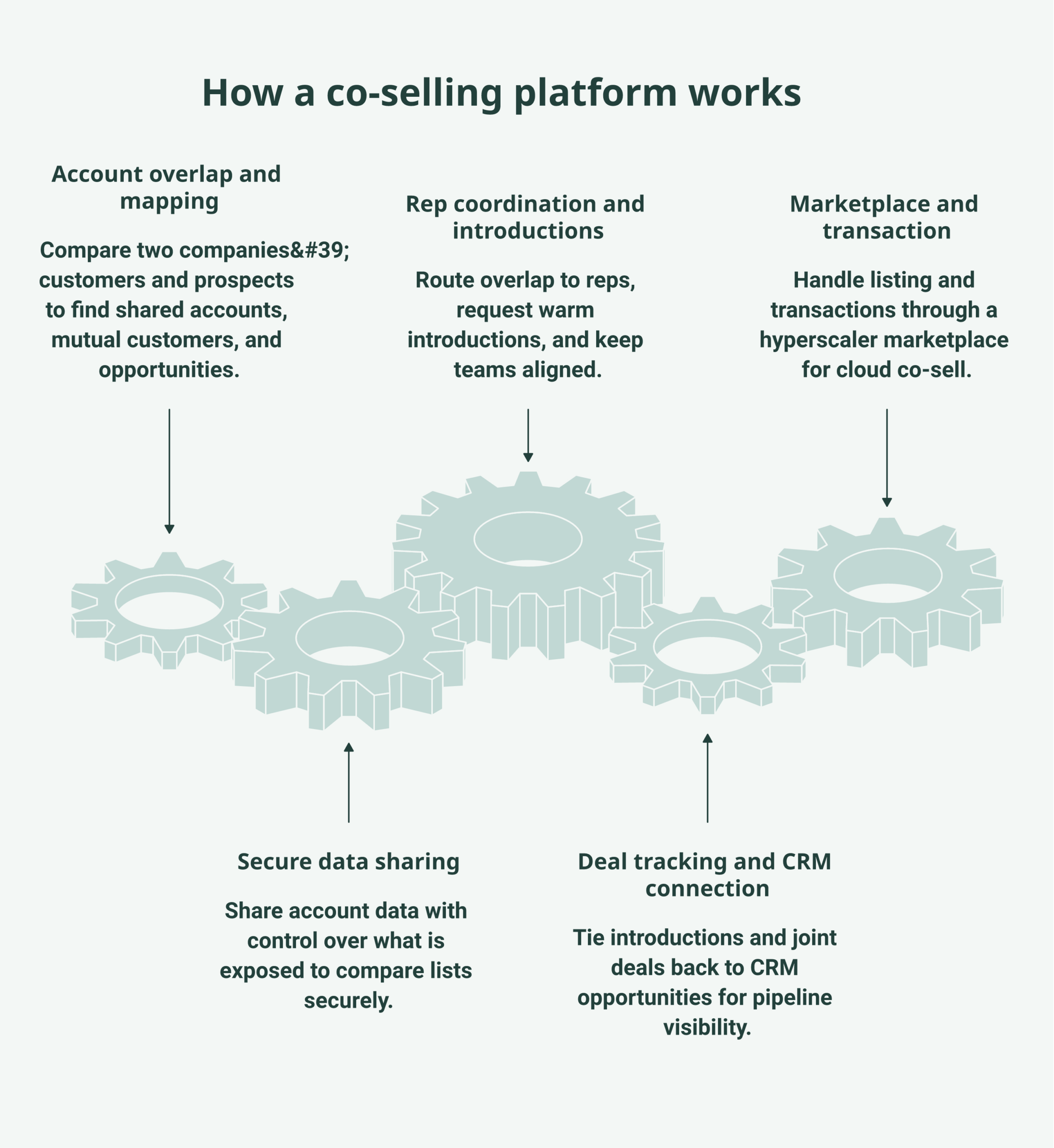
- Account overlap and mapping: Compare two companies’ customers and prospects to find shared accounts, mutual customers, and opportunities where a partner has a relationship you do not. This is the foundation, because co-sell starts with knowing where the overlap is.
- Secure data sharing: Let both sides share account data with control over what is exposed, so partners can compare lists without handing over their whole book. Trust in the data sharing is what makes partners willing to participate.
- Rep coordination and introductions: Route the overlap to the right reps, request and track warm introductions, and keep both sides aligned on who is working what. This is where overlap turns into actual selling activity.
- Deal tracking and CRM connection: Tie the introductions and joint deals back to CRM opportunities so partner-sourced and partner-influenced pipeline is visible and attributable. Without this, the motion produces revenue nobody can prove.
- Marketplace and transaction (where relevant): For cloud and marketplace co-sell, some platforms handle the listing and transaction through a hyperscaler marketplace. This layer matters for programs selling through AWS, Azure, or Google Cloud and is irrelevant to those that are not.
Common pitfalls when choosing a co-selling platform
- Buying overlap data with no motion behind it: Overlap is useless if no one acts on it. Teams buy an ecosystem data tool, see the shared accounts, and then never build the introduction and deal-review habit that turns overlap into pipeline. The data is the start, not the motion.
- Confusing the layers: An overlap tool is not a marketplace transaction tool, and neither one coordinates reps for you. Buying the wrong layer for your motion leaves a gap you feel later, so map the layers to your actual co-sell before you buy.
- Ignoring partner adoption: A platform only works if both sides use it. If your partners will not connect their data or log introductions, the tool shows half a picture. Adoption on both sides is a precondition, not a given.
- Skipping CRM connection: If joint deals do not tie back to CRM opportunities, you get activity you cannot attribute. Insist that the platform connects to your CRM, because unmeasured co-sell gets cut in the next budget review.
- Expecting the tool to build trust: The platform surfaces overlap; it does not make a partner want to introduce you. Trust and reciprocity are relationship work, and no software shortcuts them.
Tools and examples
Co-sell tooling sorts by the layer it owns. The table below groups the main categories so you can match a platform to the layer your motion needs.
| Category | What it does | Representative platforms |
|---|---|---|
| Ecosystem and overlap data | Finds shared accounts and partner overlap, shares data securely | Crossbeam, Pocus, Common Room |
| Co-sell coordination | Routes overlap to reps, tracks introductions and joint deals | Crossbeam and adjacent workflow layers |
| Cloud marketplace and transaction | Lists and transacts co-sell deals through hyperscaler marketplaces | Tackle (part of AppDirect), Labra, Suger, Clazar |
A worked example: a mid-market software team knew a handful of partners shared customers with them but could not see the full overlap, so co-sell happened only where two reps already had a personal relationship. It connected an ecosystem data platform with three partners, surfaced several hundred shared and adjacent accounts, and put a weekly introduction-and-deal-review rhythm on top. The overlap that had been invisible became a working list, warm introductions got requested and tracked, and the joint deals landed in the CRM as attributable pipeline. The platform did not make the partners cooperate; it showed everyone where cooperation would pay off and made the follow-through countable.
Forecastable’s POV on co-selling platforms
Our position is that a co-selling platform is necessary and not sufficient. You cannot scale co-sell on spreadsheets, so at some volume you need overlap data and a way to track joint deals. But the platform is plumbing. It surfaces where two companies could sell together and connects the results to revenue; it does not build the relationships, run the deal reviews, or make partners reciprocate. Teams that buy a platform expecting it to produce co-sell are always disappointed, because the motion is the human part and the tool is the visibility part.
That is the frame we would apply to any co-sell tooling decision. Name the layer you need, buy the platform that owns it cleanly, insist on the CRM connection so the motion is measurable, and then put your energy into the introduction and deal-review rhythm that actually turns overlap into pipeline. The platform earns its cost only when a real motion runs on top of it.
Forecastable is a partnerships operating platform that connects partner conversations and actions to CRM pipeline and revenue, the flywheel of Conversations to Actions to Pipeline to Revenue. We are a category authority on running partner-led growth, so we sit complementary to whatever overlap or marketplace tooling you use, making it visible which partners and which joint deals actually produce so the co-sell motion is measured by revenue rather than accounts matched.
Any third-party tools or firms referenced here are independent third-party products, and mentioning them is not an endorsement. Evaluate any co-selling platform against your own CRM, partner base, and motion before committing to it.
Frequently asked questions
What is a co-selling platform? A co-selling platform is software that helps two companies sell together by finding account overlap, sharing that data securely, coordinating the reps who work joint deals, and connecting the results to the CRM. It makes co-sell measurable and repeatable; it does not build the partner relationships for you.
What are the main categories of co-sell tooling? Three layers matter: ecosystem and overlap data that finds shared accounts, co-sell coordination that tracks introductions and joint deals, and cloud marketplace tooling that lists and transacts deals through hyperscaler marketplaces. Some platforms span layers, others go deep on one, so map the layers to your motion.
Do I need a co-selling platform or just a CRM? Once co-sell moves past a few personal relationships, a CRM alone cannot surface partner overlap or coordinate two companies’ reps. A platform adds the overlap discovery and joint-deal tracking a CRM lacks, then connects back to it so the pipeline stays attributable.
Does a co-selling platform replace the co-sell motion? No. The platform surfaces overlap and tracks deals; it does not run deal reviews, request introductions, or build partner trust. Those are relationship and process work, and the platform only makes them visible and scalable.
How do marketplace platforms fit in? For programs selling through AWS, Azure, or Google Cloud, marketplace platforms handle listing and transacting co-sell deals through the hyperscaler. That layer matters if you co-sell on the cloud marketplaces and is irrelevant if you do not, so only weigh it against your actual channel.
What should you test before buying? Whether the platform owns the layer your motion needs, whether your partners will actually connect their data and participate, and whether joint deals tie back to your CRM. Co-sell tooling only pays off with adoption on both sides and clean attribution.
Next step
If your co-sell runs on emailed spreadsheets and stalls whenever it needs to scale, a co-selling platform surfaces the overlap and makes the joint deals measurable, but only a real introduction-and-review rhythm turns that overlap into pipeline. Buy the layer you need, then build the motion on top. Start your growth journey now to build the co-sell motion your platform is meant to support. The co-sell hub frames how the motion fits the broader program.
Uncover Your Growth Potential
Schedule a Discovery Call