Forecastable

Our Latest

GTM Insights

The latest insights on the most effective go-to-market strategies

Our Founder’s Latest Insights

Blogs on Sales Reps & Sales Development

Forecastable's Education Center

The best advice on building partner programs that produce forecastable revenue.

Latest Post

Latest Post

A vendor partnerships lead and a reseller principal signing a reseller agreement across a table with a margin and pricing structure printed between them, deep navy and warm amber palette

Reseller Program: What It Is and How to Build One

Short answer Short answer: A reseller program is the structure that lets partners buy or sell your product for a margin and take it to their own customers under a defined agreement. It matters because resellers can carry your product into markets and accounts your direct team never reaches, but a reseller program only produces […]

Read Article

Editor's Picks

Through-Channel Marketing: What It Is and How It Works

Short answer Short answer: Through channel marketing is demand generation a vendor runs through its partners, supplying campaigns, content, and funds so partners market to their own customers under their own brand. It matters because partners own trusted relationships a vendor cannot reach directly, but most of these programs underperform because they push vendor material […]

Partnership Marketing: What It Is and How to Run It

Short answer Short answer: Partnership marketing is joint marketing between two companies that combine audiences, content, and channels to generate demand for a shared value proposition. It matters because a co-branded campaign borrows the trust and reach of both brands at once, which is why a partner webinar or joint guide usually outperforms the same […]

B2B Partner Marketing Strategy: To, Through, With

What a B2B partner marketing strategy is Short answer: A B2B partner marketing strategy is the plan for how you market to partners, through partners, and with partners, so partner relationships turn into pipeline rather than logos on a slide. It works when each of those three audiences has its own goal and the whole […]

Featured image for Forecastable blog post on account mapping roi

Account-Mapping ROI: How to Justify the Spend to Finance

Account mapping software pays back in three ways: pipeline acceleration via warm intros to existing prospects, expansion revenue via mapping mutual customers, and risk reduction via knowing which deals overlap with partner relationships. The defensible ROI math is (incremental partner-sourced ARR + accelerated direct ARR + churn-prevented ARR) divided by annual platform cost. Most B2B SaaS teams hit 3-5x ROI within 12 months.

Read Article
Featured image for Forecastable blog post on cro cpo relationship

Building the CRO-CPO Relationship That Drives Revenue

The CRO-CPO relationship works when the CRO treats partnerships as a revenue motion and the CPO treats partner pipeline as a forecast. Both sides need a shared operating cadence: weekly partnership pipeline review aligned to the weekly direct forecast call, joint accountability for partner-sourced ARR targets, and a Co-Sell Alignment Specialist running the operational layer between them.

Read Article
Three old brass keys lined up on a dark slate surface, lit from the right.

Where Does Ecosystem-Led Growth Work Best?

ELG works. The honest question is when to use it and when to use something else. Here are the three situations where ecosystem-led growth moves pipeline best, and the four where another motion fits better.

Read Article
Slate desk with a chalk-drawn 2x2 matrix; an amber-lit glass cube paperweight sits in the upper-right quadrant.

Bob Moore’s 2×2 Matrix Is the Cleanest Positioning Artifact Our Industry Shipped This Year. Here’s the Layer of the Argument He Stops Just Before.

Short answer: Second-party data is the AI moat in partnerships. Bob Moore’s 2×2 Matrix names that correctly. However, the data layer alone does not close deals. The next layer, the operating cadence between the second-party data reservoir and a partner-involved close, is where the actual revenue is hiding. Specifically, four operating layers, the shared mental […]

Read Article
Rusty bolt embedded in a rough concrete wall, leaning diagonally downward from the masonry surface.

Channelnomics Says AI in Partner Management Cuts Deal Velocity by 40%. The Companies Hitting It Spent 2026 Reconciling Data, Not Buying Platforms.

Short answer: Channelnomics reports that early adopters of AI in partner management see up to 40% faster deal velocity. However, that outcome is conditional on one prerequisite the citations leave out: data trust. Specifically, partner-attribution data, deal-registration data, partner-activity data, and joint-Slack data have to be reconciled before AI on top of them produces signal […]

Read Article
Wood workbench diptych: a cool-lit grid of nine machined steel gears on the left, a single warm-lit hand-tooled brass tuning fork on the right.

Bridge Partners Shipped One Line That Should Reset Every Partnership-AI Vendor Pitch. Here’s the Question Buyers Should Be Asking Instead.

Short answer: Almost every partnership-AI vendor in 2026 sells automation while telling buyers they are selling impact. However, automation and orchestration are different categories. Specifically, automation delivers scale and orchestration delivers impact. Therefore, the question every buyer should put to every vendor pitch is one specific line: show me the orchestration outcome your platform produces, […]

Read Article
Chalkboard diagram with a central circle and arrows pointing to shapes: square, triangle, hexagon, star, spiral, plus a ruler in the lower-left corner.

Atlassian’s Komal Shah Said Five to Eight Partners Per Enterprise Deal Is the New Default. Most Companies’ Operating Cadence Is Still Built for One.

Short answer: Atlassian’s Komal Shah said it on the ELG Summit stage: five to eight partners are now involved in each enterprise deal. However, most partner-program architectures, the deal-reg system, the comp plan, the partner-manager assignment, are still built for one partner. Therefore, the cadence problem is structural. Specifically, four operating layers, the shared mental […]

Read Article
Head of partnerships presenting an ecosystem map on a sticky-note wall to seated colleagues

Partner Ecosystem: How Modern B2B Companies Build One

A partner ecosystem is the network of companies a vendor sells with, sells through, and integrates with. That includes tech alliances, resellers, distributors, OEMs, agencies, ISVs, and service implementers. Together they produce more revenue than any single direct motion can. A modern partner ecosystem is not a logo wall. It is an operating system for […]

Read Article
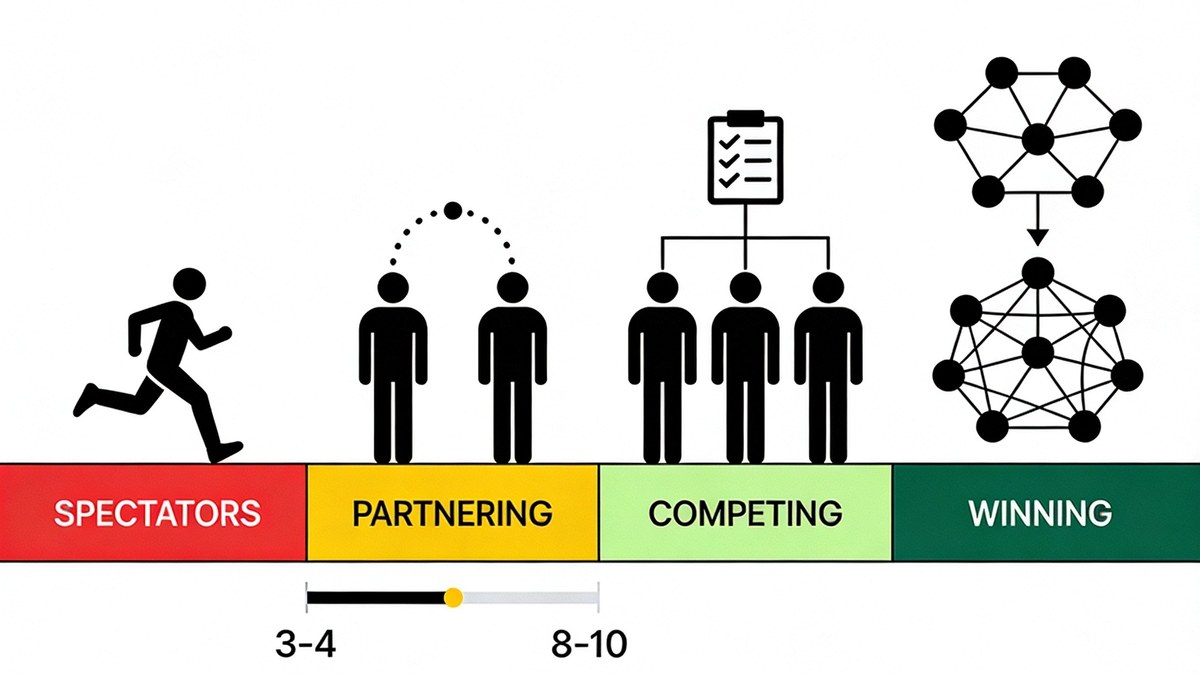
The Four-Zone Ecosystem-Led Growth Maturity Model: progression from Spectators (solo selling) through Partnering and Competing into Winning (full ecosystem orchestration), with confidence-in-market-position rising from 3-4 at the low end to 8-10 at the high end.

Ecosystem-Led Growth (ELG): Why 70% of the Revenue Comes from Execution, Not Tooling

ELG (Ecosystem-Led Growth) is a real third revenue motion alongside outbound and inbound. The conversation around ELG in 2026 is mostly wrong: roughly 70% of public content is about tooling; the actual revenue split is the inverse. Here’s the operational frame.

Read Article
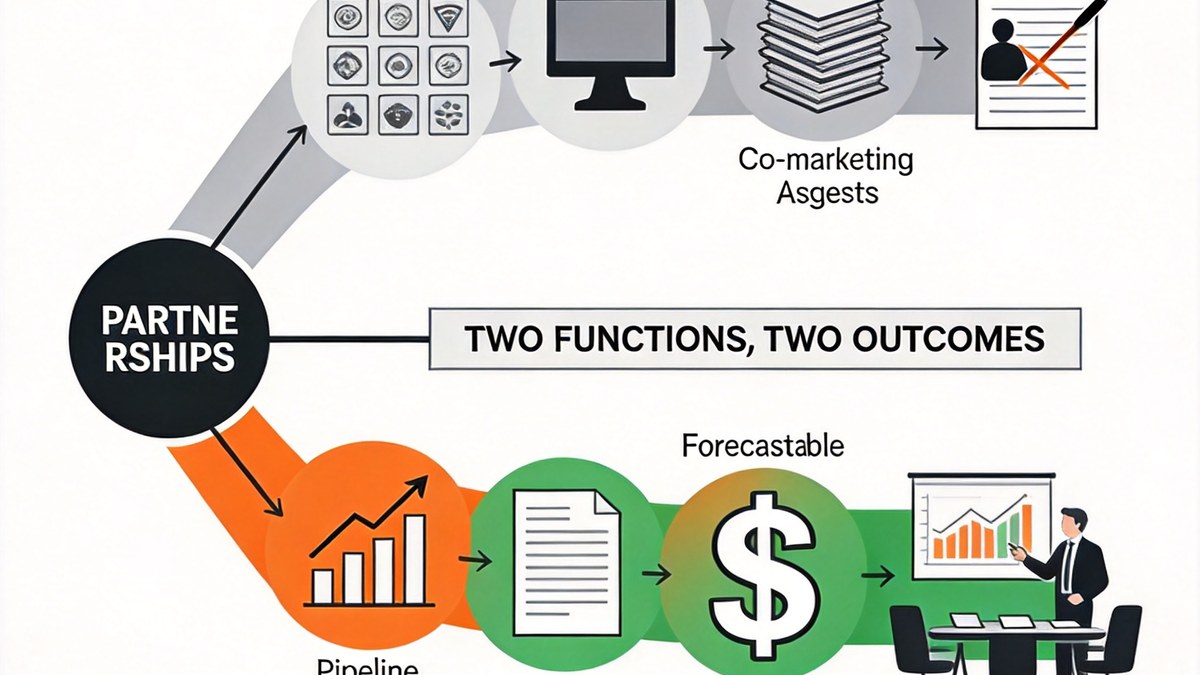
Infographic showing partnerships leading to two functions and two outcomes, with icons of charts, documents, a dollar sign, and a meeting room highlight the flow of value.

Partnerships in 2026: A Revenue Function or a Marketing Function With the Wrong Title

Partnerships is the function inside a B2B company that builds revenue-generating relationships with other companies. The defining feature is owning a revenue number. Here’s the four-question diagnostic that tells you whether you have a partnerships function or a partner-marketing function with the wrong title.

Read Article
1 8 9 10 11

Why wait?

Drive In-Quarter Impact

Whether starting with a single sales team or a single partner, any co-sell motion can be live in 2-4 weeks.