Ecosystem-Led Growth (ELG): Why 70% of the Revenue Comes from Execution, Not Tooling
ELG (Ecosystem-Led Growth) is a go-to-market motion that uses the partner ecosystem to acquire, expand, and retain customers. It works. It is the third real revenue motion alongside outbound and inbound. The category exists, the data is real, and the math holds for any B2B SaaS company with a defensible product and the discipline to run a joint motion with named partners.
The category was named by Crossbeam and popularized in their content. None of that is in dispute.
What is in dispute is the conversation around ELG in 2026. Roughly 70% of every ELG webinar, vendor deck, and analyst thread is about tooling: account-mapping platforms, partner-attribution dashboards, integration architectures, the next agentic feature. About 30% is about the operational sales motion that turns overlap data into closed pipeline. The actual revenue split is the inverse. Seventy percent of ELG revenue comes from execution discipline on five named partners running joint motions on named accounts. Thirty percent comes from the data layer that surfaced those accounts in the first place.
This post walks through what ELG is, where the conversation went wrong, and what the operational motion actually looks like at each stage of the maturity curve. The goal: you finish reading with the language and the framework to lead a 30-minute internal session that ends with an aligned answer to where you live on the maturity model and what unlocks the next zone.
What is ELG (Ecosystem-Led Growth)?
ELG is a third revenue motion that uses partner-ecosystem data and joint motions to acquire, expand, and retain customers. It is not a marketing campaign, not a vendor product category, and not a synonym for partnerships.
Crossbeam coined the term in 2023 and built most of the category vocabulary. If you want the founder version of the definition, the Crossbeam piece on what ecosystem-led growth is is where to start. The summary: every B2B buyer trusts vendors they already pay. Your partner ecosystem is the set of vendors your buyers already trust. If you can identify which partners share customers with your top-target accounts, you can short-circuit the cold-acquisition tax. The buyer hears about you from a vendor they already use rather than from your SDR.
ELG is not partner marketing. Partner marketing produces logos, webinars, and co-marketing assets. Useful work, different goal. ELG is a sales motion with its own playbook, metrics, and tooling. The output of ELG is partner-attributed pipeline, split between partner-sourced ARR (deals a partner originated) and partner-influenced ARR (deals a partner participated in but did not originate). If your team is producing partner co-marketing without a partner-sourced or partner-influenced ARR number to show for it, you are doing partner marketing, not ELG.
ELG vs. partnerships vs. nearbound (the 2026 taxonomy)
Three terms, three different shapes. Partnerships is the function. Nearbound is the warm-intro tactic. ELG is the motion. Confusing them is the most common operational mistake we see.
| Term | What it is | Primary mechanic | Primary measurement | Where it lives in the org |
|---|---|---|---|---|
| Partnerships | The function inside a company that builds revenue-generating relationships with other companies | Multi-motion (tech alliance, ISV, reseller, agency, integration) | Partner-sourced ARR plus partner-influenced ARR with a defensible attribution rule | Reports to the CRO when it owns a number; to the CMO when it doesn’t |
| Nearbound | A specific tactic: get a warm intro from a vendor the buyer already trusts | One-to-one warm-intro request through an existing partner | Intro requests sent, intros made, opportunities created | Inside partnerships or inside SDR, depending on org maturity |
| ELG | A motion that uses ecosystem data to drive acquisition, expansion, and retention | Account overlap plus trigger events plus co-sell plan plus measurement loop | Partner-sourced ARR, partner-influenced ARR, ecosystem-attribution lift on direct deals | Spans partnerships, RevOps, sales, and customer success |
| Channel sales | A structural choice: partners resell or refer the product on their paper | Reseller / referral / OEM contract | Channel-attributed bookings | Inside partnerships, separate motion from ELG |
When to use which term: nearbound when you mean the warm-intro tactic, partnerships when you mean the function, ELG when you mean the motion. They overlap. They are not synonyms. I wrote a version of this taxonomy on LinkedIn in 2023 and the boundaries have aged well.
Why the ELG conversation is mostly wrong
Roughly 70% of public ELG content in 2026 is about tooling. About 30% is about the operational motion. The actual revenue split is inverted.
There are three named patterns of where the conversation goes wrong.
The dashboard-as-motion fallacy. Account-mapping data is necessary infrastructure. It is not a motion. A partnerships team that spends 80% of its week in dashboards and 20% running joint cycles with partners and AEs is going to produce a dashboard, not pipeline. The dashboard is the input. The motion is the work.
The “if we get account overlap right, the revenue follows” fallacy. This one is especially seductive because it sounds like a strategy. It is not. We have customers running half-broken Crossbeam instances who produce four million dollars in ELG-attributed ARR. We have customers running pristine Crossbeam instances who produce zero. The variable is execution discipline on the co-sell motion, not the quality of the overlap data.
The “AI agents will run the motion for us” fallacy. AI execution agents are real and useful. They scale execution. They don’t substitute for the operational discipline of running a joint motion with five named partners on named accounts. AI agents that scale a missing motion just scale noise faster.
The pattern across all three: vendors and analysts have a structural incentive to talk about the data layer, because that’s where most of the spend is and where most of the product is. The execution layer is where the revenue is.
What ELG actually requires (the four-zone maturity model)
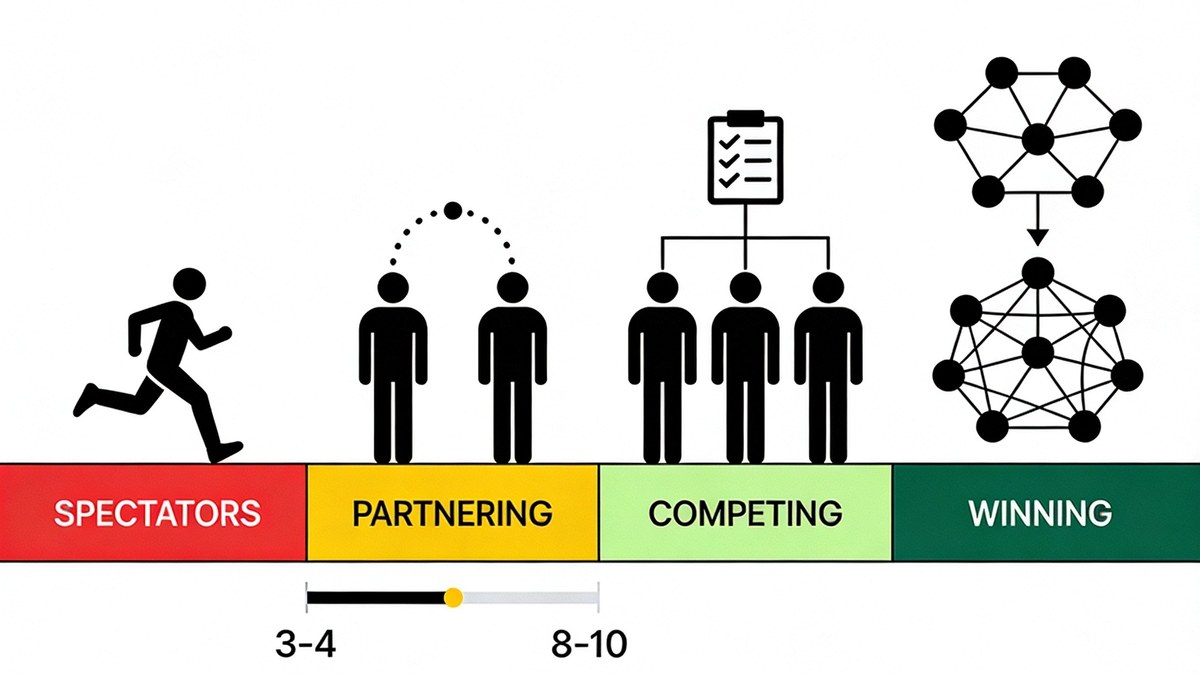
We use a four-zone model to diagnose where a partnerships team lives on the ELG curve. Most teams are in Zone 2. The work is moving them to Zone 3 and then to Zone 4.
Zone 1, Spectators (Red)
Sidelines. The belief is “we can grow alone.” Confidence in market position runs three to four out of ten. Direct selling only. Partnerships either does not exist as a function or runs as logo-collecting. There is no ecosystem data and no need for it yet. What unlocks Zone 2: a defensible direct-sales motion at $5M to $10M ARR, plus a partnerships hire who owns a number from day one.
Zone 2, Partnering (Yellow)
Account mapping is in place. Data exchange happens. Co-selling is sporadic. The dashboard exists. The team calls itself ELG. Behind the dashboard, the motion is hand-to-hand and inconsistent. This is the illusion-of-cohesion-on-a-house-of-cards stage. Confidence stays in the three to four range because the team can’t yet defend the partner-sourced number to a CFO. What unlocks Zone 3: five named partners, five named co-sell plans, and a weekly cadence on the four leading indicators (more reps reached, more resellers activated, plan progress, pipeline growth).
Zone 3, Competing (Light Green)
Last-mile execution is nailed. Co-marketing is intentional. Co-selling is intentional. Mutual action plans cover every joint deal. The team is viewed as a strong, unified front by partners and customers, but the glue is self-interest: “we win as long as I win.” Many teams live here indefinitely, and that’s fine. The numbers are defensible. The CFO is satisfied. What unlocks Zone 4: ecosystem orchestration across multiple partner archetypes simultaneously, plus the operational confidence to design joint motions where everyone in the ecosystem benefits, not just the named pair.
Zone 4, Winning (Dark Green)
Ecosystem orchestration. Systematic, intentional, predictable outcomes. The team is viewed as a category leader. Confidence runs eight to ten. The mindset that defines Zone 4 is “we win when anyone wins,” and it shows up in how the team designs joint motions, allocates MDF, and prioritizes partner asks. Few teams reach Zone 4. The ones that do tend to be ten-year-old partnerships functions inside category leaders, or two-year-old partnerships functions inside founder-led companies that decided early that ecosystem was the moat.
The execution layer most ELG conversations skip
ELG runs on a five-step playbook. Skip any step and the motion collapses back into a generic partner program.
- Map customers and prospects against the partner ecosystem. Use account-mapping software (Crossbeam, PartnerTap) to identify which of your target accounts your partners already work with. The output is a ranked list. Where this stalls: the team treats the ranked list as a deliverable instead of an input.
- Define the trigger events that fire a play. When a target account hits a defined signal (a partner closes a deal there, a partner’s CSM has an active project there, a champion at the partner moves into a buying role), fire a specific play. The play could be an intro request, a co-sell motion, or a joint webinar. Where this stalls: triggers stay implicit. The dashboard surfaces accounts; the team doesn’t act because no one owns the action.
- Run the play through a Co-Sell Plan. A co-sell plan turns vague mutual interest into a forecastable revenue motion. Named owners on each side. Milestones and dates. Economic split named upfront. Where this stalls: the plan exists as a document and not as a discipline.
- Measure ecosystem-attributed pipeline. Track partner-sourced and partner-influenced pipeline as separate lines in the forecast. Partner-sourced converts higher and faster. Partner-influenced lifts win rate and velocity on existing direct deals. Both belong on the CRO’s report. (We covered this split in the partner-sourced vs. partner-influenced pipeline post.) Where this stalls: attribution rot. AE comp doesn’t reward partner-attributed deals so AEs stop updating the field.
- Feed the loop. When ELG produces revenue, reinvest in the partners who produced it. Co-marketing dollars, MDF, tighter integration, joint events. Starve the partners who don’t move the number. Tier ruthlessly. Where this stalls: the team treats every partner the same out of fairness instinct. Five active producers get crowded out by twenty inactive logos.
ELG benchmarks (real numbers from the field)
Three anonymized examples from Forecastable customers in the last 18 months. Different stages, different motions, different sizes. Same operational pattern.
A 10-person HubSpot services partner working in the banks and credit-unions vertical, with 15 years of partnership history, ran into a velocity wall. Six months of dedicated co-sell work produced 15 net-new opportunities, all in the $300K to $400K ARR range, including one Fortune 500 insurance close. The motion eliminated the seasonality that had defined their pipeline for three years.
An Australian property-management SaaS company started from zero on the ELG curve. Six weeks from the first kickoff to three named reps generating partner-sourced deals on a weekly cadence. The fastest proof of viability we have measured.
A Fortune 100 cloud-software company received notice of non-renewal from a strategic partner running on a low data tier. One conversation, anchored on a single-slide framework explaining how to activate the partner’s data through the four-zone maturity model, took the relationship from notice-of-non-renewal to expansion at the highest tier in one cycle. The slide did not invent new product. It re-framed the data the partner already had.
What the three examples have in common: zone progression was the unit of measurement, not deal velocity in isolation. The work moved each customer one zone at a time. The numbers followed.
Forecastable’s POV
Three positions, all consistent with what we have published and shipped over the last three years.
The 70/30 inversion. The ELG conversation is dominated by tooling vendors because they have the marketing budget and the structural incentive to talk about the data layer. The revenue split is the inverse. Most of the work is execution discipline on five named partners. Most of the published content is dashboards. A partnerships leader who internalizes that one frame will allocate their team’s hours differently and produce more pipeline.
Crossbeam built the category. The execution is the moat. Crossbeam coined the term, built the data layer that made the motion practical at scale, and deserves the credit. ELG is a motion, not a product. The partnerships discipline that surrounds the motion (co-sell plans, AE accountability, tier governance, executive sponsorship) is where the differentiated revenue lives. Crossbeam is the data layer. Forecastable is the team that builds partner-led pipeline with you, alongside whichever data layer you run. Partners don’t create revenue. People do. We activate the people, run the motion with sales rigor, and put a defensible partner-sourced ARR number on the CRO’s dashboard. We don’t sell software. We don’t sell services. We sell revenue outcomes.
Don’t run ELG before product-market fit. ELG amplifies an effective sales motion. ELG does not substitute for one. A pre-PMF company that pivots to ELG is borrowing trust from partners they cannot pay back. The result is a year of ELG investment, burned partner relationships, and no revenue. Build PMF first. Then build the ecosystem motion on top.
Frequently-Asked Questions
Who coined the term ELG? Crossbeam coined the term in 2023 and built most of the category vocabulary. The underlying motion (partners as a primary go-to-market channel rather than a side experiment) predates the label by decades.
How is ELG different from channel sales? Channel sales is a structural choice: partners resell or refer your product on their paper. ELG is a motion choice: you use ecosystem data and joint motions to accelerate any pipeline, including your direct pipeline. The two can coexist.
What is the difference between partner-sourced and partner-influenced ARR? Partner-sourced ARR is revenue from a deal a partner originated (the opportunity would not exist without the partner). Partner-influenced ARR is revenue from a deal a partner participated in but did not originate (the partner accelerated or expanded a deal already in motion). They convert at different rates and should be reported as separate lines in the forecast.
Do you need a PRM to run ELG? Not at the earliest stage. You can run ELG on a CRM customization and a shared drive for the first 10 to 20 partners. By partner number 30, a PRM becomes the difference between a manageable program and a leaky one.
Is ELG just a Crossbeam thing? No. Crossbeam built the term and the data layer that made the motion practical at scale. The motion exists with or without any specific platform. Multiple data vendors and orchestration teams compete in the category in 2026.
When does ELG start to outperform direct motions? Typically at the 12 to 18 month mark, once five to ten partners have run real joint cycles end to end. Before that, ELG produces a few wins but isn’t yet a defensible forecast line.
How do I get my CRO to invest in ELG? Two artifacts. First, a partner-sourced ARR forecast for the next four quarters, anchored on a small number of named partners and named accounts. Second, a single-slide read on which zone of the maturity model your team is in today and what unlocks the next zone.
What is an ecosystem-qualified lead (EQL)? A lead surfaced by partner-ecosystem data (account overlap with a strategic partner, partner usage signal, partner-sourced trigger event) that meets the same qualification bar as an MQL or SQL. EQLs convert higher and faster than cold-sourced leads when the ecosystem motion is operational.
Next step
If you want a 30-minute version of the maturity-model conversation tailored to your team, that’s the first conversation we have at Forecastable with every customer. The output is a one-slide read on which zone you live in, what unlocks the next zone, and the named partners we’d run the motion through. We don’t sell software. We don’t sell services. We sell revenue outcomes. Partner-led pipeline built with your team, with sales rigor and full visibility, alongside whichever data layer you run. Talk to Forecastable.
For deeper reading on the parts of the motion this pillar references, the co-sell motion post and the partnerships function pillar both expand on the operational layer above the data.
By Alex Buckles
Forecastable is an independent third-party professional services company. Our evaluations of other vendors are based on publicly-available information as of May 2026 and our own client experience.
Uncover Your Growth Potential
Whether starting with a single sales team or a single partner, any co-sell motion can be live within 30 days.
Schedule a Discovery Call