Bob Moore’s 2×2 Matrix Is the Cleanest Positioning Artifact Our Industry Shipped This Year. Here’s the Layer of the Argument He Stops Just Before.

Short answer: Second-party data is the AI moat in partnerships. Bob Moore’s 2×2 Matrix names that correctly. However, the data layer alone does not close deals. The next layer, the operating cadence between the second-party data reservoir and a partner-involved close, is where the actual revenue is hiding. Specifically, four operating layers, the shared mental model, the better-together story, pipeline choreography, and mutual action plans, sit between the consented data and the closed-won deal.
In 2026, every partnership platform vendor is making some version of the same argument: AI changes the partner-data conversation, and if you don’t have the right data, the rest of your AI strategy is theater.
Therefore, Bob Moore at Crossbeam published the cleanest articulation of why that argument is right. His 2×2 Matrix of AI Data sorts every B2B AI conversation by two dimensions: who has the data (yours or someone else’s), and how proprietary it is (commodity or defensible). The matrix lands cleanly on a single conclusion. The AI moat in partnerships is built from second-party data, the data your partners consent to share with you, that your competitors cannot reproduce because they don’t have your partners’ consent.
This is the right answer. It belongs on every executive whiteboard where the partnership-AI conversation is happening this year.
Specifically, it is also where the argument stops, and the layer right after it is where the actual revenue is hiding.
The data layer is real. The data layer is moving fast.
Crossbeam’s repositioning to “From Overlaps to Outcomes” and the Lists product launch are the most visible moves in the second-party data category in 2026. PartnerTap shipped the Co-Sell Engine, productizing automated double opt-in across organizations. Bridge Partners + SAP’s “Power of 3” program deployed PartnerTap to all Solex and Endorsed ISV partners and built the orchestration layer with Bridge Partners as the named services partner. York Group productized partner-portfolio classification with their Six-Classification System and shipped Partner Forensics™ as an AI competitive-intelligence overlay.
By contrast, these are not adjacent moves. They are the same architectural move from four different angles: second-party data, increasingly clean and increasingly real-time, made operational and AI-ready.
The math behind why this is happening: Bridge Partners and Jay McBain (Omdia) put a number on what enterprise B2B buying actually looks like in 2026. The average buyer engages 7+ partners per deal, consults 13+ decision-makers, and the average solution stitches together 7 distinct layers, roughly 28 factors influencing a single deal. Crossbeam’s canonical ELG triplet says partner-involved deals see 53% bigger ACV, 46% higher win rates, 58% faster cycles.
In practice, the data layer is real. By every measure that matters, it is also durable. Most importantly, it is moving fast in the right direction.
However, the data layer is also not where deals close.
A reservoir of second-party data does not produce a single closed deal
A reservoir of consented second-party data, no matter how clean and AI-ready, does not by itself produce a closed-won deal. What it produces is opportunity surface area, a much larger surface than any single vendor could see on their own.
Notably, the expansion is meaningful. But the surface is not the close. The surface is the input to a series of operational steps that have to actually happen for the deal to advance. And those operational steps live in a layer almost no partnership program has deliberately built.
Notice what the celebrated stats actually describe. The Crossbeam ELG triplet (53% / 46% / 58%) measures outcomes on deals that closed partner-involved. Channelnomics’ 40%-faster-deal-velocity stat measures outcomes for AI-in-partner-management early adopters. None of these stats describe the conversion rate from “we have an overlap” to “we have a partner-involved deal that closed.” That conversion rate is what determines whether your forecast ever sees the celebrated outcomes.
In most partnership programs, when you actually pull the funnel honestly, the conversion from “overlap surfaced” to “joint deal closed” is in the low single digits. Even with high-quality data. Even with consenting partners. Even with a co-sell platform deployed.
Crucially, the leak is not in the data. The leak is everywhere downstream.
Four operating layers between the reservoir and the close
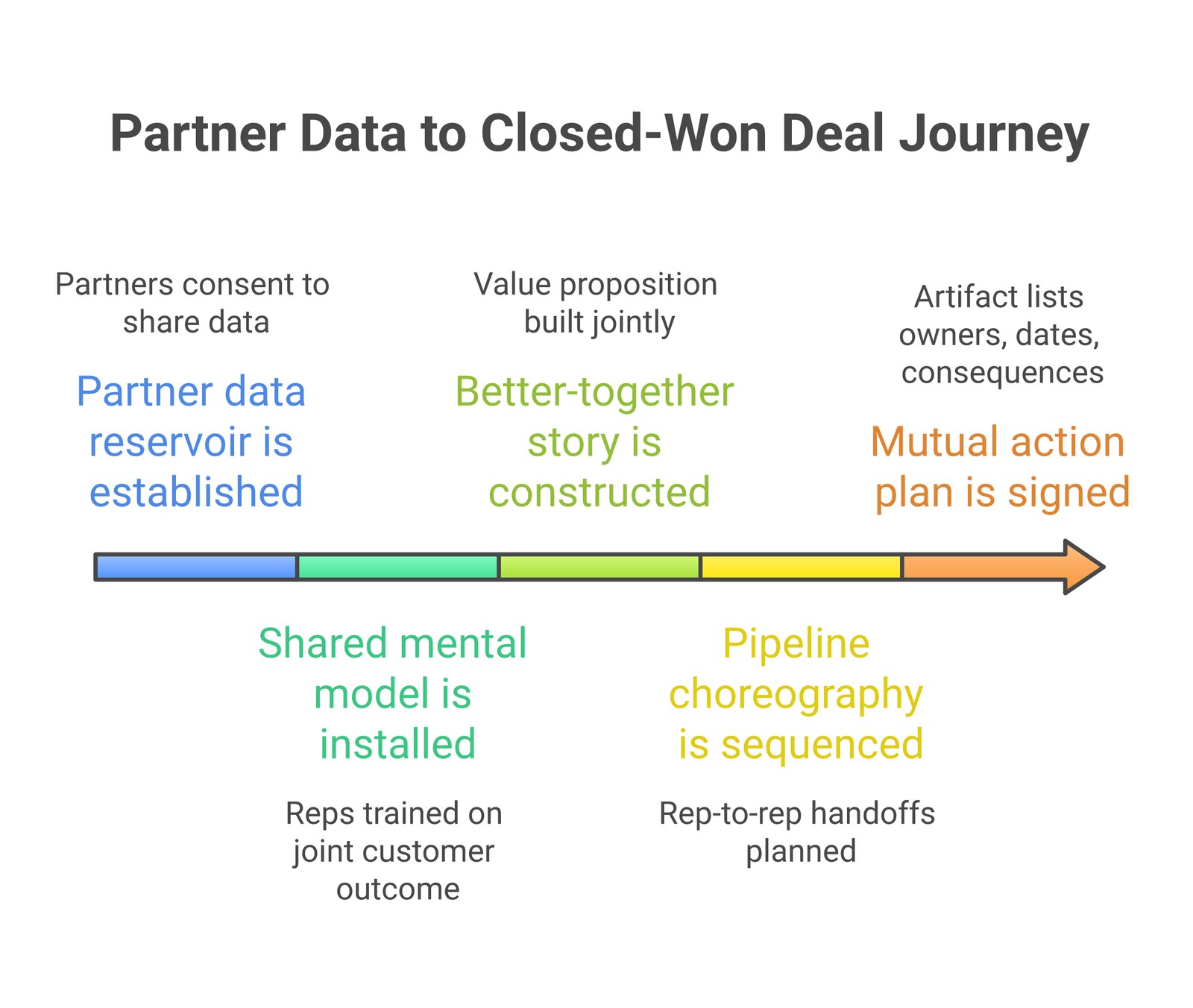
Between “we have the second-party data” and “we won the deal that the data surfaced,” there are four operational layers, every one of them under-built in most partnership programs.
Layer 1: The shared mental model
Indeed, research from outside our industry, NASA’s work on what predicts high-performing teams in tough environments, NFL teams drilling set plays off the wristband, special-operations units running zero-margin missions, converges on a single answer. The number-one predictor of high-performance team execution is not skill, culture, or leadership. It is a shared mental model. In multi-partner deals, this is what every partner-side rep carries on the wristband: what the joint customer outcome looks like, who owns which moment in the cycle, what “good” looks like for the deal. Without it, every overlap-data signal lands on a different mental model in each partner and gets translated into something different. The buyer ends up with five partial pitches that don’t aggregate.
Layer 2: The better-together story
The story has to land at the level of here is the customer outcome neither of us can produce alone, and here is exactly how we deliver it together. Most “better together” stories die at the surface, we have an integration, because nobody did the work to construct the actual joint value proposition. The work is uncomfortable. It requires both partners to subordinate their individual pitch to the joint outcome. Which is why almost no one does it without facilitation.
Layer 3: Pipeline choreography across all partners
Meanwhile, the deliberate sequencing of who opens, who deepens, who lands. When the customer hits a stage gap, who fires which play in what order? When a stakeholder goes silent, who owns the re-engagement? Choreography lives at the rep-to-rep layer across multiple partners, not at the exec-to-exec layer that runs the QBR. This is where the work happens. It is also where most multi-partner programs go quietly silent, the data surfaced the opportunity, nobody designed who runs the play.
Layer 4: Mutual action plans across N partners
A mutual action plan is the artifact that turns choreography from we agreed in the room to we still know what we’re doing in week six. In bilateral partnerships, mutual action plans are common but under-used. In multi-partner deals, they are almost non-existent, because there’s no shared infrastructure for one. Each vendor has their own CRM. Each partner has their own pipeline review. The only people who see the full picture are the customer (who isn’t going to coordinate it for you) and possibly a strategic alliance manager who has the title but not the authority to enforce it.
In fact, these four layers are the pipes from the reservoir to the deal. Without them installed, the data flow surfaces opportunity and produces noise.
Why “more AI” doesn’t fix this
Every partnership platform vendor with an AI roadmap right now is solving for one of two things: making the data layer faster (better matching, smarter notifications, predictive scoring) or making the analyst layer faster (chat-with-your-data, “Ask the Platform”). Both are valuable. Neither is the operational layer above.
Most importantly, Bridge Partners put the principle in one line: automation delivers scale; orchestration delivers impact. When the operational layer is missing, AI does not generate it. AI makes the data movement faster. If the operational layer underneath the data is well-designed, AI accelerates it. If the operational layer underneath is broken, AI accelerates the broken cadence too.
The most expensive partnership AI investment in 2026 is the one made by a company that has not yet built the operating cadence underneath. The platform produces signal at higher and higher fidelity. The signal lands in an organization that has no choreography for it. The signal becomes noise. The leadership team concludes AI didn’t work. The platform becomes a cost line.
What this means for your team this month
However, two diagnostics worth running before the next leadership meeting.
Diagnostic one: The data-layer funnel
Pull a 90-day snapshot of your second-party data feed. How many partner overlaps were surfaced? What percentage triggered an action, any action, by a partner-side rep? Of those that triggered an action, how many produced a meeting? Of those that produced a meeting, how many produced a joint deal in the pipeline? The conversion ratio at each stage tells you whether the data layer is operational or theatrical.
Diagnostic two: The four-layer audit
Therefore, pull your top three multi-partner deals currently in pipeline. For each, score:
- Do all partner-side reps see the same picture of the joint customer outcome (shared mental model)? Yes / No.
- Has the better-together story been deliberately constructed and trained, or are partners pitching their individual narratives? Constructed / Improvised.
- Is the pipeline choreography deliberately sequenced (who opens, who deepens, who lands), or is it improvised play-by-play? Sequenced / Improvised.
- Does a single mutual action plan with explicit owners and dates exist across all involved partners, or are there multiple uncoordinated tracking surfaces? Single / Multiple.
If you score yes / constructed / sequenced / single on all four for any of the three deals, that deal is operating with the cadence the ELG triplet promises. If you score otherwise on most of them, the data layer is doing its job and the operational layer is the missing variable.
The Forecastable layer
Specifically, the Forecastable methodology, the 9-accelerator system across Strategy, Story, and Selling, is built to operate exactly the cadence layer that the data alone cannot produce. The Strategy axis (partner activation, ecosystem leverage, disproportionate advantage) integrates with the second-party data layer rather than replacing it. The Story axis (layered value, shared model, pipeline choreography) builds the four operating layers above. The Selling axis (production culture, discipline & accountability, frontline engagement) installs the discipline that makes the cadence survive between reorgs.
Most companies come in red on three or four of the nine accelerators. Within a quarter, they have moved at least two to yellow. Within a year, the ones who commit are running dark green on five or more, and the partner-sourced forecast looks fundamentally different than it did when they started.
By contrast, the system is the same whether you are at $10M ARR or $1B. The execution is the work.
Closing
Bob Moore named the moat. The next layer of the argument, what installs the operating cadence that turns the moat into deal motion, is the layer almost no one is operationalizing.
In practice, if your partnership program is sitting on a Crossbeam data layer, an AI investment, and a partner roster, and the platform is producing more dashboards than deals, the data is not the problem. The four operating layers underneath the data are missing.
That is the work we do, and at a price point that is in reach of any company doing $10M ARR or above.
Notably, the second-party data layer is going to keep getting better. The companies that build the operating cadence underneath that data layer in 2026 will be operating at a structural advantage in 2027 that will be increasingly difficult for competitors to close.
That is the actual conversation worth having with your leadership team this quarter.
Talk to our team about installing the cadence in your program →
Related reading
Forecastable is an independent third-party professional services company. Our evaluations of other vendors are based on publicly-available information as of May 2026 and our own client experience.
Uncover Your Growth Potential
Schedule a Discovery Call