Account Based Marketing Agency: Partner-Led ABM That Produces Pipeline

Short answer: An account based marketing agency runs targeted campaigns into a named list of high-value accounts. Forecastable is the ABM agency that runs those programs through your partners. So target accounts come from partner overlap data. Partners bring third-party credibility, and they often co-fund the program with MDF. And because every motion runs with a partner, the pipeline counts as partner-sourced.
What does an account based marketing agency do?
Salesforce defines it plainly: “Account-based marketing (ABM) is a B2B marketing strategy for high-value customer accounts.” In other words, you stop marketing to everyone and pick the accounts you actually want. An agency runs that work for you.
Typically, a traditional ABM agency handles five jobs:
- Account selection: picking targets from fit and intent data.
- Buying-group research: mapping the people who decide at each account.
- Messaging: writing account-specific copy and content.
- Outreach: running ads, email, LinkedIn and direct mail into those accounts.
- Reporting: tracking engagement account by account.
That’s useful work, but there’s a catch. Every touch comes from one brand, and it’s yours. Buyers know you’re biased. So your brand only carries so much credibility on its own.
Why does partner-led ABM beat traditional ABM?
I’ve worked ABM from both sides of the table. Early on, I was a technical marketing-automation marketer, and I was a Marketo customer from 2015. After Vista Equity Partners bought Marketo, I became an Enterprise AE there. Then I stayed through the Adobe acquisition. In that seat, I helped guide some of the largest enterprises on marketing strategy, ABM, attribution and multi-touch attribution, including Marketo’s Bizible acquisition.
Back then, prospects kept asking me how Marketo compared with Salesforce Pardot. So I’d hand them our comparison collateral, and they might even read it. Still, they knew it came from the vendor. They knew it carried vendor bias.
On the Adobe side, I collaborated with SIs and tech partners to get things done. Then I switched to the SI side and co-sold the reverse way, with the Adobe reps. I knew their pain points. And even when I said the same thing they were saying, it carried more credibility. Why? Because it came from a third party. We doubled revenue and flipped the company.
That’s the whole case for partner-led ABM in one story. When a partner says it, buyers listen differently.
Think about how you shop on Amazon. You don’t buy on the product description alone. Instead, you look at the stars and how many people vouched for the product. In the same way, a buyer who keeps hearing your name from different partners starts to wonder what they’re missing.
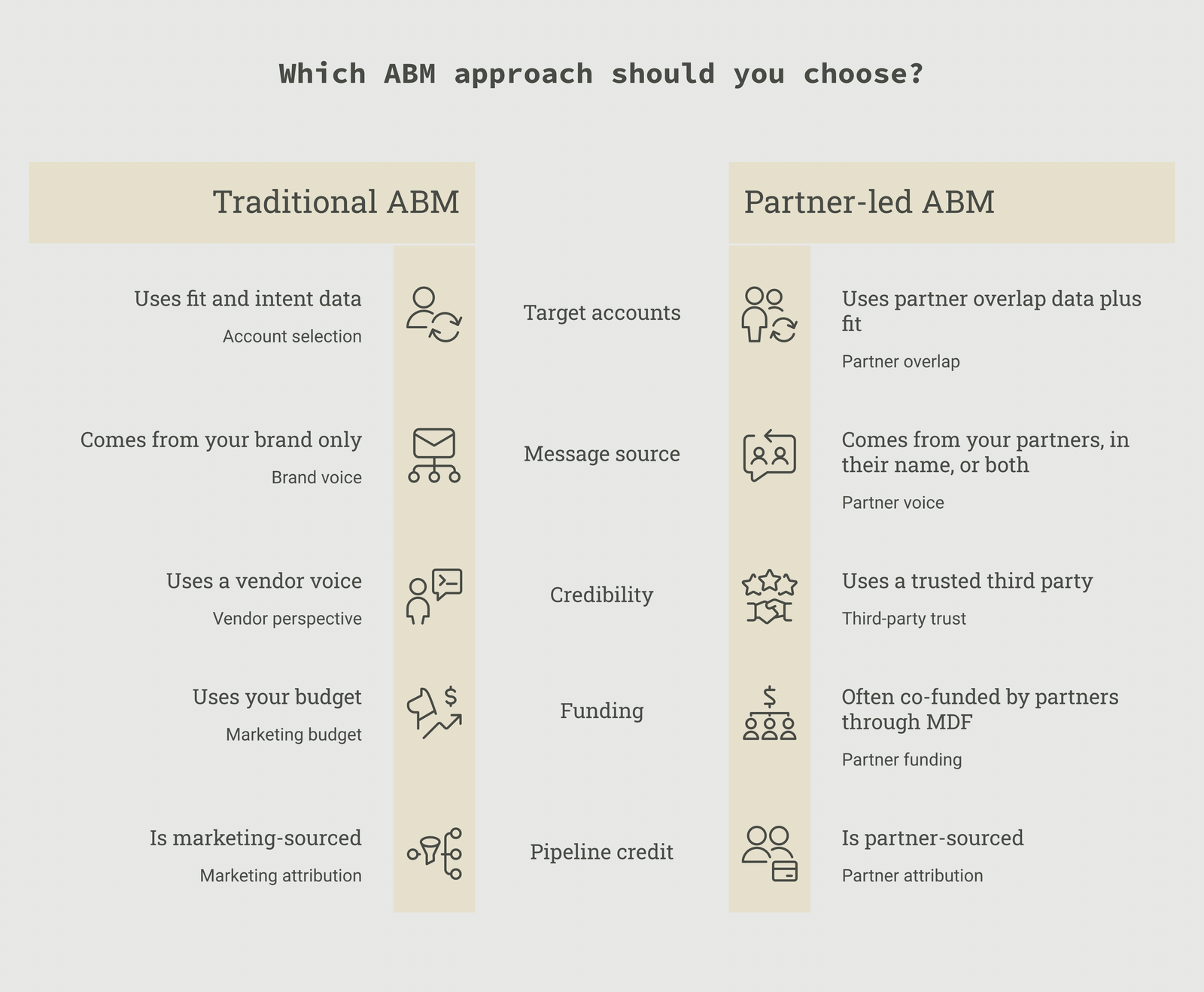
Traditional ABM agency vs partner-led ABM
| Traditional ABM agency | Partner-led ABM with Forecastable | |
|---|---|---|
| Target accounts | Fit and intent data | Partner overlap data, plus fit |
| Who the message comes from | Your brand only | Your partners, in their name, or both |
| Credibility | Vendor voice, discounted for bias | A third party the buyer already trusts |
| Main channels | Ads, email and content | Email, LinkedIn and calls, plus events |
| Who funds it | Your marketing or sales budget | Often co-funded by partners through MDF |
| Pipeline credit | Marketing-sourced | Partner-sourced |
| Who runs it | The agency plus your marketing team | Our campaign operations specialists and SDRs |
What partner surround sound looks like
Each partner brings a different reason to engage. For example, in week one the buyer hears from one partner about an integration. Then in week two, a services partner talks about getting it live. The messages differ, but one name stays constant, and it’s yours.
We call that partner surround sound. Of course, it only works when someone controls the sequence, so we stagger partners and no account gets over-contacted. More messages is not the point. More relevant reasons to engage is.
Why should partner-led ABM be written for the CRO?
ABM is usually sold as a way to speed up the sales process. As a result, the budget often comes from sales, not marketing. Judd Borakove, our Managing Partner, Client GTM Activation, has spent two decades as a GTM strategist and fractional CRO. In his experience, most of the time the CRO says yes and marketing executes.
That changes what you write and what you measure. A CRO cares about meetings, SQOs and pipeline. So every GTM motion we write gives the buyer a different, relevant reason to engage, not the same pitch from a new sender.
Here’s the question I like to put to a CRO. Take your top 500 target accounts. How many of them have no partner activity on them at all? That gap is where partner campaigns should go first. It’s also why ABM belongs inside how you build a partner marketing strategy.
What’s included in our ABM agency program?
Forecastable is a B2B partnerships agency. Our partner-led ABM runs inside Produce My Pipeline, our done-for-you Partner-Sourced Pipeline program. Here’s what you get:
- Target accounts from overlap data. We work your Crossbeam overlaps to find accounts where a partner already has a relationship. Crossbeam describes account mapping as cross-referencing your pipeline with a partner’s list.
- Partner selection. We workshop which partners should produce, and into which accounts.
- Joint messaging. Each partner gets its own angle, so partners don’t send the same thing to the same accounts.
- Multichannel outreach. Email, LinkedIn and calls go out as the partner, as you, or both.
- A real human SDR. The included SDR, a person and not AI, makes about 1,000 cold calls a month. With three to five motions running, we prioritize which motions get SDR calls, or add a second SDR for more calling.
- Real people on replies. Follow-up is handled by people, never AI agents.
- Webinars and events. These run as co-marketing motions when they fit the account list.
- Funding help. We help partners fund the program through MDF or other budgets.
- Visibility without a login. You see everything through the Forecastable MCP in Claude, ChatGPT or Microsoft 365 Copilot. Meanwhile, Eva, our AI partner ops agent, watches the data in the background.
How does an ABM engagement run?
Here’s the sequence we follow:
- Program-Fit Analysis. First, a 30-minute call with a senior partnerships leader to see which program fits, if any.
- Workshop. Next, we learn where you need to win and which partners should produce.
- Account list. Then we set the named accounts in advance and sort each one as ask, give or mutual.
- Build. A working GTM motion is typically ready about two weeks after the workshop.
- Launch. Motions go live in two to three weeks, depending on calendars.
- Run. After launch, motions run for two full months while you watch activity as it happens.
- Expand. Finally, we contract a quarter at a time, with no long-term lock-in.
Who is partner-led ABM for?
It fits companies that already believe in ABM but want more trusted paths into the same accounts:
- Platform companies with large ecosystems of technology and services partners.
- Enterprises whose partner program runs on hope instead of a forecast.
- GSIs and services partners who want technology partners to fund campaigns.
- CROs who want partners to become a predictable pipeline channel.
- Partner leaders sitting on Crossbeam data with no one to act on it.
By contrast, it isn’t a fit for affiliate, ambassador or influencer programs. We work only with B2B partners: resellers, distributors, integrators, agencies, MSPs, technology partners and platforms, and the list goes on.
How is an ABM agency measured?
We measure partner-led ABM on four numbers:
- Target accounts engaged. Accounts on your list that responded.
- Meetings held. Not booked. Held conversations with the accounts on your list.
- SQOs. Sales-qualified opportunities your reps accept.
- Partner-sourced pipeline. The dollar value of those opportunities.
Here’s the rule that keeps the number honest. If your SDR team books it, it isn’t partner-sourced. But when a motion runs with the partner, it counts as partner-sourced. Credit then follows each platform’s own attribution policy. If the terms are new to you, here’s how partner-sourced and partner-influenced pipeline differ.
Watch for one trap. Partner ABM warms accounts up, and reps notice. But if your rep or SDR picks up the phone on that signal, it counts as a direct deal, not a partner deal. So agree up front on who acts on engagement, and when, before anyone jumps the gun.
Net new is the North Star, and partner-sourced expansion counts too. Partner-influenced helps, but it isn’t the number.
Related reading
- Account-Based Discovery for Partner Teams
- Ecosystem-Led Pipeline: The Warmest Channel You Own
- How to Prioritize Which Accounts to Target First in Account-Based Selling
- Partner Incentive Program: Design One That Produces
- Partner-Led GTM: A Go-to-Market Built on Partners
Frequently asked questions
How much does an ABM agency cost?
Our Partner-Sourced Pipeline program starts at $50,000 a quarter. That activates a campaign operations specialist, an SDR and the platform. It’s the floor, not a cap. Each GTM motion plans at about $12,500, so four fill the $50,000. Also, partners can cover all or part of it, so it could cost you $0. See our pricing for the full list.
What is partner ABM?
Partner ABM means running account-based campaigns through partners instead of under your brand alone. Same target accounts, more trusted paths in, one coordinated strategy.
How is a partner-led ABM agency different from an outbound agency?
An outbound agency books meetings in your name. By contrast, we run motions as your partners, so the pipeline counts as partner-sourced. Here’s our full comparison with an outbound agency.
Can partners pay for ABM with MDF?
Often, yes. The M in MDF is market, not marketing, so partners can fund all of a program or split it with you. Our MDF guide explains how the money works.
Do I need Crossbeam for partner-led ABM?
It helps a lot, because overlap data picks the accounts. Still, when data can’t be shared, the platform can hand partners account lists instead. If you want someone working those overlaps daily, that’s our account-mapping service.
How fast can a partner-led ABM program launch?
Typically, a working GTM motion is ready about two weeks after the workshop. It then goes live in two to three weeks, depending on calendars.
Does partner-led ABM replace our existing ABM?
No, it can run right alongside it. Your own ABM keeps your brand in market. Meanwhile, partners add the third-party voice your own campaigns can’t.
Will multiple partners over-contact the same account?
Not when someone controls the sequence. Instead of letting partners pile on, we stagger them so each one brings a different reason to engage at a different moment.
What’s the bottom line?
Traditional ABM puts one brand in front of a target account. Partner-led ABM puts several trusted voices there, and they all point back to you. So pick the accounts from partner data, let partners carry the credibility, and measure it the way your CRO does. And if you want reach beyond a named list, our B2B demand generation through partners uses the same motions.
Forecastable is an independent third-party professional services company, a B2B partnerships agency and Crossbeam’s Solutions Partner of the Year. Our evaluations of other vendors are based on publicly-available information as of November 2026 and our own client experience.
Want your partners carrying your ABM into your target accounts? Book a Program-Fit Analysis
Uncover Your Growth Potential
Schedule a Discovery Call