Account-Based Discovery for Partner Teams

What is account-based discovery?
Short answer: Account-based discovery is the practice of starting from a defined list of target accounts and working backward to find the partner relationships, signals, and entry points into each one, rather than starting from inbound leads and hoping the right accounts show up. It flips discovery from reactive to deliberate.
For partner teams this is the difference between chasing whatever a partner happens to mention and systematically asking, for each account you want, which partner can get you in. The account leads; the partner is the path.
Why account-based discovery matters in 2026
Account-based discovery matters because partner introductions are most valuable when they are aimed. A warm path into a random account is a nice surprise; a warm path into an account already on your target list is pipeline you planned for. Starting from the accounts you want turns the partner ecosystem from a source of lucky breaks into a deliberate route to revenue, which is what makes it fundable.
In 2026 the signals to do this well are finally available. Overlap data shows which partners already work with your target accounts, so you no longer have to guess which relationship to lean on. The teams that combine a target-account list with partner overlap can ask a precise question, which partner introduces us to this specific account, while the teams still working lead-first leave those introductions on the table because they never thought to ask.
There is also a focus argument. Partner attention is limited, and a vague request to a partner produces a vague response. Asking a partner about a specific account you both care about gets a specific answer, because you have given them something concrete to act on. Account-based discovery concentrates partner effort where it converts instead of spreading it across whatever comes up.
How account-based discovery actually works
Account-based discovery runs as a sequence from target list to partner-enabled entry. The components below are the steps that turn a list of accounts into warm conversations.
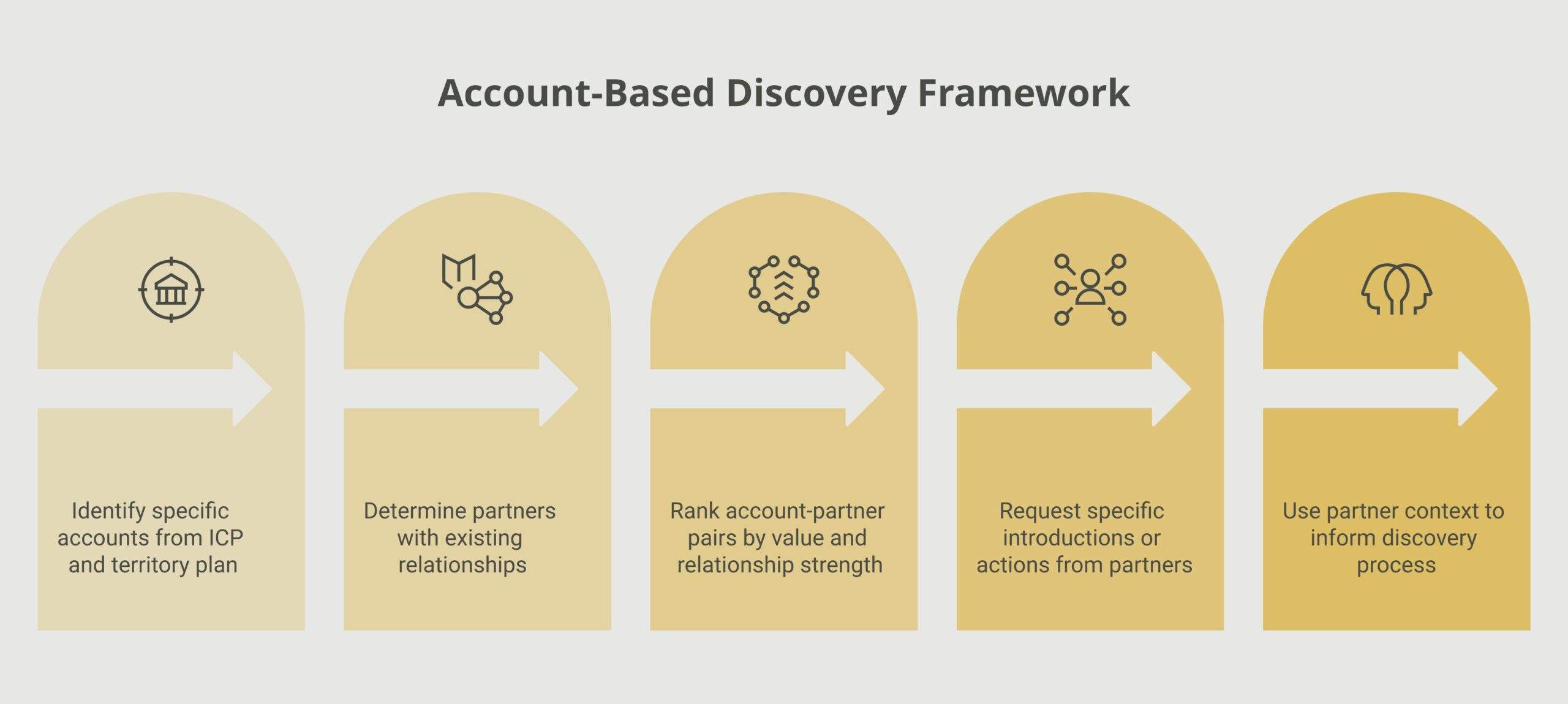
- Define the target accounts: Start with the specific accounts you want, drawn from your ideal customer profile and territory plan. Discovery is only as focused as the list that anchors it.
- Map partner overlap: For each target account, find which partners already have a relationship, using overlap data rather than guesswork. This is the step that tells you which path actually exists.
- Prioritize the paths: Rank the account-partner pairs by account value and the strength of the partner relationship. Not every overlap is worth pursuing, and the strongest paths deserve effort first.
- Make the specific ask: Go to the partner with a named account and a clear request, such as an introduction to a specific buyer, not a general request for leads. Specificity is what turns partner goodwill into action.
- Run discovery jointly: Use the partner’s context on the account to enter discovery already informed about the buyer, their situation, and the right entry point. The partner’s knowledge is half the value of the path.
Common pitfalls in account-based discovery
- No real target list: Account-based discovery with a vague or oversized account list is just lead-chasing with extra steps. The discipline starts with a list tight enough to act on.
- Guessing at partner overlap: Asking partners broadly who they know wastes their time and yours. Without overlap data you cannot aim the question, so the introductions you could have had never surface.
- Generic partner asks: A request for leads gets a shrug; a request for an introduction to a named buyer at a named account gets an answer. Vague asks produce vague results.
- Ignoring relationship strength: A partner with a weak tie to an account cannot open the door, no matter how much you want in. Pursue the paths where the partner actually has standing.
- Treating the partner as a lead source, not a guide: The partner’s value is their context on the account, not just the introduction. Skipping their knowledge wastes the most useful part of the path.
What this looks like in practice
A sales team ran discovery from inbound leads and occasionally got a partner referral, but never connected the two to a plan. They had a clear list of target accounts and a set of active partners, yet no one had asked, account by account, which partner could get them in. The introductions they could have had sat unrequested because discovery started from leads, not from accounts.
The shift was to run discovery account-first. The target list was matched against partner relationships using overlap data, surfacing which partners already worked with each priority account, with the matches pulled from the team’s overlap tools and partner platform such as Introw or Euler. For the strongest pairs, the team made a specific ask, an introduction to a named buyer, and entered each conversation already briefed by the partner on the account’s situation. The same partners who had produced occasional referrals now produced targeted introductions into accounts the team actually wanted, because the team finally asked the precise question.
Forecastable’s POV on account-based discovery
Our position is that the partner ecosystem is wasted as a lead source and powerful as a routing layer. When you start from leads, partners give you whatever they happen to have; when you start from accounts, partners give you a path into the ones you chose. The accounts should always lead, because that is what turns partner relationships from luck into strategy.
We also think the overlap question is the unlock most teams skip. The reason discovery stays lead-first is that teams cannot easily see which partner already works with a given target account, so they never ask. Once that overlap is visible, the question becomes obvious and precise, and the partner has something concrete to act on. The data is what makes account-based discovery practical rather than aspirational.
Finally, specificity is the whole game. A partner asked for leads gives you nothing; a partner asked to introduce you to a named buyer at a named account gives you a meeting. The teams that get the most from partners are the ones that do the work to make the ask precise, because precision is what converts a relationship into pipeline you can forecast.
Forecastable is a partnerships operating platform. Any third-party tools named here are independent third-party products, and naming them is not an endorsement of one over another. Decide how account-based discovery should run for your own accounts, partners, and motion.
Frequently asked questions
What is account-based discovery?
It is starting from a defined list of target accounts and working backward to find the partner relationships and entry points into each one, rather than starting from inbound leads. The account leads and the partner is the path in.
How is account-based discovery different from lead-based discovery?
Lead-based discovery reacts to whatever comes in; account-based discovery deliberately pursues the accounts you chose. For partner teams, that means asking which partner can introduce you to a specific target rather than waiting for a referral to appear.
How do partners fit into account-based discovery?
Partners provide the warm path and the context into target accounts. Overlap data shows which partners already work with each account, so you can make a specific introduction request and enter discovery already briefed on the buyer.
What data do you need for account-based discovery?
A tight target-account list and partner overlap data that shows which partners have a relationship with each account. Together they let you aim discovery instead of guessing which partner to ask.
Why do generic partner asks fail?
Because a request for leads gives the partner nothing concrete to act on. A request for an introduction to a named buyer at a named account is specific enough to produce a real answer.
Is account-based discovery only for enterprise teams?
No. Any team with a defined target-account list and active partners can run it. The discipline scales down as long as the account list is tight enough to act on and you can see partner overlap.
Next step
If your team runs discovery from leads while a list of target accounts sits unworked, partner overlap can turn that list into warm paths in. Forecastable helps partnerships teams match target accounts to partner relationships and turn discovery into deliberate, account-first motion. Start your growth journey now to aim partner introductions at the accounts you actually want. The partner program hub frames how discovery fits the wider partner motion.
Uncover Your Growth Potential
Schedule a Discovery Call