Partner-Led GTM: A Go-to-Market Built on Partners

What is partner-led GTM?
Short answer: Partner-led GTM is a go-to-market model in which partners are the primary route to reaching, selling, and serving customers, rather than a supplementary channel layered on top of a direct sales motion. It means the company designs its entire commercial engine, sales, marketing, support, and product, around partners carrying the customer relationship, treating the partner ecosystem as the main way the business grows instead of an add-on to direct selling.
Most companies run a direct-led motion with partners bolted on, and call any partner activity partner-led. True partner-led GTM is a different commitment: the company organizes around partners as the front line, which reshapes how it hires, comps, builds product, and measures success.
The frame that matters is that partner-led GTM is a strategic choice, not a tactic. It is the decision to make the ecosystem the engine, with everything that implies, and a company that adopts the language without the structural commitment ends up with neither a strong direct motion nor a real partner one.
Why partner-led GTM matters in 2026
Buyers increasingly prefer to buy through trusted parties, marketplaces, advisors, and existing vendors, rather than from a direct seller, and partner-led GTM meets them where they already are. In 2026, with ecosystems and marketplaces a larger share of how software gets bought, building the go-to-market around partners is a way to align with how customers actually purchase.
The second reason is economics and reach. A direct motion scales linearly with headcount, while a partner-led motion can reach markets, segments, and geographies a direct team could never cover affordably. For companies whose addressable market is broader than their direct sales capacity, partner-led GTM is the only model that reaches it.
The third reason is durability. A customer relationship held through a trusted partner can be stickier and more defensible than a direct one, because the partner is embedded in the customer’s operations. A well-built partner-led motion creates a moat that a purely direct motion does not, which matters more as markets get more competitive.
How partner-led GTM actually works
Partner-led GTM works when the whole commercial engine is organized around partners carrying the customer, and the value is in the structural commitments most companies are unwilling to make.
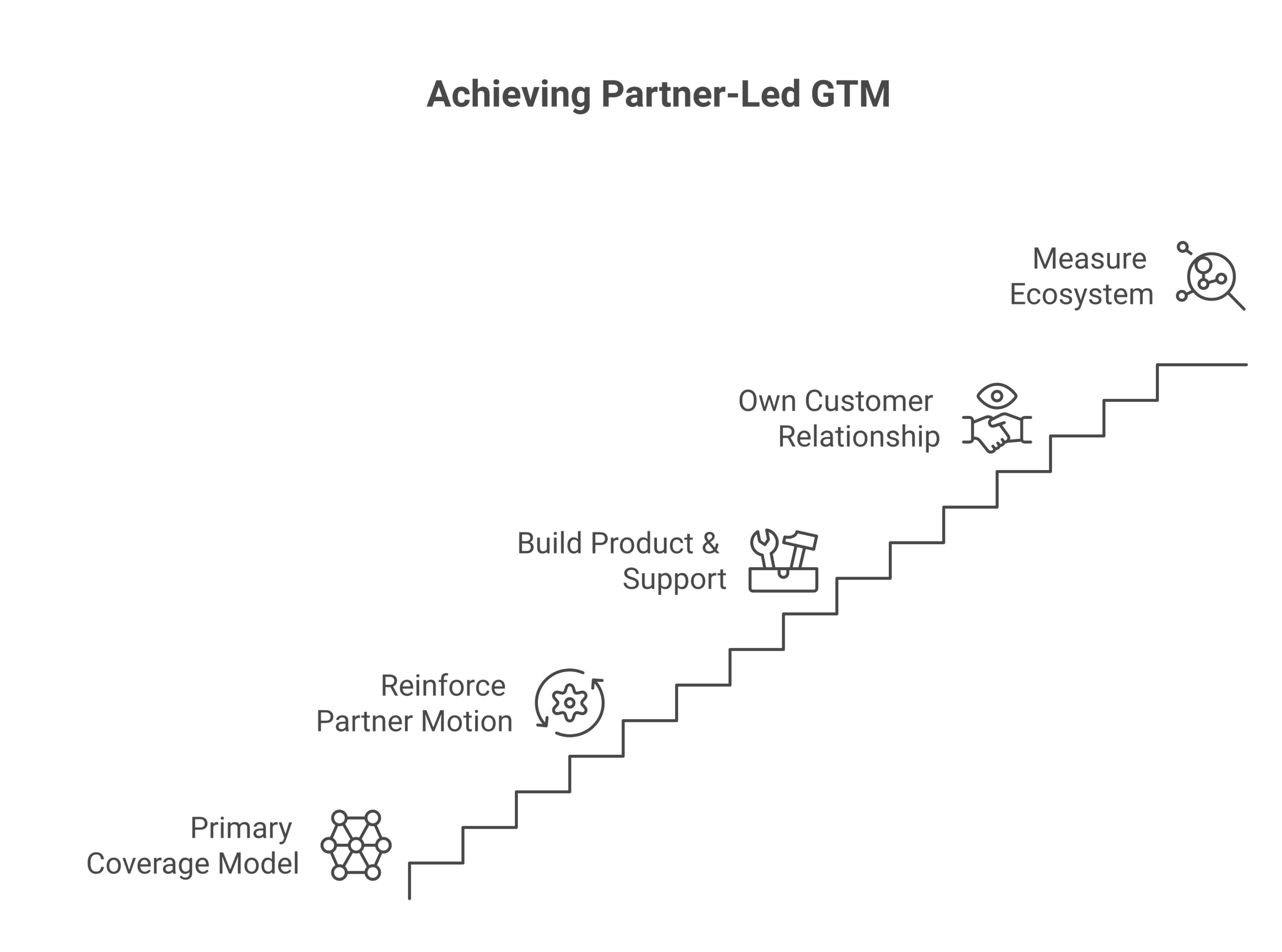
- Make partners the primary coverage model: Design territory and account coverage so partners are the front line for most of the market, with direct sellers focused where partners cannot reach or a deal demands it. A coverage model that still defaults to direct is not partner-led.
- Comp and organize to reinforce the partner motion: Align sales compensation, roles, and incentives so the company’s people are rewarded for winning through partners rather than around them. A comp plan that pays more for direct deals guarantees the organization quietly undermines the partner-led strategy.
- Build the product and support for partner delivery: Make the product something partners can implement, extend, and support, and give them the tools to do it, because partner-led GTM fails if partners cannot actually deliver. The product has to be built for a partner to carry, not just to be sold by one.
- Enable partners to own the customer relationship: Equip partners to sell, onboard, and support customers with enough depth that the customer’s primary relationship is genuinely with the partner. Half-enabled partners produce a fractured experience where neither the partner nor the company fully owns the customer.
- Measure the ecosystem, not just direct metrics: Track the health and production of the partner ecosystem, sourced and influenced revenue, partner capacity, customer outcomes through partners, as the primary scorecard. A company that still measures itself mainly on direct metrics is not actually running a partner-led model.
The model is read against ecosystem production and customer outcomes through partners, so the company can see whether its structural commitments are producing a real partner-led engine or just a relabeled direct one.
Common pitfalls in partner-led GTM
- Adopting the language without the structure: A company that calls itself partner-led while keeping a direct-first coverage model and comp plan gets the worst of both, an underpowered direct motion and a partner motion the organization quietly works around. The label without the commitment produces nothing.
- Comp that rewards direct over partner: When sellers earn more on direct deals than partner ones, the organization will route around partners no matter what the strategy says. Compensation is the truest statement of what a company actually wants, and a misaligned plan defeats the model.
- A product partners cannot deliver: Partner-led GTM collapses if partners cannot actually implement and support the product, leaving the company to backfill delivery and the customer with a poor experience. The product has to be built to be carried by a partner.
- Half-enabling partners: Partners equipped to sell but not to onboard and support produce a fractured customer experience and a relationship that belongs fully to neither side. Owning the customer requires depth the program often underinvests in.
- Keeping direct metrics as the scorecard: A company that organizes around partners but still measures itself on direct bookings sends a mixed signal and starves the partner motion of attention. The scorecard has to reflect the strategy or the strategy is just talk.
What this looks like in practice
A software company serving a broad market it could never cover with direct sellers decided to go genuinely partner-led rather than bolt partners onto its existing motion. The shift was structural and uncomfortable. Coverage was redrawn so partners were the front line across most segments, with a small direct team reserved for the largest accounts. Compensation was rebuilt so winning through a partner paid as well as winning directly, which ended the quiet routing-around that had plagued earlier partner efforts. The product roadmap took on work to make the platform something partners could implement and extend, and enablement deepened until partners could onboard and support customers themselves. The company changed its primary scorecard to ecosystem production. The transition cost a year and some attrition among sellers who preferred the old model, but at the end the company reached markets its direct team never could, and the partner-held customer relationships proved stickier than its direct ones had been. Partner-led GTM worked because the company actually rebuilt around it rather than relabeling what it already had.
Forecastable’s POV on partner-led GTM
Comp is the strategy, whatever the slides say. The single most reliable predictor of whether a company is actually partner-led is its compensation plan, because if sellers earn more on direct deals they will route around partners regardless of any stated commitment, and the organization’s real strategy is whatever its incentives reward. A company serious about partner-led GTM rebuilds comp first; one that leaves comp direct-first has decided not to be partner-led no matter what it announces.
The second conviction is that partner-led GTM is a structural commitment most companies are not willing to make, and that is fine as long as they are honest about it. The model demands rebuilding coverage, comp, product, and metrics, and a company that wants the benefits without the disruption ends up with a relabeled direct motion that disappoints everyone. The honest path for many companies is a partner-influenced or hybrid motion, not full partner-led, and pretending otherwise just produces a confused organization.
The candid limit is that partner-led GTM does not fit every business. A company with a narrow market its direct team can cover, a product that genuinely requires direct delivery, or a customer base that wants to buy directly may be better served by a direct-led motion with partners in support. The model is powerful where it fits and destructive where it is forced, and the strategic skill is telling the difference rather than adopting it because it is fashionable.
Forecastable is a partnerships operating platform; any third-party tools or platforms referenced here are independent third-party products, and naming them is not an endorsement of one deployment over another. Evaluate each against your own market.
Frequently asked questions
What is the difference between partner-led GTM and a partner channel?
A partner channel is partners added to a direct-led motion; partner-led GTM makes partners the primary route to market, with the whole commercial engine organized around them. The difference is whether partners are the front line or a supplement.
How do you know if a company is really partner-led?
Look at coverage, compensation, and the primary scorecard. If the coverage model defaults to direct, comp rewards direct over partner, or the company measures itself mainly on direct bookings, it is partner-influenced at best, not partner-led, regardless of the label.
Does partner-led GTM mean no direct sales?
No. Most partner-led models keep a direct team for the largest or most complex accounts and where partners cannot reach. The point is that partners are the primary coverage model, not that direct selling disappears entirely.
What has to change to go partner-led?
Coverage, compensation, product, enablement depth, and metrics. The model is a structural commitment, not a tactic, and changing the label without rebuilding these produces a relabeled direct motion that satisfies no one.
When does partner-led GTM fit a company?
When the addressable market is broader than the direct team can cover, when buyers prefer to purchase through trusted parties, and when the product can be delivered by partners. It fits poorly for narrow markets a direct team can cover or products requiring direct delivery.
Why does compensation matter so much?
Because comp is the truest statement of what a company rewards. If sellers earn more on direct deals, they route around partners no matter the strategy. A partner-led model that leaves comp direct-first has effectively decided not to be partner-led.
Next step
If you are considering a partner-led motion, the move this week is to look honestly at your compensation plan and ask whether it pays your sellers as well for winning through a partner as for winning directly.
Start your growth journey now to decide whether partner-led GTM fits your market and what it would take to commit, or read the orientation on the partner program for the broader operating m
Uncover Your Growth Potential
Schedule a Discovery Call