Workday Partner Program: Partner Types, How to Join and How to Get Noticed

Short answer: The Workday partner program has three tracks. Innovation Partners build, Sales Partners grow and Services Partners deliver. Most software vendors join as Innovation Partners and list apps on Workday Marketplace. But joining is the easy part. Workday doesn’t publish tier thresholds, so the vendors who stand out are the ones bringing Workday new deals. And the fastest way I know to do that is partner-sourced pipeline with Workday’s services partners.
Looking for the Workday partner portal login? Go to the Workday partner portal.
Already in the program? Here’s how partners turn it into pipeline.
What is the Workday partner program?
The Workday partner program is how Workday works with the firms that build on it, sell it and deploy it. In fact, Workday’s own partner program overview splits it into three programs. Each one maps to a verb:
- Build: Workday Innovation Partners offer complementary offerings “while driving verticalization and customer exposure.”
- Grow: Workday Sales Partners “play a key role in our go-to-market strategy by creating demand, expanding sales, and advising customers.”
- Deliver: Workday Services Partners “manage deployments, support application-managed services, and provide staffing solutions.”
So when people search “Workday partner program,” that’s the structure they land on. As of November 8th, 2026, Workday lists four partner benefits on that page. Those are Workday training and product information, partner logo eligibility, co-innovation opportunities and Workday Partner Management.
The history explains the shape. Back in a September 13th, 2022 announcement, Workday said its enhanced partner program would have three consolidated tracks for innovation, go-to-market and services partners. In the same release, it said it was launching co-selling programs with partners. It also eliminated fees for the Workday Extend partner program.
What types of Workday partners are there?
Here’s the confusing part. The program page names three tracks. Yet the “Find a Partner” section of Workday’s partners page lists four partner types. And Marketplace, Built on Workday and the Agent Partner Network sit on top of those. So here’s how they line up:
| Partner type or program | What it is | Who it’s for | Where Workday describes it |
|---|---|---|---|
| Innovation Partners (Build) | Complementary software that integrates with and enhances Workday | Software vendors and ISVs | Partner program overview |
| Sales Partners (Grow) | Partners that create demand, expand sales and advise customers | Go-to-market partners | Partner program overview |
| Services Partners (Deliver) | Deployments, application-managed services and staffing | Systems integrators and consulting firms | Partner program overview |
| Advisory Partners | Guidance on digital acceleration, product selection and change management | Advisory and consulting firms | Find a Partner |
| VNDLY Managed Service Provider Partners | Help to reduce costs, set recruitment strategies and mitigate risk | MSPs working with VNDLY | Find a Partner |
| Built on Workday | Partners build apps on Workday’s platform and distribute them to customers | Software partners and developers | Built on Workday page |
| Workday Marketplace | Vetted apps and agents from Workday, customers and partners | Every partner with something to list | Partners page |
| Agent Partner Network | Partners building AI agents that connect to Workday | AI software vendors | Workday newsroom, June 3rd, 2025 |
In practice, a software vendor joins in the first row and shows up in the last three. Meanwhile, the services partners in row three are the ones in the room for deployments.
Does the Workday partner program have tiers?
Not publicly. As of November 8th, 2026, Workday’s public partner pages don’t list tier names, bars or fees. If you’re comparing ecosystems, our breakdown of the ServiceNow partner program is a useful contrast.
Back in 2022, Workday said each track would have multiple tiers, with performance and competency indicators and different incentives and benefits. It just hasn’t put the details on its public site. So ask your Workday partner manager what’s measured and when it’s reviewed. Then plan around that answer, not around a blog post.
But here’s what Workday does show publicly. The 2026 Workday Partner Awards include Sales Partner of the Year in three regions, plus Partner of the Year awards for AI Excellence, Innovation and Marketplace, among others. Those categories tell you what Workday wants to celebrate.
How do you become a Workday partner?
If you want in, the public path is short:
- Start on the program page. Go to the partner program overview and select “Start Your Partner Journey.”
- Contact Workday. Under “Ready to become a partner?” the page offers a “Contact Us” link.
- Talk to Workday. Workday doesn’t publish eligibility rules or application steps on its public pages. Expect a conversation about which track fits you.
- Move into the partner portal. Once you’re in, Workday points partners to its partner portal for resources and community.
That’s it on the public side. So don’t wait on a checklist that isn’t there. Instead, show up to that first conversation with a clear story about which customers you serve and which services partners you already work with.
How do Workday Marketplace, Built on Workday and Agent & App Builder fit together?
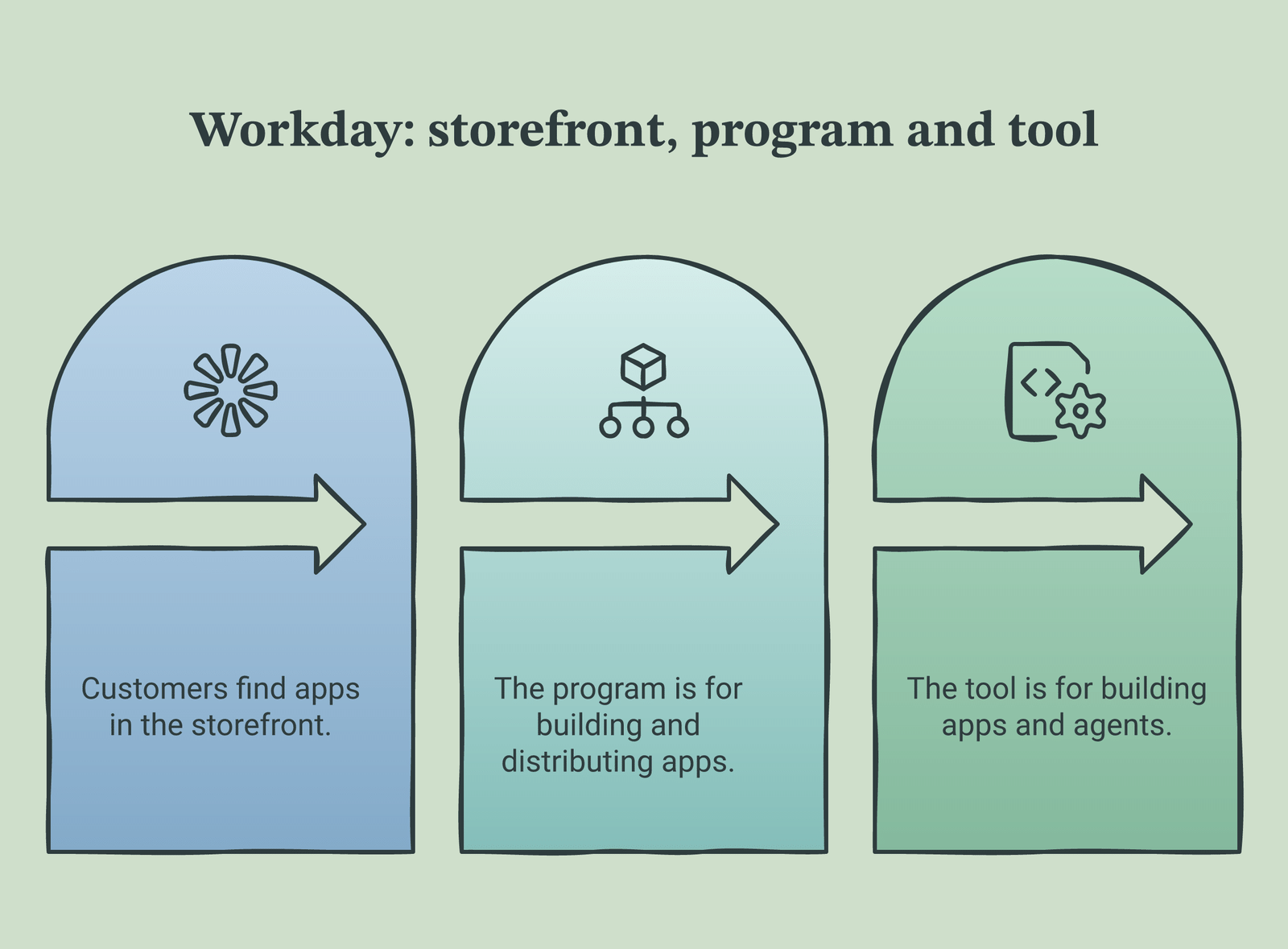
These three get mixed up a lot. In short, one is a storefront, one is a program and one is a tool.
Workday Marketplace is the storefront
First, the program page says Marketplace “features solutions built on and certified for the Workday platform.” It pitches it in two lines: showcase your advantage and capture customer interest. In other words, it’s where customers find you and where you capture leads.
Built on Workday is the app program
Workday announced Built on Workday on June 5th, 2024. It lets partners build finance and HCM apps on Workday’s platform and monetize them through Marketplace. Workday’s launch release called it a “build once, distribute to many” approach. Its program page says the platform runs on data from 70 million users and 800 billion transactions a year.
Agent & App Builder is the tool
Agent & App Builder sits under Workday Extend, Workday’s low-code builder. In short, it’s where partners and customers build apps and agents. Also worth knowing: on June 3rd, 2025, Workday launched an Agent Partner Network for partners building AI agents. By September 16th, 2025, Workday said it had grown to over 50 partners. And agents from those partners list on Marketplace too.
How does a software vendor get Workday’s attention?
Here’s the hard math. Built on Workday pitches distribution “to thousands of Workday customers.” From Workday’s side, you’re one product of many.
The same is true for the services partners. Each services partner works with many software vendors. You’re one vendor of many to them, too.
I treat a platform like Workday as a big bet. A Marketplace listing is a win for awareness. But don’t expect it to produce on its own. First, learn how Workday’s go-to-market is structured and who’s pushing partner deals inside it. Then go where the deals already happen.
Why the services partner is your best door
Think about who holds the trust. A services partner manages the deployment. So it sees the customer’s roadmap, the gaps and the timing. Meanwhile, you have the product that fills one of those gaps. Neither of you gets far alone.
I’ve sat on both sides of this. At Adobe, I worked with SIs and tech partners to get deals done. Then I switched to the SI side and co-sold the other way, with the platform’s enterprise AEs. We doubled revenue and flipped the company. So I know what an SI wants from a vendor. It wants deals that open services work. It won’t trade a services engagement for your license, and nobody should ask it to.
Side by side, a vendor and a services partner have a reason to call the same customers. That’s partner-sourced pipeline: deals that start because a partner opened the door. If you need the definitions, here’s how partner-sourced and partner-influenced pipeline differ.
Why your own SDRs can’t do this for you
There’s a catch, though. If your SDR team books it, it isn’t partner-sourced. After all, a cold email from your domain is just outbound. But a motion run with the partner, under the partner relationship, counts.
Still, partner managers can’t do it alone either. They’re in the relationship business, not the list-building business. Building lists and calling into accounts aren’t their job, so the motion stalls. Salesforce ISVs face the same problem, because a Salesforce partner listing isn’t the business either.
What does a partner GTM motion with a Workday services partner look like?
A partner go-to-market (GTM) motion is one campaign, run with one partner, into accounts you both care about. Here’s how we run one in the Workday ecosystem:
- Pick the partner. Choose a services partner whose customers match your buyer. An advisory partner, another Innovation Partner selling to the same HR or finance leader, and the list goes on.
- Set the account list in advance. Overlap your account lists before the meeting, not live on the call. Then sort every account as an ask, a give or a mutual. Give first.
- Write one joint story. Answer one question: why these two firms, for this Workday customer, right now?
- Run the outreach. Email, LinkedIn and cold calls go out under the partner relationship. A real human SDR makes the calls, not AI. Where it fits, add a field event or an in-person meeting.
- Hand off the meetings. Booked meetings go to whoever owns the deal, with the partner’s context attached.
- Track every result. Count meetings held, opportunities and closed deals. That’s your proof for the SI and for Workday.
Each one-off motion is quoted on its own, so there’s no fixed price. As a rough guide, about $15K tends to be the average for a one-off motion with a part-time SDR making a limited number of calls. For scale, one full-time SDR makes about 1,000 cold calls a month. So a program running three to five motions either picks which ones get the calling or adds a second SDR. And any GTM motion could cost you $0 if partners pay for it. Our Produce My Pipeline program is the version that runs every quarter.
And you may not pay for it alone. Partners often fund motions like this, because big companies fund programs, not tools. It’s worth knowing how market development funds work before you sign anything.
Related reading
- Partner Sales Process: How Partner Deals Get Worked
- SaaS Channel Partners: Types, Economics, and Motion
- Channel Partner: What It Is, Types, and How It Works
- What Is a Channel Partner Program? Definition and Types
- Strategic Alliance: Definition, Types, and Examples
- Partner Vetting: Choosing Partners Worth the Bet
Frequently asked questions
Is the Workday partner program free?
No public price exists. Workday doesn’t post partner fees on its public pages. In 2022, it said it eliminated fees for the Workday Extend partner program. For anything else, ask Workday directly.
What’s the difference between an Innovation Partner and a Services Partner?
In short, Innovation Partners build software that plugs into Workday. Services Partners manage deployments, run application-managed services and provide staffing. Software vendors fit the Innovation track. By contrast, systems integrators fit the Services track.
Do I need to be a Workday partner to list on Workday Marketplace?
Workday’s public pages don’t spell out listing rules. Marketplace carries vetted apps and agents from Workday, customers and partners. So start the partner conversation first, then ask about listing.
Does Workday publish its partner tiers?
No. As of November 8th, 2026, Workday’s public pages don’t list tier names or thresholds. Workday said in 2022 that each track would have multiple tiers, so ask your partner manager what applies to you.
How do we get Workday to send us deals?
Give before you ask. Bring Workday demand from your own customer base first, then ask for reciprocation. And don’t stall while you wait for it. Build pipeline with a services partner in the meantime, because that’s the part you control.
Who pays for a co-sell motion with a Workday services partner?
It can be split. Partners can cover all or part of a motion, often from MDF or other discretionary budget. When a services partner runs the motion, the software vendor has a reason to fund it, because every deal it opens is net new for the vendor. The services partner keeps the implementation and services work.
Where is the Workday partner portal?
Workday’s partner program page points existing partners to a partner resources hub on Workday Community. New firms start from the same page with “Start Your Partner Journey.”
The bottom line
The Workday partner program is easy to enter and hard to stand out in. Workday doesn’t publish a ladder to climb, so a badge won’t carry you. Deals will. So don’t wait for Workday to send you opportunities. Instead, go build pipeline with the services partners who already sit with your buyers. That’s what makes a platform notice you. For other enterprise platforms, start with our partner program directory.
Forecastable is an independent B2B partnerships agency. We are not affiliated with or endorsed by Workday. Program details are drawn from Workday’s public pages and are current as of November 8th, 2026.
Are you a software vendor or services partner that wants more pipeline in the Workday ecosystem? We’ll show you which services partners and accounts to start with. Book a Program-Fit Analysis.
Uncover Your Growth Potential
Schedule a Discovery Call