ServiceNow Partner Program: How It Works and Who Should Join

The ServiceNow Partner Program (run through the Now Partner Hub) is a tiered partner program that gives partners access to ServiceNow’s enterprise customer base, joint go-to-market support, and certification credentials. The program organizes partners into a tier structure (Registered, Specialist, Premier, Elite, plus designations like Build Partner and Service Partner) with progressive benefits at each level. Partners that operate against the program with discipline produce ServiceNow-attached revenue that compounds; partners that treat the program as a logo on a slide produce ServiceNow relationships that don’t translate to deals.
This is a buyer’s-guide piece for technology and services partners evaluating whether to join the ServiceNow Partner Program. The category matters because ServiceNow is one of the largest enterprise software platforms in 2026 and has a partner ecosystem that drives a meaningful share of the platform’s enterprise revenue. The decision to join, and at what tier, turns on partner motion fit, operating commitment, and the structural economics the program produces.
This piece covers what the ServiceNow Partner Program is, how the tiers work, who the program is right for, the operating mechanics that determine partner success, the failure modes I see most often, and how the ServiceNow program fits inside the broader partner program landscape.
What is the ServiceNow Partner Program?
The ServiceNow Partner Program is the structured partner ecosystem run by ServiceNow to give external partners access to the platform’s customer base, technical resources, and joint go-to-market motion. The program covers Build Partners (technology vendors building on the Now Platform), Service Partners (consultancies and SIs implementing ServiceNow), and a smaller set of specialty designations. Partners qualify for tiers based on certification depth, customer outcomes, joint pipeline, and program contribution.
The program is one of the larger structured partner programs in enterprise software, comparable in scope and rigor to the AWS Partner Network, the Salesforce AppExchange Partner Program, and the Microsoft Partner Network. The structure is meant to be specific enough that ServiceNow customers can identify partner capabilities and broad enough that ServiceNow can run a coherent partner-led GTM motion. The program runs through the Now Partner Hub.
The program differs from a generic vendor partner program in three structural ways. The platform anchor is deep. ServiceNow partners typically build deeply on the Now Platform, which produces high-investment partnerships that don’t churn easily. The certifications matter operationally. The certification system (CIS, CAD, CMA, etc.) is rigorous and gates access to specific tier levels, customer engagements, and platform features. The customer co-sell motion is structural. ServiceNow’s enterprise sellers actively engage on partner deals through the program’s co-sell mechanics.
How the ServiceNow tier structure works
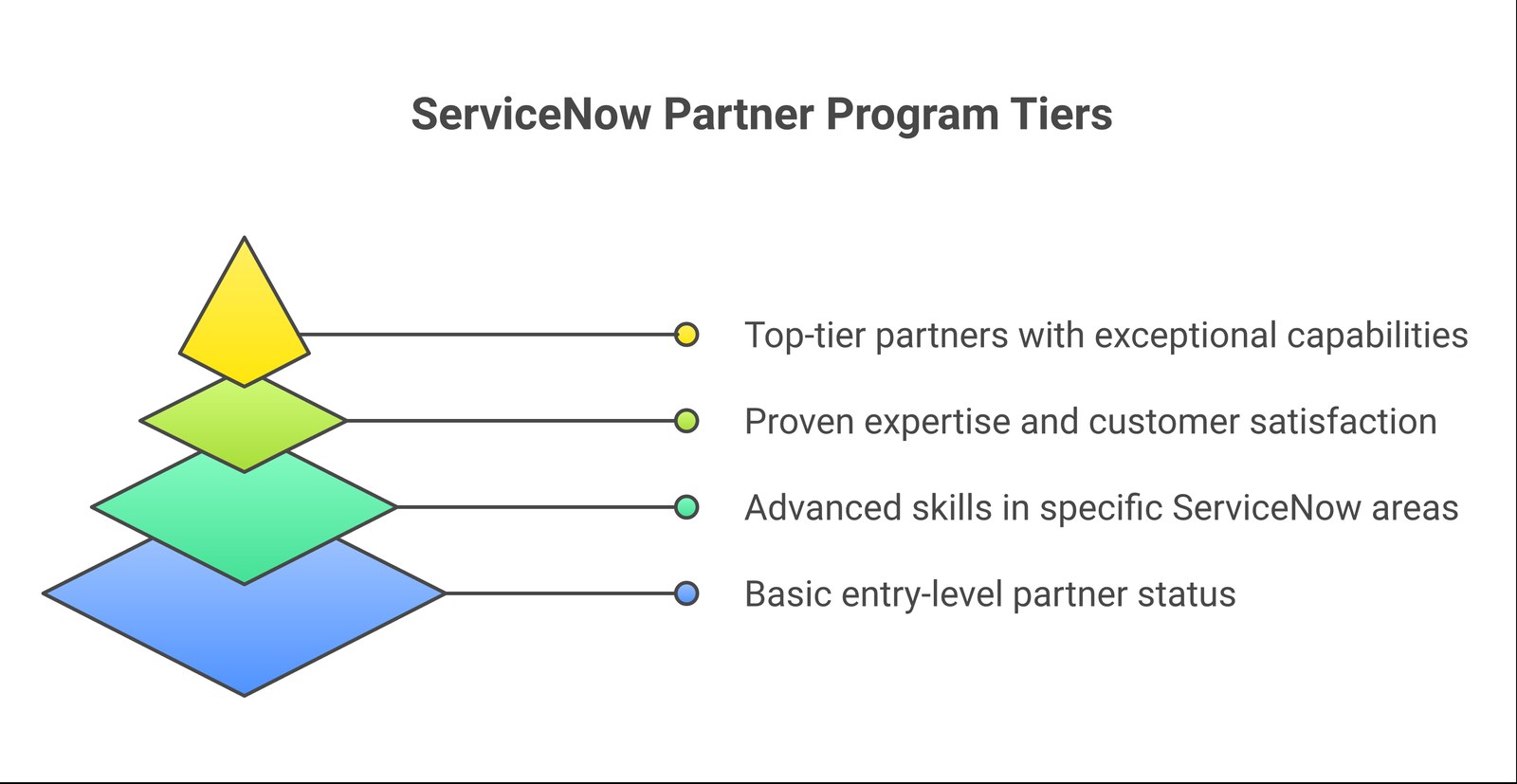
The ServiceNow Partner Program runs four primary tiers (Registered, Specialist, Premier, Elite) with designations layered on top (Build Partner, Service Partner, Reseller, etc.). Tier advancement requires meeting certification, customer outcome, and program contribution criteria.
Registered
The entry tier. Open to partners completing initial onboarding requirements. Provides access to basic program resources, certification training, and partner portal capabilities. Typically the qualification stage before a partner commits to a deeper investment.
Specialist
The first paid tier. Requires meeting certification thresholds, customer-outcome metrics, and program contribution criteria. Provides access to MDF, joint marketing programs, and named partner-success engagement. Most operating-stage partners qualify at the Specialist tier.
Premier
The mid-tier. Requires deeper certification, larger customer-outcome metrics, and more substantive program contribution. Provides access to deeper joint go-to-market motion, larger MDF allocation, and more substantive ServiceNow field engagement.
Elite
The top tier. Requires the highest level of certification, customer outcomes, and program contribution. Provides access to the deepest ServiceNow field engagement, largest MDF allocation, and most substantive joint executive sponsorship. Elite partners are typically the largest SIs and the most strategic Build Partners.
The tier system is layered with designations that distinguish partner type. Build Partner is for technology vendors building on the Now Platform. Service Partner is for consultancies and SIs implementing ServiceNow. Specialty designations (Authorized Training Partner, Authorized Service Provider) further specialize the partner’s capability. The exact criteria for each tier evolve over time. The Now Partner Hub has the most current information.
Who the ServiceNow Partner Program is right for
The ServiceNow Partner Program is right for organizations whose customer base meaningfully overlaps with ServiceNow’s enterprise customer base, whose product or service has a clear use case on the Now Platform, and who can commit to the operational investment the tier system requires.
- Customer overlap. Your target market overlaps meaningfully with ServiceNow’s enterprise customer base.
- Clear platform use case. Your product, service, or implementation capability has a defined use case on the Now Platform.
- Certification commitment. You can commit to maintaining the certifications the tier system requires.
- Operational investment. You have the partner-team capacity to run the recurring operating cadence with ServiceNow’s PDM, attend joint customer engagements, and maintain the partner-facing program metrics.
Organizations missing any of the four typically end up at the Registered or Specialist tier, get limited benefit from the program, and treat the partnership as a marketing relationship. Organizations with all four typically advance to Premier or Elite over time.
The four operating habits of strong ServiceNow partners
Strong ServiceNow partners run four operating habits that average partners do not: maintain certifications proactively, name the ServiceNow field contact on every joint opportunity, run a recurring Now Partner Hub cadence with the PDM, and tie certification and pipeline metrics to internal partner-team compensation.
Maintain certifications proactively
Certifications expire on a defined schedule and tier metrics depend on current certifications. Strong partners maintain a certification calendar, plan renewals 60 days in advance, and budget for new certifications as the platform evolves. Average partners let certifications lapse and find themselves dropped a tier when ServiceNow runs the audit.
Name the ServiceNow field contact
The single most predictive practice for ServiceNow co-sell revenue is naming the ServiceNow field seller contact on every joint opportunity. Partners that name the contact get faster engagement, more substantive joint pursuit, and higher close rates.
Run a recurring PDM cadence
Strong partners run a monthly cadence with their ServiceNow Partner Development Manager (PDM). The cadence covers joint pipeline, MDF deployment, certification progress, customer-outcome metrics, and tier-advancement progress.
Tie metrics to internal compensation
Strong partners include ServiceNow-program metrics (certified sellers, registered opportunities, joint pipeline, customer outcomes) in the partner team’s internal compensation.
Common pitfalls in ServiceNow partner program operations
Five recurring failure modes account for most of the underperformance I see at customer organizations.
- Joining for the logo, not the motion. Partners that join for the marketing logo and don’t commit to the operating cadence end up at the Registered tier with limited benefit.
- Letting certifications lapse. Tier metrics depend on current certifications; partners that don’t manage the certification calendar proactively get downgraded.
- No PDM cadence. Partners that don’t run a monthly cadence with their PDM produce a transactional relationship rather than an operational alliance.
- Ambiguous use case. Partners without a clear use case on the Now Platform spend program-resource time without producing customer outcomes.
- No internal compensation tie. Partner teams that don’t tie ServiceNow-program metrics to internal compensation produce inconsistent program engagement.
Tools and operating cadence stack
| Operating stage | Now Partner Hub usage | PDM cadence | Internal tooling |
|---|---|---|---|
| Pilot (Registered) | Onboarding completion | Quarterly | CRM partner-touched flag |
| Operating (Specialist) | Joint pipeline reporting + MDF | Monthly + quarterly review | PRM with ServiceNow workflow |
| Mature (Premier / Elite) | Full integration with executive cadence | Monthly + quarterly + annual planning | Full PRM + certification tracking + internal compensation tie |
Forecastable’s POV
My take is that the ServiceNow Partner Program is one of the more rigorous and rewarding enterprise partner programs in 2026, and the rigor is a feature rather than a bug. The program design rewards operating discipline; partners that invest in the discipline produce co-sell revenue that compounds, and partners that don’t pay program tax for the logo without the upside.
The pattern that compounds
The ServiceNow partners I see compound across multi-year horizons share four traits. They maintain a certification calendar with proactive renewal planning. They name the ServiceNow field contact on every joint opportunity. They run a monthly PDM cadence and protect it. They tie ServiceNow program metrics to internal partner-team compensation.
The contrarian position
The contrarian position is that joining the ServiceNow Partner Program is a major operational commitment, not a marketing decision, and many of the partners that join would be better served running a single deep ServiceNow relationship outside the formal program rather than chasing tier advancement they can’t operationally sustain.
Frequently asked questions
What is the ServiceNow Partner Program?
A tiered partner program run by ServiceNow that gives partners access to the platform’s customer base, joint go-to-market support, and certification credentials. Covers Build Partners (technology vendors), Service Partners (consultancies and SIs), and specialty designations.
How do the ServiceNow partner tiers work?
Four primary tiers (Registered, Specialist, Premier, Elite) with designations layered on top. Tier advancement requires meeting certification thresholds, customer-outcome metrics, and program contribution criteria.
What are the ServiceNow partner designations?
Build Partner, Service Partner, Reseller, Authorized Training Partner, and other specialty designations.
Who should join the ServiceNow Partner Program?
Organizations whose customer base overlaps with ServiceNow’s enterprise customer base, whose product has a clear platform use case, and who can commit to the operational investment.
What are the four operating habits of strong ServiceNow partners?
Maintain certifications proactively, name the ServiceNow field contact on every joint opportunity, run a recurring PDM cadence, and tie metrics to internal compensation.
What is the most common ServiceNow partner mistake?
Joining for the logo without committing to the operating cadence.
How does the ServiceNow program compare to AWS or Salesforce partner programs?
All three are tiered enterprise partner programs with similar operating structure. The ServiceNow program is more depth-oriented (fewer, deeper partnerships); AWS is more breadth-oriented (more partners with structured co-sell mechanics); Salesforce sits between.
Next step
If you’re evaluating ServiceNow partnership, run the four-condition fit check before committing to the program.
Talk to our team about running the fit check before you commit to a ServiceNow partnership →
By Alex Buckles
Uncover Your Growth Potential
Schedule a Discovery Call