SaaS Channel Partners: Types, Economics, and Motion

Short answer
Short answer: SaaS channel partners are the resellers, integrators, and service firms that sell or extend a software product on a recurring-revenue model, and the recurring part changes almost everything about how you recruit, pay, and activate them. In a perpetual-license world a partner sold a box once; in SaaS they are signing you up for a relationship that has to renew and expand, so the economics and the motion look different.
Here is the position. SaaS channel partners are not a discount channel. They are a recurring-revenue channel, and treating them like resellers of a one-time product is the first mistake most programs make.
What are SaaS channel partners?
SaaS channel partners are third-party firms that help a software company acquire, serve, or grow customers in exchange for margin, incentives, or influence credit. The common types are resellers and value-added resellers who transact the sale, systems integrators who implement and configure, managed service providers who run the product on the customer’s behalf, technology or integration partners who extend it, and referral partners who send opportunities without transacting.
What makes them SaaS channel partners specifically, rather than generic resellers, is the revenue model underneath. A SaaS sale is not a one-time transaction; it is a subscription that has to be renewed and can be expanded. That means a partner’s value is not just the initial sale. It is whether the customer stays and grows, which pulls the partner into onboarding, adoption, and retention in a way a box-moving reseller never was.
The confusion I see is companies porting a hardware or perpetual-license channel model straight into SaaS. They set a resale margin, hand the partner a price list, and wait. In SaaS the partner who only cares about the first transaction is a liability, because a churned customer erases the margin you paid. The model has to reward the whole lifecycle, not the signature.
Why SaaS channel partners matter in 2026
SaaS channel partners matter more now because software buyers increasingly arrive through a partner, and the numbers back it up. Partnership Leaders has reported partner-involved deals closing faster and larger, and Crossbeam has reported multiples on pipeline and win rate for partner-attached deals. When a large share of SaaS pipeline is partner-surrounded, the channel stops being optional.
The second reason is that SaaS economics reward partners who drive retention, not just acquisition. Because the revenue recurs, a partner who lands a customer and helps them adopt is compounding value every renewal. That makes the right SaaS channel partners some of the highest-value relationships a software company has, and the wrong ones a slow, recurring cost.
The catch is that most SaaS channel programs still pay and manage partners like a transactional channel. They optimize the first sale, ignore the lifecycle, and then wonder why partner-sourced customers churn at the renewal. The tooling to run a modern SaaS channel exists; the operating motion that activates partners across the full lifecycle usually does not.
How SaaS channel partners actually work
SaaS channel partners run on a five-part model. The first two set up who and why, and the last three are where the recurring-revenue motion lives.
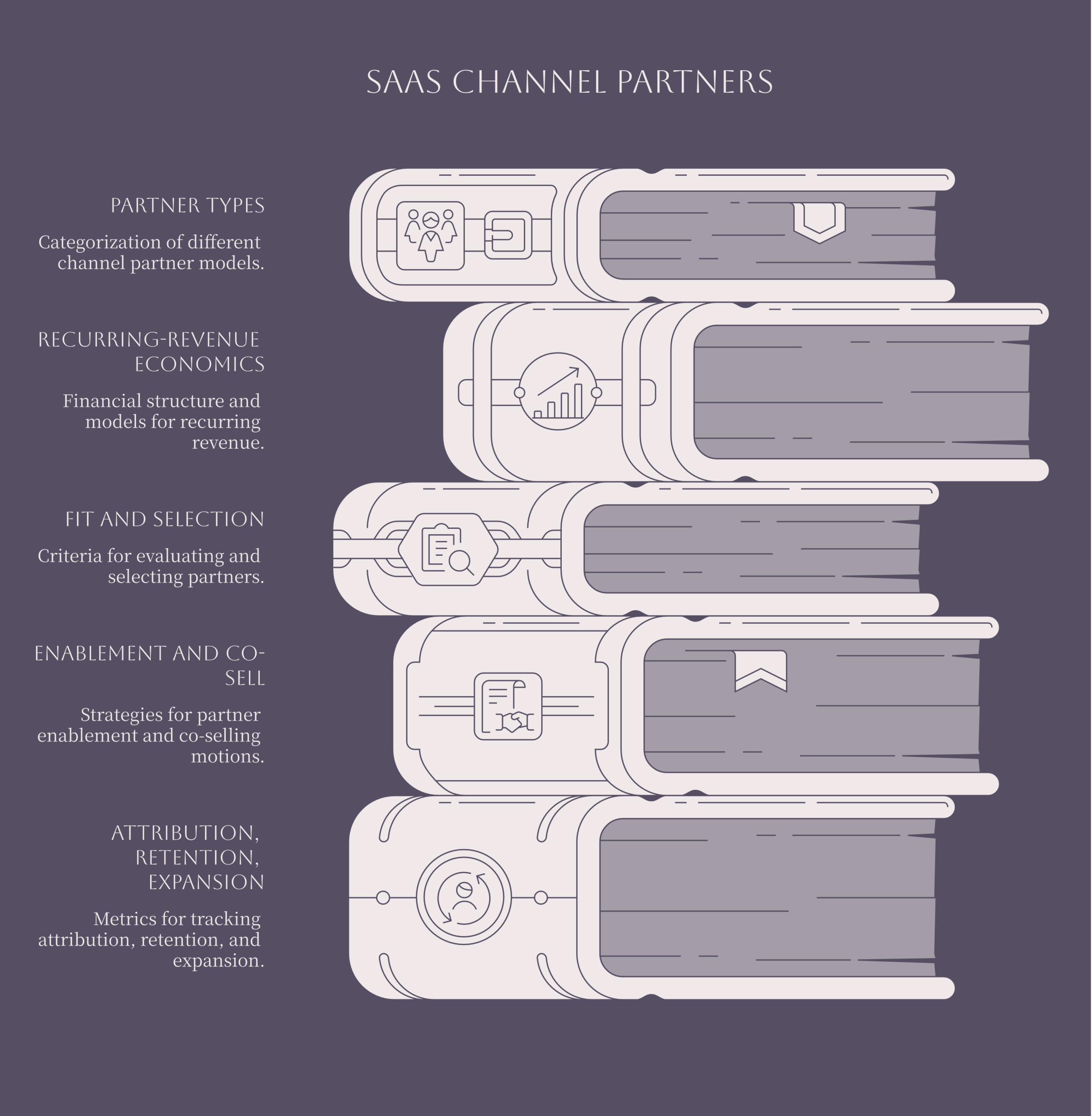
- Partner types: knowing which type you are recruiting, reseller, value-added reseller, systems integrator, managed service provider, technology partner, or referral partner, because each sells a different way and needs a different program. Mixing them under one set of rules produces a program that fits none of them.
- Recurring-revenue economics: structuring margin, incentives, and quota relief around the subscription lifecycle rather than a one-time sale, so partners are paid to land customers who stay and grow, not just to sign them.
- Fit and selection: recruiting partners whose customers and expertise match your product, against a defined profile, rather than signing every firm that asks. A poorly fit SaaS partner brings you churn, which is worse than no partner at all.
- Enablement and the co-sell motion: taking a signed partner to a first deal with the product knowledge, positioning, and a documented joint motion, then working targeted accounts together rather than hoping the partner sells on their own.
- Attribution, retention, and expansion: tracking partner-sourced and partner-influenced revenue across renewals and expansion, so you can see which partners compound value over the lifecycle and invest accordingly.
The through-line is that the first three components decide who is in the program and the last two decide whether they produce recurring revenue. A SaaS channel that pays on the first sale and stops managing at the signature optimizes exactly the wrong moment.
Common pitfalls
- Porting a transactional channel model into SaaS: setting a resale margin and a price list and treating the first sale as the finish line, when the renewal is where SaaS value is made or lost.
- Recruiting partners who bring churn: signing firms whose customers are a poor fit for the product, so partner-sourced customers land and then leave, erasing the margin at the first renewal.
- Paying for signatures, not lifecycle: rewarding the initial sale and ignoring adoption and retention, so partners have no incentive to help the customer succeed after the deal closes.
- One program for every partner type: applying the same rules and enablement to resellers, integrators, and referral partners, when each sells differently and needs a different motion.
- No co-sell motion after enablement: certifying a partner and then waiting, instead of running a documented joint motion against real accounts, so trained partners never actually sell.
What this looks like in practice
A worked example shows the recurring-revenue difference. A SaaS company I advised had recruited a set of resellers and given them a standard resale margin, treating them like a hardware channel. The partners sold a few deals, the customers under-adopted, and half churned at the first renewal. The program looked active and produced almost no durable revenue.
We rebuilt it around the lifecycle. First, we separated the partner types, because the integrators needed a services-attach motion and the referral partners needed a clean handoff, not a resale margin. Then we changed the economics so partners earned on retained and expanded revenue, not just the initial sale, which made adoption the partner’s problem too. Finally, instead of handing partners a price list and hoping, we ran a co-sell motion: each priority partner got targeted accounts where they already had trust, a joint offer, and a documented cadence. The next cohort of partner-sourced customers landed with the partner involved in onboarding, and they stayed.
The lesson is that a SaaS channel partner is worth what the customer is worth over time, not what the first invoice says. Design the program around the lifecycle and the right partners compound; design it around the signature and you pay for churn.
Forecastable’s POV
SaaS channel partners expose a gap between how software is sold and how partner programs are still run. The revenue model went recurring years ago, and most channel programs still reward the transaction. That mismatch is why so many SaaS channels look busy and produce fragile revenue, customers landed by partners who had no reason to care whether they renewed.
The fix is not a better margin table. It is aligning the economics and the motion to the full lifecycle, so partners are recruited for fit, paid for retention and expansion, and activated through a real co-sell motion instead of a price list. That is the difference between a channel that compounds and a channel that leaks.
At Forecastable we work at the motion layer of that problem. We are a partnerships operating platform focused on connecting partner conversations and actions to CRM pipeline and revenue, the flywheel from conversations to actions to pipeline to revenue. The program economics and administration can live in your partner tech; our Co-Sell Alignment Specialist is delivered as part of the service and uses the platform to run the co-sell motion that gets SaaS partners producing and keeps them attached through the renewal.
My bet: the SaaS companies that win the channel will stop running it like a resale channel and start running it like a recurring-revenue channel, recruiting for fit and paying for the lifecycle.
Forecastable is an independent third-party. Any tools, vendors, or third-party figures referenced here are described from public information for the reader’s own evaluation, not as paid placements.
Frequently asked questions
What are SaaS channel partners? SaaS channel partners are third-party firms, resellers, value-added resellers, systems integrators, managed service providers, technology partners, and referral partners, that help a software company acquire, serve, or grow customers on a recurring-revenue model in exchange for margin, incentives, or influence credit.
How are SaaS channel partners different from traditional resellers? The revenue recurs. A traditional reseller optimizes a one-time sale, while a SaaS channel partner’s value depends on whether the customer renews and expands. That pulls SaaS partners into onboarding, adoption, and retention, and it means the economics have to reward the lifecycle, not just the signature.
What types of SaaS channel partners are there? The main types are resellers and value-added resellers who transact the sale, systems integrators who implement, managed service providers who operate the product for the customer, technology or integration partners who extend it, and referral partners who send opportunities without transacting.
How do you pay SaaS channel partners? Structure economics around the subscription lifecycle: margin or commission on recurring revenue, incentives tied to retention and expansion, and quota relief where the direct team is involved. Paying only on the first sale rewards partners for signatures rather than durable customers.
How do you activate SaaS channel partners? Recruit for fit, separate the partner types, and run a documented co-sell motion, targeted accounts, a joint offer, and a weekly cadence, rather than handing partners a price list and waiting. Enablement matters only if it ends in a partner who is actually selling.
Next step
Look at your SaaS channel and ask whether it is built for the transaction or the lifecycle. If your partners are paid on the first sale and no one is measuring whether partner-sourced customers renew, you have a resale channel wearing a SaaS label, and the churn will find you at the first renewal.
If you want the co-sell motion that gets SaaS partners producing and keeps them attached through renewal and expansion, that is what we do. Start your growth journey with Forecastable and we will run the motion on top of your program. Our partner program guide covers how partner types, economics, and motion fit together.
Uncover Your Growth Potential
Schedule a Discovery Call