What Is a Channel Partner Program? Definition and Types

Short answer
Short answer: A channel partner program is the structured system a vendor uses to recruit, enable, and reward third-party companies that sell or deliver its product, such as resellers, VARs, MSPs, systems integrators, and ISVs. It matters because the program is what turns a loose set of partners into a repeatable channel that produces revenue instead of a directory that produces announcements.
The mistake most programs make is designing around access instead of behavior. A tier ladder that pays the same margin for a partner who sells hard and one who does nothing buys you a price list, not a channel.
What is a channel partner program?
A channel partner program is the framework of tiers, benefits, incentives, and rules that governs how a company works with the partners who take its product to market. It defines who qualifies, what each level of partner earns, what the vendor provides in return, and how deals are registered and rewarded. Named plainly, it is the operating system for selling through other companies rather than only through your own reps.
The program covers several partner types, and they do not all do the same thing. Resellers and VARs buy and resell, often adding services. MSPs deliver and manage the product as an ongoing service. Systems integrators implement it inside larger projects. ISVs integrate their software with yours. A well-built program does not run all of these through one identical playbook; it segments by what each type actually does for a customer and designs the tiers and incentives to match.
The confusion worth clearing up is program versus ecosystem. A channel partner program is the structure you build. A partner ecosystem is the living network of relationships and the customers they surround. The program is the container; the ecosystem is what flows through it. You design a program, but you have to activate an ecosystem.
Why a channel partner program matters in 2026
A channel partner program matters because selling through partners is now a primary route to market, not a supplement to direct sales. Analyst Jay McBain has estimated that around 96% of technology purchases involve partners, which means the quality of your channel program shapes a large share of your revenue. A program that recruits well and activates poorly leaves most of that on the table.
It matters more now because scrutiny has risen. Finance leaders want to see that partner spend produces sourced revenue, not just partner counts and event photos. A modern channel partner program has to be defensible: it should show which partners produce, what the incentives bought, and how the tiers correlate with actual selling. Programs that cannot answer those questions are the first line item questioned in a budget review.
How a channel partner program actually works
A channel partner program runs on four components. Recruiting partners is the visible one; the other three decide whether the program produces.
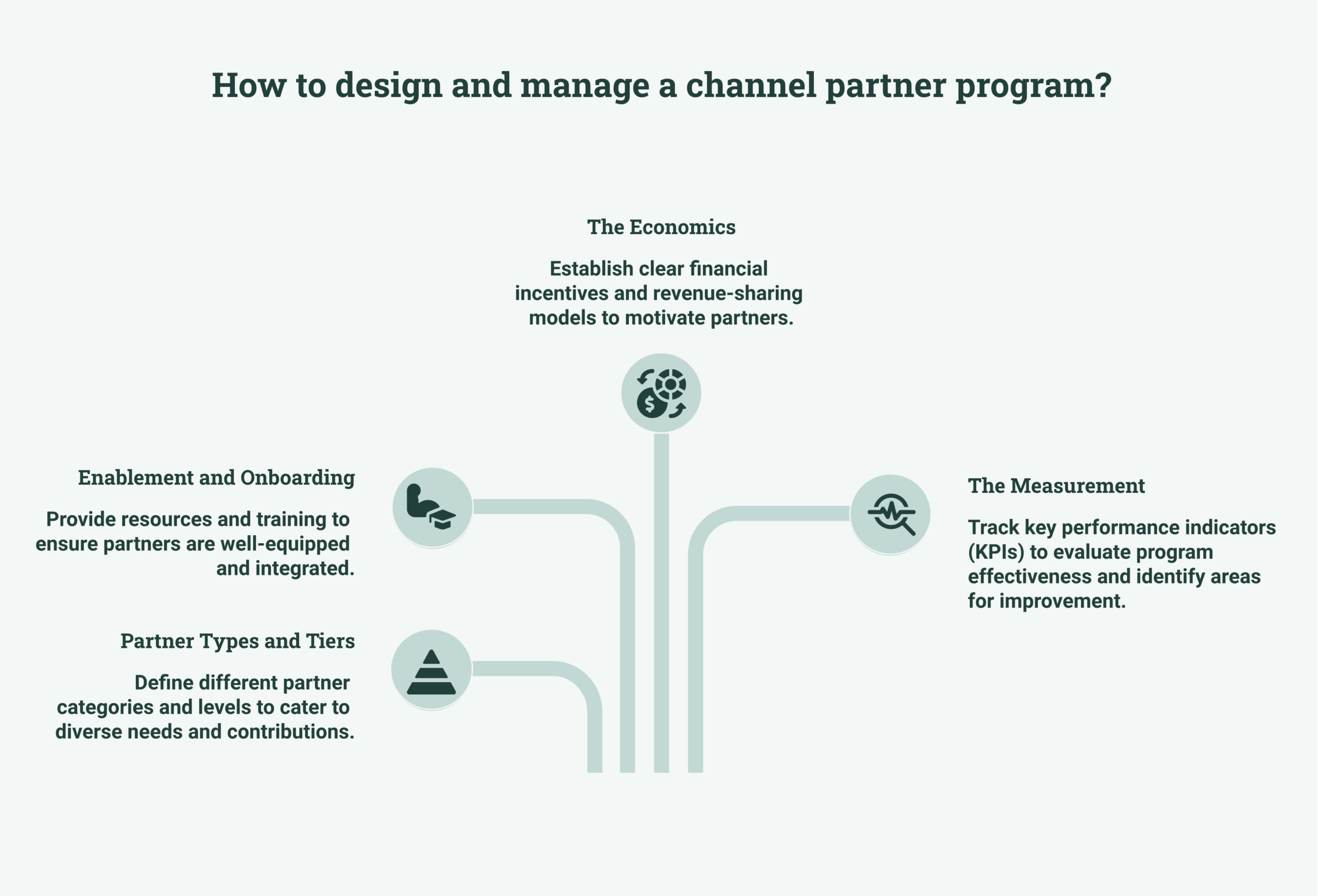
- Partner types and tiers: the segmentation of partners by what they do, resellers, MSPs, SIs, ISVs, and the levels within each that set expectations and rewards. Tiers should reflect demonstrated selling, not just revenue committed on paper.
- Enablement and onboarding: the training, certification, and joint value proposition that let a partner actually position and sell the product. Enablement without an activation target is just content nobody uses.
- The economics: margin, discounts, market development funds, and deal registration that make it worth a partner’s effort. This is where most programs go wrong by paying for status rather than for named selling behavior.
- The measurement: partner-sourced and partner-influenced revenue tracked per partner, plus the share of partners who are genuinely active. This is what tells you the program is a channel and not a mailing list.
The through-line is that a program is an operating system, not a benefits brochure. The tiers and the funds are inputs; sourced revenue per active partner is the output, and the design should push partners toward the behavior that produces it.
Common pitfalls
- Paying for status, not selling: a tier ladder that rewards a partner the same whether they sell hard or coast, which buys a price list instead of a channel.
- Recruiting past your capacity to activate: signing far more partners than the program can enable, so most sit dormant and the active few carry everything.
- Enablement with no activation target: publishing certifications and portals and never driving a partner to a first sourced deal.
- Measuring the roster, not the revenue: reporting partner counts and tier distribution while nobody can say which partners actually source pipeline.
What this looks like in practice
The version that works activates in sequence. A program I would model this on segmented partners by type, proved the motion with its strongest first tier, and only then rolled the expanded playbook out to the next tier, rather than trying to activate everyone at once. The tiers were tied to demonstrated selling, the incentives rewarded named behavior, and the program grew from a few producing partners outward.
The contrast is the program that launches every tier and benefit at once and measures success by how many partners signed. It looks impressive at kickoff and sources little, because the incentives rewarded joining rather than selling and no one activated the roster. Same partners, wrong design. The lesson is consistent: a channel partner program is judged by sourced revenue per active partner, and the design should pay for the selling you actually want.
Forecastable’s POV
A channel partner program is where companies most often confuse structure with production. The tiers, the portal, and the funds answer “do we have a program.” They do not answer “which partners are producing, and does the design reward the behavior that produces.” That second question is the whole point, and it is an operating and incentive-design problem, not a paperwork one.
At Forecastable we build for the operating side. We are a partnerships operating platform focused on connecting partner conversations and actions to CRM pipeline and revenue, the flywheel that runs from conversations to actions to pipeline to revenue. The work we deliver as part of the service is activating the partners a program signs and measuring them on sourced revenue, so the tiers and funds map to real selling. The specialist runs that motion; the platform is the software they run it on.
My bet: the channel programs that win will tie every tier and incentive to a named selling behavior and report themselves on sourced revenue per active partner, not on how many partners they have recruited.
Forecastable is an independent third-party. Any tools or vendors named here are described from public information for the reader’s own evaluation, not as paid placements, and Forecastable does not resell them.
Frequently asked questions
What is a channel partner program? A channel partner program is the structured system a vendor uses to recruit, enable, and reward the third-party companies that sell or deliver its product, including resellers, VARs, MSPs, SIs, and ISVs. It sets the tiers, benefits, incentives, and deal rules that turn partners into a repeatable route to market.
What are the types of channel partners? The common types are resellers and VARs who buy and resell, MSPs who deliver and manage the product as a service, systems integrators who implement it in larger projects, and ISVs who integrate their software with yours. A good program segments by what each type does rather than treating them alike.
What is the difference between a channel partner program and a partner ecosystem? A channel partner program is the structure you build to recruit and reward partners. A partner ecosystem is the network of those relationships and the customers they surround. The program is the container; the ecosystem is what flows through it.
What should a channel partner program include? Partner types and tiers tied to demonstrated selling, enablement and certification with an activation target, economics such as margin, MDF, and deal registration, and per-partner measurement of sourced revenue. The economics should reward selling behavior, not just status.
Why do channel partner programs fail? Usually because they pay for status instead of selling and recruit past their capacity to activate. The program looks large, the incentives reward joining, and only a few partners actually source revenue while the rest sit dormant.
Next step
Look at your own program and ask whether a partner who sells hard earns meaningfully more than one who coasts. If the answer is no, your incentives are buying membership, not selling, and that is the design to fix first.
If you want your channel program activated and measured on sourced revenue per active partner, that is exactly what we do. Start your growth journey with Forecastable and we will tie the program to real selling. Our partner program guide covers how a channel program fits the wider strategy.
Uncover Your Growth Potential
Schedule a Discovery Call