Partner Sales Process: How Partner Deals Get Worked

What is a partner sales process?
Short answer: A partner sales process is the defined, repeatable set of stages a partner-involved deal moves through, from the first signal to the close, with an owner and an exit criterion named at each stage. It exists so that partner deals advance on a known set of gates instead of being worked from memory every time a partner brings one in.
Most companies can describe their direct sales process stage by stage and cannot describe their partner process at all. A partner opportunity arrives, someone improvises the next step, and the result depends entirely on who happened to catch it. A process is the decision to stop improvising and write the stages down.
The useful way to think about it is that a process is a set of gates, not a set of activities. Direct selling has its gates defined, qualified, proposal, negotiation, closed, and partner selling usually does not, which is why partner deals get stuck in an undefined middle that no stage describes and no owner moves them out of.
Why a partner sales process matters in 2026
Partner-involved deals are taking a larger share of pipeline, and an undefined process gets more expensive as that share grows. A handful of partner deals a year can survive being worked ad hoc; hundreds cannot, and the volume in 2026 has pushed most growing programs past the point where memory is enough.
The second reason is forecasting. A process with named stages produces a forecast, because each stage has a known probability and a known time in stage. A program with no stages cannot forecast its partner pipeline at all, so partner revenue stays a hopeful guess rather than a number leadership can plan against.
The third reason is accountability. When the process has gates, you can see which deals are stuck and where, which means you can assign someone to move them. Without stages, a stalled partner deal looks identical to an active one until the quarter closes and the revenue is not there.
How a partner sales process actually works
A working process is a short sequence of stages, each with a single owner and a clear exit criterion, and the value is in defining the exit criteria rather than just naming the stages.
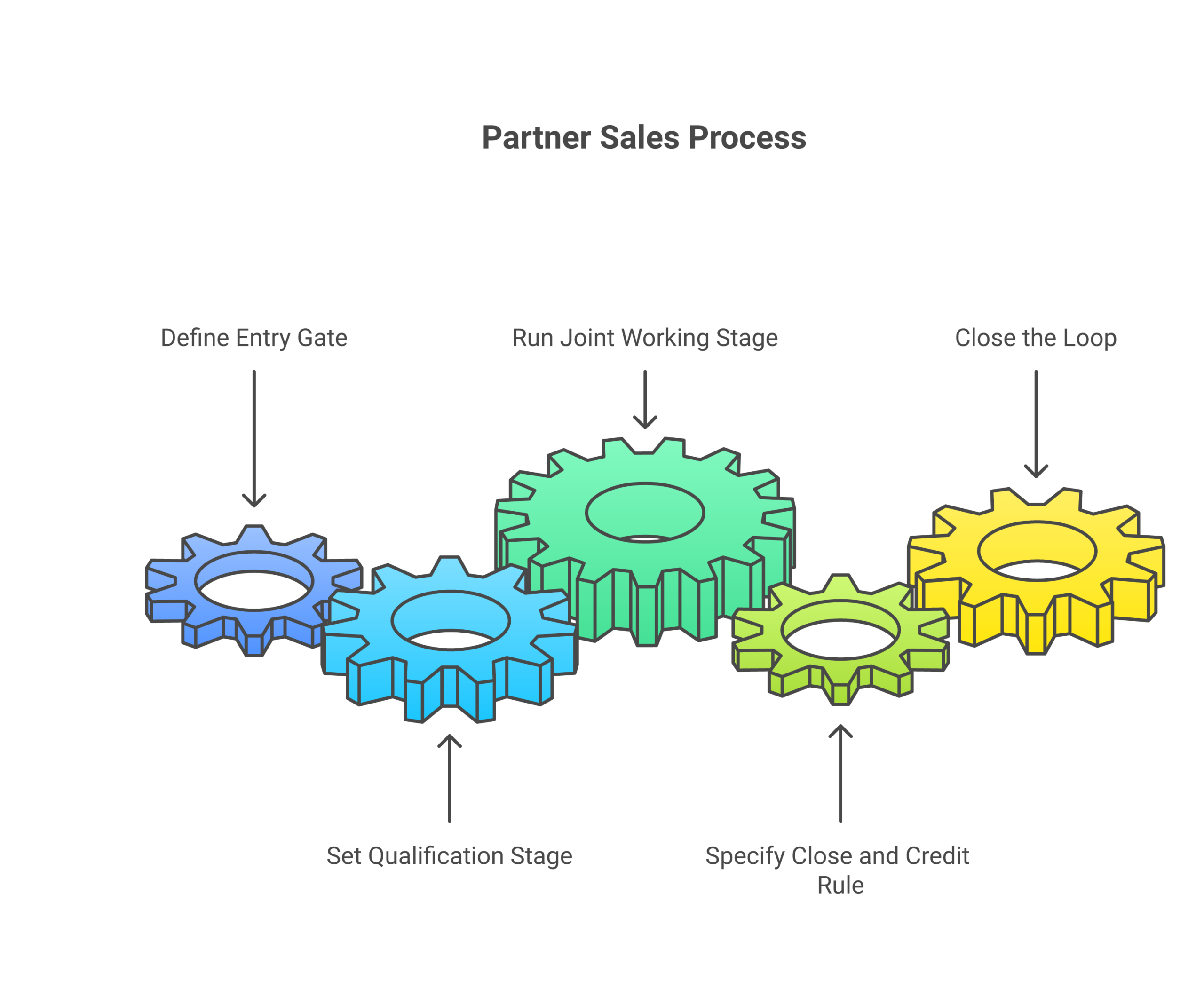
- Define the entry gate and what qualifies a deal in: Specify what a partner opportunity must have before it enters the process, a named account, a confirmed need, a partner of record, so deals start consistently. A vague entry gate fills the early stages with deals that were never real.
- Set the qualification stage and its owner: Name who confirms the deal is worth working and what they check, budget, timing, fit, and what moves it forward or out. Qualification with no owner means weak deals linger and strong ones get the same attention as everything else.
- Run the joint working stage with defined roles: Lay out what the partner and the seller each do while the deal is active, who owns the customer relationship and who owns the technical and reference work. Two parties on one deal with unclear roles either duplicate effort or both assume the other is driving.
- Specify the close and the credit rule before the close: Define who closes, how the win is recorded, and how partner credit is assigned, set at the start, not negotiated after. Credit decided after the fact is the fastest way to lose a partner’s next deal.
- Close the loop back to the partner and the data: Update the partner on the outcome and record the deal so the process can be measured and tightened. A process that never reports back cannot improve and quietly teaches partners that bringing deals leads nowhere.
The process is reviewed against where deals actually stall, so the stages and exit criteria tighten as the program learns its own leak points rather than staying fixed on paper.
Common pitfalls in a partner sales process
- Copying the direct process onto partner deals: A partner deal has a second party and an extra handoff that the direct process never accounts for, so forcing partner deals through direct stages hides exactly the steps that fail. The partner process needs its own gates for the partner-specific moments.
- Stages with no exit criteria: When a stage has a name but no definition of what moves a deal out of it, deals sit in that stage indefinitely and the forecast becomes fiction. Every stage needs a written criterion for advancing or being disqualified.
- No single owner per stage: A stage owned by everyone is owned by no one, so deals stall at the moment they need a decision. Each stage has to name the one person accountable for moving the deal.
- Deciding partner credit at the end: Leaving credit ambiguous until close invites disputes that damage the relationship and make the partner cautious about the next deal. The credit rule belongs at the entry gate.
- No feedback to the partner: A process that closes deals but never tells the partner what happened trains partners to disengage. Closing the loop is what keeps the partner bringing opportunities.
What this looks like in practice
A company with a fast-growing roster kept finding partner deals that had simply gone quiet, with no one able to say what stage they were in or who owned them. The partnerships lead built a five-stage process and wrote an exit criterion for each. Partner deals now entered only with a named account and a confirmed need, a single owner qualified each one against budget and timing, and the joint working stage assigned the customer relationship to the seller and the technical fit to the partner. Credit was recorded at entry, and every closed deal triggered an update back to the partner. The first review showed deals were piling up at qualification because no one had owned it; assigning that stage to one person cleared the backlog within a month. Partner deal velocity improved and, for the first time, leadership could forecast partner pipeline because every deal sat in a known stage. The deals were not new; the process just made them visible and movable.
Forecastable’s POV on a partner sales process
The exit criteria are where the value lives, and most programs skip them. Naming five stages is easy and feels like progress, but a stage without a written rule for advancing is just a label, and labels do not move deals or produce a forecast. If a program defined nothing but the exit criterion for each stage, it would forecast better than one with a beautiful pipeline diagram and no rules.
The second conviction is that the partner process must be designed around the handoff, because that is the moment the direct process never had to handle. A partner deal lives or dies at the point it passes between the partner and the seller, so the process should put its sharpest definition there, not spread its attention evenly across stages a good seller would handle on instinct.
The candid limit is that process has a cost, and an over-built partner process slows deals and annoys the sellers it is supposed to help. The goal is the fewest stages that make deals visible and the handoff owned, not the most detailed flowchart. A heavy process that sellers route around is worse than a light one they actually follow.
Forecastable is a partnerships operating platform; any third-party tools or platforms referenced here are independent third-party products, and naming them is not an endorsement of one deployment over another. Evaluate each against your own process.
Frequently asked questions
What is the difference between a partner sales process and a partner sales motion?
They overlap heavily. Process tends to emphasize the stages and gates a deal passes through, while motion emphasizes the choreography of who acts when. In practice most teams use them to mean the same defined way partner deals get worked.
How many stages should a partner sales process have?
Few enough that sellers actually use it, usually four to six. The number matters less than whether each stage has a single owner and a written exit criterion. A short process that is followed beats a detailed one that is ignored.
Who owns the partner sales process?
Partnerships defines it, but it has to be owned jointly with sales, because the process governs how sellers work partner deals. A process written without sales buy-in gets bypassed the moment a deal feels easier to work directly.
Where do partner deals stall most often?
At qualification and at the handoff between partner and seller. Both are moments that often lack a named owner, so deals sit there until someone notices. Assigning owners to those two points fixes most stalls.
How does a partner sales process help forecasting?
Each stage carries a known conversion rate and time in stage, so a deal’s position in the process implies a probability and a timeline. That is what turns partner pipeline from a guess into a number leadership can plan against.
Can you reuse the direct sales process for partner deals?
Only as a starting point. The direct process has no stage for the partner handoff or the credit rule, which are exactly where partner deals fail, so a reused direct process hides the steps most likely to break.
Next step
If your partner deals keep going quiet with no one able to say what stage they are in, the move this week is to write down four to six stages, assign one owner to each, and define the single criterion that moves a deal out of each stage.
Start your growth journey now to build a partner sales process that makes deals visible and movable, or read the orientation on the partner program for the broader operating model.
Uncover Your Growth Potential
Schedule a Discovery Call