Account-Mapping Service: A Real Person Working Your Crossbeam Overlaps Every Day

Short answer: An account-mapping service puts a real person on your Crossbeam overlaps every day. Forecastable’s account-mapping service monitors your partner data, opens doors at partners with real outreach, runs mapping sessions for you and builds account plans for reps. It also runs “give” motions that send leads to partners, so partners can share the cost. It’s $7,500 a month part time (20 hours a week) or $12,000 a month full time, and it requires Crossbeam.
What is an account-mapping service?
Finding the overlaps is the easy part. Crossbeam describes account mapping as “taking a list of your pipeline and cross-referencing or ‘mapping’ it with a partner’s list.” Once you connect a partner, the overlaps show up.
The hard part is what comes next. Overlaps are the raw material of a working partner ecosystem, but only work turns them into pipeline. So an account-mapping service is a team that does that work, the work your partner managers don’t have time for:
- Always-on monitoring: watching your Crossbeam data for new matches every day.
- Opening doors: real outreach to partner account owners, not just drafted intro asks.
- Mapping sessions, run for you: agendas set in advance and next steps owned after.
- Account plans for reps: custom research on your top targets, with the right partner to call first.
- “Give” motions: sending leads to partners, so the relationship runs both ways.
If you’re new to the concept, start with our guide to account mapping. This page is about having it done for you.
What should you do with Crossbeam overlaps?
Most teams fall into one of three patterns. Only the third is built to produce pipeline.
- Waiting for alerts. A partner manager waits for a new overlap, then pings the partner’s account owner in Slack or email. Then, sometimes, it goes somewhere.
- Handing it to reps. Reps see that 10 partners already have their account as a customer. But they don’t know which partner to call first. So they ignore it, or they start reaching out at random.
- Running real sessions. The teams that have it together hold regular mapping sessions around specific scenarios, with named accounts on the agenda.
The second pattern does real damage. When reps hound partners at the end of the quarter, it creates friction that partner managers then have to repair. That’s why reps need instructions on a silver platter. Someone has to decide which partner, which account and why. And you can’t train reps to do that on their own.
Crossbeam’s own guide on what to do after you find overlaps points the same way. It suggests “a human-led sales approach for the top 10% of accounts.” So that’s the work our account-mapping service does.
Why centralize account mapping instead of leaving it to each partner manager?
Because the skill and the structure end up living in one person’s head. My recommendation is to centralize these operations, with one standard way to pull account mapping data and put it into agendas. Partner managers can still do one-off things. But a central team running the same process for every partner is what makes it scale.
How does Forecastable run Crossbeam account mapping?
We start in the Account Mapping Matrix. In it, your Populations run down the side and your partner’s run across the top. Each cell is a co-sell scenario, like “my prospect, their customer.” When you click a cell, Crossbeam loads the accounts behind it.
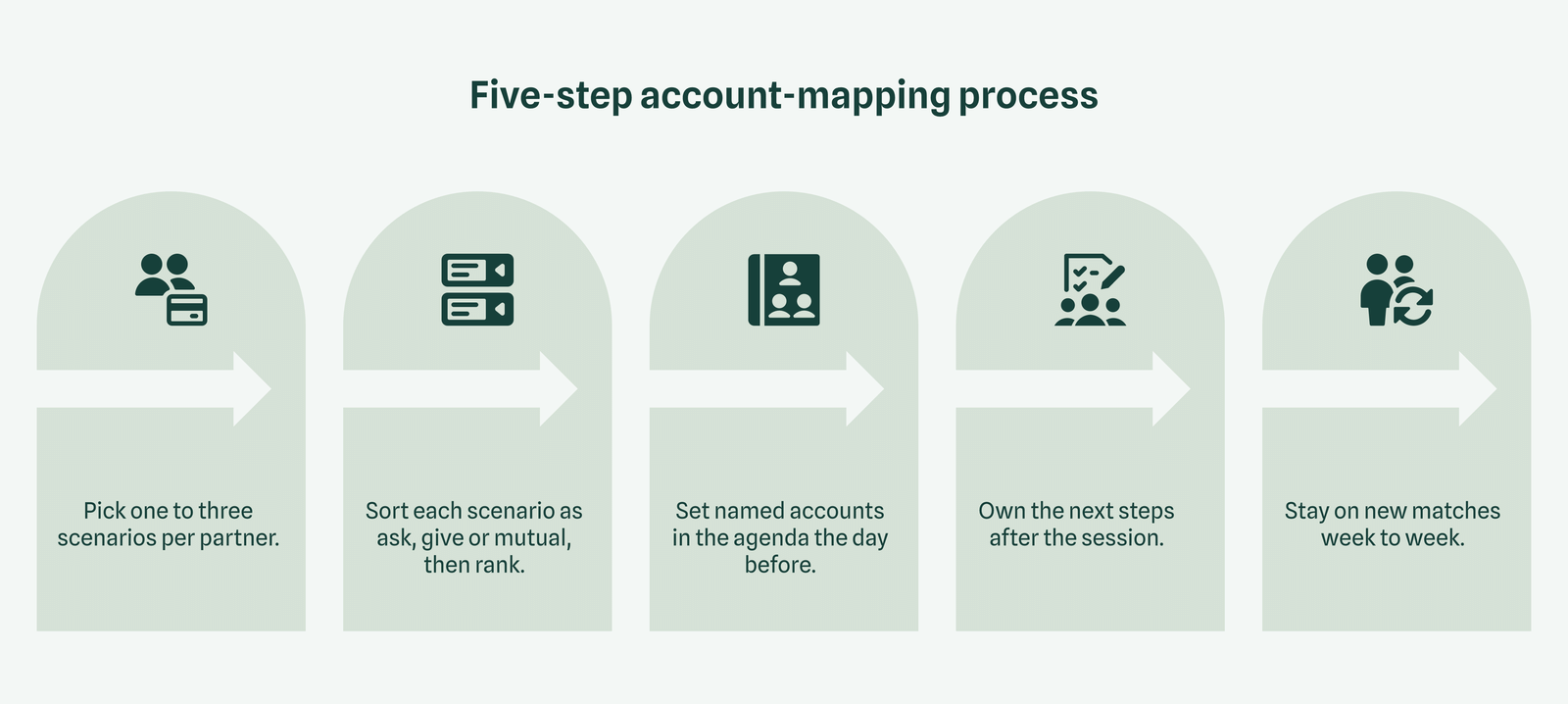
Step 1: Pick the scenarios for each partner
Not every cell matters for every partner. So for each partner, we agree on one to three scenarios to map on a regular basis. Common customers and mutual open opportunities are often on the list. Then we check that partner’s data before anything goes to your reps, because reps who get a list that isn’t real stop trusting the data.
Step 2: Sort each scenario as ask, give or mutual
Every scenario lands in one of three buckets:
| Bucket | What it means | Example scenarios |
|---|---|---|
| Ask | Intros you want from the partner | Your target account is their customer; your open opportunity is their customer; your closed-lost deal is their customer |
| Give | Leads you can hand the partner | Your customer is their prospect |
| Mutual | Accounts you work together | You both have open opportunities |
Then we rank them, so the scenario that matters most comes first in case the meeting runs short. For example, one partner manager we worked with put closed-lost deals at the top for his most important partner.
Step 3: Set the agenda before the session
Here’s where most sessions fail. Most teams show up and open Crossbeam live. Then they waste the first ten minutes of a 30-minute meeting clicking around to decide which accounts to discuss.
We fix that the day before. First, our team pulls the Crossbeam data, filters it, sorts it by match date and picks the accounts. We might filter to accounts with more than 100 employees, or pull in the opportunity stage your partner shares from their CRM. Then we put the named accounts right in the calendar agenda. We also ask each partner manager how many accounts they can cover. One told us about ten with one partner and about five with the others.
Step 4: Own the next steps
After the session ends, we chase every commitment. That means intros requested, intros made, meetings booked and gives delivered. We also check the call recording against the agenda, so we can see which accounts were actually discussed and who owns each next step. So nothing waits for the next meeting.
Step 5: Stay on the new matches
The first pass through historical overlaps can take a month or two. After that, the work shifts to new matches. For example, a partner signs a customer last week, and that account shows up in the right cell. Then it’s on next week’s agenda.
What’s included in the account-mapping service?
Here’s what you get each month:
- A real person on your data. Daily monitoring of Crossbeam overlaps, not just alerts.
- Partner outreach. We contact partner account owners and ask for the intro directly.
- Mapping sessions, run for you. Scenario planning, agendas set in advance, and follow-up owned.
- Account plans for reps. Custom research on top targets, including which partner to work first and why.
- “Give” motions. Leads sent to partners, which is why partners can share the cost.
- Visibility without a login. You see everything through the Forecastable MCP in Claude, ChatGPT or Microsoft 365 Copilot. Meanwhile, Eva, our AI partner ops agent, watches the data in the background.
It runs on its own or alongside GTM motions in Produce My Pipeline. When an overlap list is big enough to campaign into, we can turn it into a motion like Overlap Outbound or Wake the Dead. When a list needs calls, our outsourced SDRs who call as your partner pick it up as part of Produce My Pipeline.
Why do “give” motions matter?
Because the relationship has to run both ways. Crossbeam’s guide says the same thing. It suggests you “identify your existing customers who are prospects for your partner,” because “connecting them strengthens your partnership and adds value.”
So we build gives into the sessions we run. When a partner opens a deal at one of your customers, we send that rep intel before they ask. That goodwill comes back when the roles reverse. And gives do a second job. Because partners get leads from the service, they can share its cost.
Who is the account-mapping service for?
It fits teams that already have the data but not the hands:
- Partner leaders with connected Crossbeam partners and overlaps nobody works.
- Partner managers who’d rather spend time on relationships than on lists.
- Sales leaders who want reps to get partner intros without spamming partners.
- Platforms with dozens of connected partners and no one to run sessions with all of them.
By contrast, it isn’t a fit if you haven’t connected partners in Crossbeam yet. In that case, start there. Our Crossbeam page explains how we work with it.
How is an account-mapping service measured?
We measure it on four numbers:
- Intros made. Partner introductions that actually happened.
- Meetings held. Not booked. Held.
- SQOs. Opportunities your reps accept.
- Partner-sourced pipeline. The dollar value of those opportunities.
Credit follows each platform’s own attribution policy. If the terms are new to you, here’s how partner-sourced and partner-influenced pipeline differ.
Related reading
- Account-Mapping ROI: How to Justify the Spend to Finance
- Account Mapping Template: How to Build and Use One
- Account Mapping Tool: How To Choose and Use One
- Account Mapping Tool Integration: A Practical Guide
- Account-Mapping Tools: A 2026 Buyer’s Guide for Partner Teams
- The Needle in the Haystack Partner Problem
Frequently asked questions
How much does an account-mapping service cost?
Forecastable’s account-mapping service is $7,500 a month part time (20 hours a week) or $12,000 a month full time. It runs standalone or alongside GTM motions, and it requires Crossbeam. Partners can share the cost, because “give” motions send them leads. See our pricing for the full list.
Do I need Crossbeam?
Yes. The service requires Crossbeam with account limits that fit your partner data. Forecastable is Crossbeam’s Solutions Partner of the Year, and Crossbeam sits at the center of every program we run.
What’s the difference between this and a Crossbeam alert?
An alert tells you an overlap exists. Our account-mapping service decides what to do about it, then does it.
Can’t our reps do this themselves?
Sure, they can see the data. But most reps don’t know which of ten partners to call first. And without that guidance, they ignore the data or reach out at random. If you just need meetings booked, see our partner appointment setting service.
How often do mapping sessions happen?
It depends on how many overlaps you share with each partner. More overlaps means more sessions. Some run weekly and some monthly. Either way, the agenda is set before the meeting, so nobody spends the first ten minutes clicking around.
Who is Forecastable?
Forecastable is a B2B partnerships agency. We run partner-sourced pipeline for our clients, done with them or for them.
What’s the bottom line?
Finding overlaps takes a few clicks. Turning them into meetings takes a person who sets the agenda, makes the ask, sends the gives and chases the next step. So put someone on it every day, and measure it on intros, meetings and pipeline.
Forecastable is an independent third-party professional services company. Our evaluations of other vendors are based on publicly-available information as of November 2026 and our own client experience. Crossbeam details are drawn from Crossbeam’s public pages and help center and are current as of November 8th, 2026.
Want a real person working your Crossbeam overlaps every day? Book a Program-Fit Analysis
Uncover Your Growth Potential
Schedule a Discovery Call