How to Get a Co-Sell Playbook Adopted in 2026

What does adoption of a co-sell playbook look like?
Short answer: How to get co-sell playbook adopted is to shrink the asset to one page, attach it to the weekly co-sell deal review, confirm the comp plan rewards the motion it describes, and audit usage on every deal in the room. A playbook lives or dies on whether AEs reach for it when a real opportunity is in front of them, not on whether they read it once at launch.
The failure mode is universal. Partnerships ships a sixty-page enablement deck, runs a town hall, and the document is never opened again. Adoption is not a launch event; it is a weekly habit.
Why co-sell playbook adoption matters in 2026
A co-sell playbook is the artifact that turns a partnership theory into a repeatable AE motion. In 2026, three pressures make adoption the rate-limiting step.
First, AE attention is scarce. Quotas are up, teams are smaller, and any asset that takes more than two minutes to read loses to the AE’s next outbound sequence. A playbook that does not respect that constraint will not be adopted at scale.
Second, partner-sourced and influenced pipeline is now a board metric, and the number only moves when the playbook actually runs. A playbook that sits unread is a budget-line risk in the next planning cycle.
Third, partner motion is no longer carried by a single partner manager hand-walking deals. The playbook is the only artifact that lets the partner motion outlive the partner manager who built it. Adoption is what makes the motion survive a reorg or a personnel change.
How to get a co-sell playbook adopted, step by step
The motion that produces adoption is a tight five-step loop. Each step removes a specific reason adoption stalls.
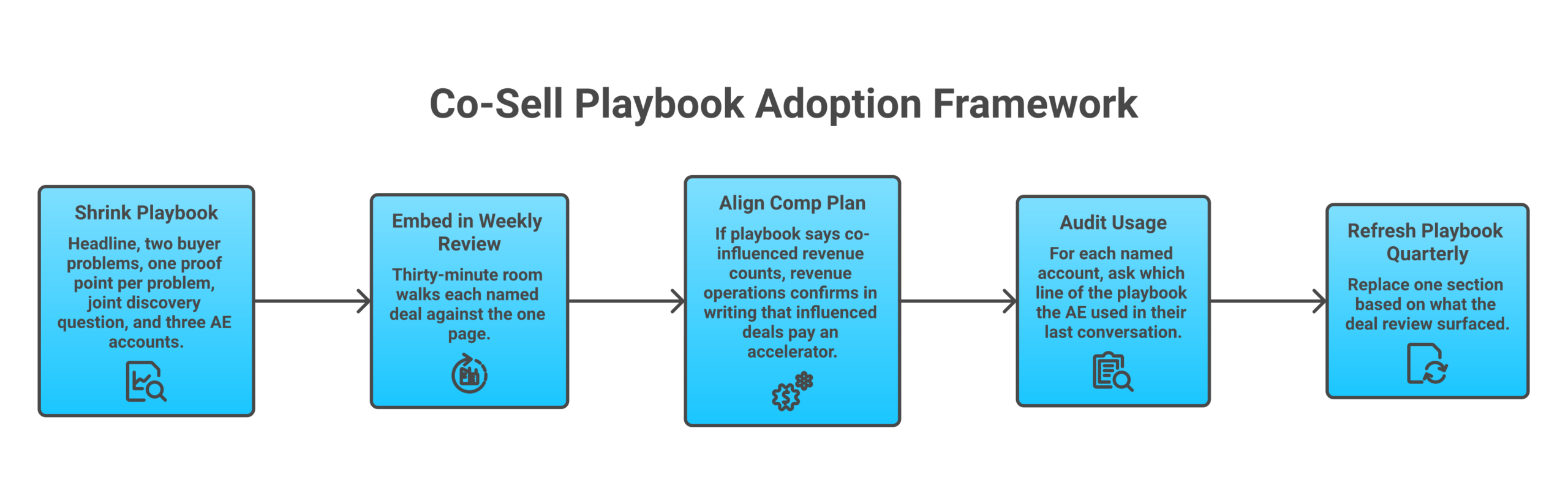
- Shrink the playbook to one page: Headline, two named buyer problems the partnership solves, one proof point per problem, the joint discovery question, and the three accounts the AE should work this quarter. Everything else lives in an appendix the AE can ignore.
- Embed the playbook in the weekly co-sell deal review: The thirty-minute room walks each named deal against the one page. The playbook is not a separate training; it is the meeting’s agenda template.
- Align the comp plan with the motion the playbook describes: If the playbook says co-influenced revenue counts, revenue operations has to confirm in writing that influenced deals pay an accelerator. Comp misalignment kills adoption faster than any other failure.
- Audit usage on every deal in the room: For each named account, ask which line of the playbook the AE used in their last conversation. If the AE cannot point to one, the playbook lost that week; root cause it before the next week.
- Refresh the playbook quarterly: Replace one section based on what the deal review surfaced. A playbook that never changes signals to the field that the motion is theatre.
Common pitfalls that kill playbook adoption
- Shipping a sixty-page playbook at launch: Length is the single best predictor of non-adoption. One page beats sixty every time. If the partnership needs sixty pages, the field will use none of them.
- Launching the playbook with a town hall and no cadence: A town hall is a one-time event; adoption requires a weekly room. Without the cadence, the playbook is forgotten by week three.
- Writing the playbook for the partner’s brand team: A playbook that reads like co-branded marketing copy will not survive an AE’s reality check. It has to read like the talk track the AE would use in a discovery call.
- No named owner on either side: The playbook needs a partner manager owner and an AE owner per account. Unowned, the playbook produces no audit trail and no learning.
- Never refreshing the playbook: A playbook that has not changed in a year tells the field that the partnership has stopped paying attention. Refresh one section per quarter on what the field surfaced.
What this looks like in practice
A B2B SaaS team replaced a forty-two page co-sell deck with a one-page playbook anchored on three named accounts per AE. The Wednesday thirty-minute deal review used the page as its agenda. Within four weeks, the playbook was referenced in every recorded discovery call on a named account; within one quarter, co-sourced and co-influenced pipeline against the named accounts ran four times the prior baseline.
Forecastable’s POV on co-sell playbook adoption
Adoption is the only metric that matters for a co-sell playbook. Pageviews, downloads, and certification completion are vanity. The honest measure is whether the playbook is open on the desk during the weekly deal review and whether the AE can point at the line they used in their last conversation.
The teams that win do three things mechanically: they shrink the asset, they install the cadence, and they align the comp plan in the same week. The teams that struggle ship long playbooks, run a launch town hall, and expect adoption to follow. It does not.
A playbook is a working instrument or a wall decoration. The choice is made in week one and confirmed weekly.
Forecastable is a partnerships operating platform; the tools above are independent third-party platforms, and naming them is not an endorsement of any specific deployment over another. Evaluate each on your own motion.
Frequently asked questions
How long should a co-sell playbook be? One page. An appendix is fine; the working asset is the page.
How do we measure playbook adoption? On each deal in the weekly review, ask which playbook line the AE used in their last conversation. Track the percentage of deals where the AE can point to a line.
Who owns the playbook, partnerships or sales? Both. The partner manager owns the artifact and the cadence; the AE owns the usage on the deal. Unowned playbooks die.
How often should the playbook be refreshed? Replace one section per quarter based on what the deal review surfaced. Quarterly cadence keeps the asset honest without inducing change fatigue.
Do we need a PRM to host the playbook? Not at the start. A shared doc and a recurring meeting are enough for one quarter. Bring in a PRM (Introw, Euler, Impartner, PartnerStack, Channelscaler) when the motion is repeatable and you need workflow and audit.
Next step
If a co-sell playbook is shipped and sitting unused, the move this week is to shrink it to one page, attach it to a thirty-minute Wednesday deal review, and confirm with revenue operations that the comp plan rewards the motion the playbook describes.
Start your growth journey now to walk through what a one-page playbook looks like in your specific environment, or read the orientation on co-sell for the broader operating model.
Uncover Your Growth Potential
Schedule a Discovery Call