Co-Sell Examples: Motions That Produce Revenue

What are co-sell examples?
Short answer: Co-sell examples are concrete illustrations of partners and reps selling together, showing who fronts the customer, how the deal runs, and how credit is shared. They turn the abstract idea of joint selling into specific motions a team can recognize and copy.
People talk about co-sell as if it were one thing. It is not. There are several distinct motions, and the examples are how you tell them apart.
The value of looking at co-sell examples is that they make the design choices visible. Once you see how a referral motion differs from a true joint-selling motion, you can pick the one that fits your partnership instead of mixing them into something that produces nothing.
Why co-sell examples matter in 2026
Co-sell has become a core growth motion, and in 2026 co-sell examples matter because most teams launching one have never run a clean version and default to a vague blend of referrals and hope. Seeing specific motions, named, with the mechanics spelled out, is how a team picks a design it can actually execute rather than improvising something that produces meetings and no revenue.
The second reason is that examples expose the credit question early. Most co-sell programs stall on attribution, and the examples make the credit-sharing choice concrete before it becomes a fight. Looking at how a real motion settles credit is cheaper than learning it through a quarter of disputes.
The third reason is fit. Different partnerships call for different co-sell motions, and an example that worked for one company can be the wrong model for another. Seeing several lets a team match the motion to the partnership rather than copying the first one they read about.
How co-sell examples actually work
The useful co-sell examples fall into a few recognizable motions, each with its own answer to who fronts the customer and how credit flows, so a team can pick the one that fits.
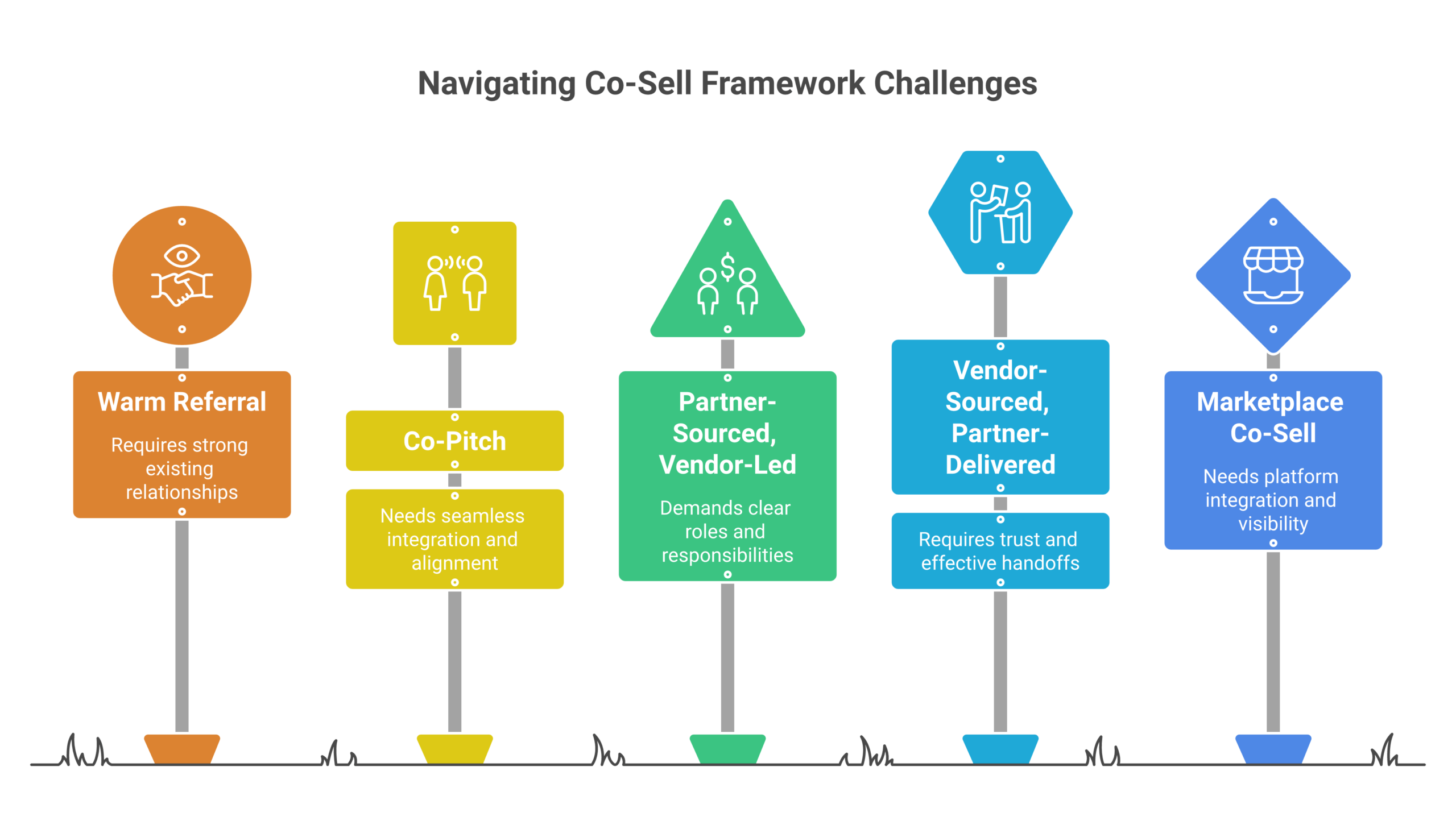
- The warm referral: One partner introduces a customer to the other and steps back, and the receiving company runs the deal solo from there. It is the lightest motion, easy to run and easy to track, but it captures the least joint value because the partner does not stay in the deal.
- The co-pitch: Both companies sell into the same opportunity together, often in the same meetings, presenting a joint solution to a shared customer. It produces the most value and demands the most coordination, because two sellers from two companies have to run one deal.
- The partner-sourced, vendor-led deal: The partner finds and qualifies the opportunity, then hands it to the vendor’s rep to close, staying involved for context. It splits the work along each side’s strength and needs clear credit rules so the partner stays motivated to keep sourcing.
- The vendor-sourced, partner-delivered deal: The vendor wins the customer and brings in a partner to implement or service the solution, expanding the deal. It is common with services partners and turns a software sale into a larger joint engagement.
- The marketplace co-sell: The deal transacts through a cloud marketplace where the vendor and the cloud provider co-sell into a shared account, drawing down committed spend. It is increasingly common with hyperscalers and changes both the motion and the economics.
Co-sell examples are working as a tool when a team can point at one and say “that is the motion we are running,” and they are failing when the team blends several into an undefined hybrid where nobody knows who fronts the customer or who gets the credit.
Common pitfalls in reading co-sell examples
- Copying the motion without the mechanics: Teams admire a co-sell example and adopt the label without the attribution and credit rules that made it work. The motion is the mechanics, not the name, and copying the surface produces a program that stalls.
- Blending motions into a hybrid: Mixing a referral motion with a co-pitch produces a muddle where the partner thinks they sourced the deal and the rep thinks they closed it alone. Each example works because it is one clean motion, not a blend of several.
- Ignoring the credit question: Looking at an example for the selling mechanics while skipping how it settles credit misses the part that actually determines whether reps run it. The attribution is the hard part of every example, not an afterthought.
- Matching the wrong example to the partnership: A co-pitch motion forced onto a partnership with no real solution overlap produces awkward joint meetings and no deals. The example has to fit the partner, not the other way around.
- Treating examples as proof it is easy: A clean example makes a motion look simple, hiding the coordination and incentive work behind it. The example is the destination; the build is still the work.
What this looks like in practice
A software company wanted to “do co-sell” with a consulting partner and started booking joint meetings with no defined motion. Three months in, the partner believed they were sourcing deals and the company’s reps believed they were closing solo deals the partner happened to attend, and the credit fight was already brewing. The fix was to pick one example and run it cleanly. Given the partner’s strength in delivery, they chose the vendor-sourced, partner-delivered motion: the company’s reps would win the software deal, then bring the partner in to implement, expanding the engagement and giving the partner clear, uncontested revenue. Credit was settled in advance, the company kept the software number, the partner kept the services number, and nobody fought over the same dollar. Naming the motion ended the confusion, and the partnership started producing the larger joint deals it had been fumbling toward.
Forecastable’s POV on co-sell examples
The position we hold is that “co-sell” is not one motion, and the most common mistake is treating it as a single thing to switch on. The examples matter because they force the real question: which motion, with which partner, settling credit how. A team that picks one clean example and runs it produces; a team that blends several into “we co-sell now” gets meetings and disputes.
The second conviction is that every useful example is mostly about credit, and teams underweight that when they study them. They look at the selling mechanics, who is in the meeting, what gets pitched, and skim past the attribution that determines whether reps will actually run it. The credit-sharing rule is the load-bearing part of every co-sell motion, and the examples are most valuable when read for that.
The honest caveat is that examples are descriptive, not prescriptive. A motion that produced for one company sat on a specific partnership, a specific overlap, and a specific set of incentives, and lifting it whole onto a different situation can fail for reasons the example never shows. Use them to understand the design space and pick a fit, not as templates to copy unexamined.
Forecastable is a partnerships operating platform; any third-party tools or platforms referenced here are independent third-party products, and naming them is not an endorsement of one deployment over another. Evaluate each against your own motion.
Frequently asked questions
What are the main types of co-sell motion?
The common ones are the warm referral, the co-pitch, the partner-sourced vendor-led deal, the vendor-sourced partner-delivered deal, and the marketplace co-sell. Each answers who fronts the customer and how credit flows differently, and picking one cleanly is what makes a co-sell program work.
Which co-sell example is best?
The one that fits your partnership. A co-pitch needs real solution overlap; a partner-delivered motion suits services partners; a marketplace motion suits hyperscaler relationships. There is no universally best motion, only the one matched to the partner and the value you share.
Why do blended co-sell motions fail?
Because they leave who-fronts-the-customer and who-gets-credit undefined, so the partner and the rep form different assumptions and collide over the same deal. Each clean example works precisely because it answers those questions; a blend answers neither.
What is the easiest co-sell motion to start with?
The warm referral. It is the lightest to run and track, since one partner introduces and steps back. It captures the least joint value, but it is a reasonable first motion for a partnership building trust before attempting a true co-pitch.
How do co-sell examples handle credit?
Each settles it differently, and that is the point. Referrals often use a fee or a reciprocal arrangement; sourced-and-closed motions split along sourcing and closing; delivered motions split software and services revenue. The credit rule is the load-bearing part of any example.
Can you run more than one co-sell motion at once?
Yes, but run each one cleanly rather than blending them. A company can use a referral motion with one partner and a co-pitch with another; the failure is mixing motions within a single partnership so the mechanics and credit become undefined.
Next step
If your co-sell is producing meetings but not revenue, the move is to name which motion you are actually running, with each partner, and settle the credit rule before the next joint deal rather than after the dispute.
Start your growth journey now to pick and build the co-sell motion that fits your partners, or see the orientation on co-sell for how the motions relate.
Uncover Your Growth Potential
Schedule a Discovery Call