How to Get AEs to Co-Sell: A 2026 Field Guide

What does it take to get AEs to co-sell?
Short answer: How to get aes to co-sell is to make co-sell the easiest path to their next deal: pick three named accounts per AE, run a thirty-minute weekly deal review, ship a one-page joint value prop the AE can read in two minutes, and confirm the comp plan pays out on co-sourced and co-influenced revenue. It is not a training problem; it is a friction and incentive problem.
AEs are rational. They will co-sell when the partner-routed motion produces meetings, pipeline, and commission faster than their direct outbound. They will not co-sell when partner activity feels like a tax on top of quota.
Why getting AEs to co-sell matters in 2026
AE attention is the scarcest resource in the partner program. Three forces have made it scarcer in 2026: quota inflation, smaller teams after the 2024 to 2025 reductions in force, and tighter forecast scrutiny from finance. An AE who is two deals short on a Friday will not run a partner-sourced motion they have not seen work.
Partner-sourced and influenced pipeline is also a board-level metric now. The CRO defends the number quarterly, and the number only moves when AEs are actually working partner-routed accounts. A team where the partner manager carries every co-sell deal alone is a team where the joint number plateaus and the budget conversation gets harder.
The lever is small but specific. Three accounts per AE, a weekly thirty-minute room, and a comp plan that pays.
How to get AEs to co-sell, step by step
The motion that works in the field runs on four habits. Each one removes a specific reason an AE walks away from co-sell.
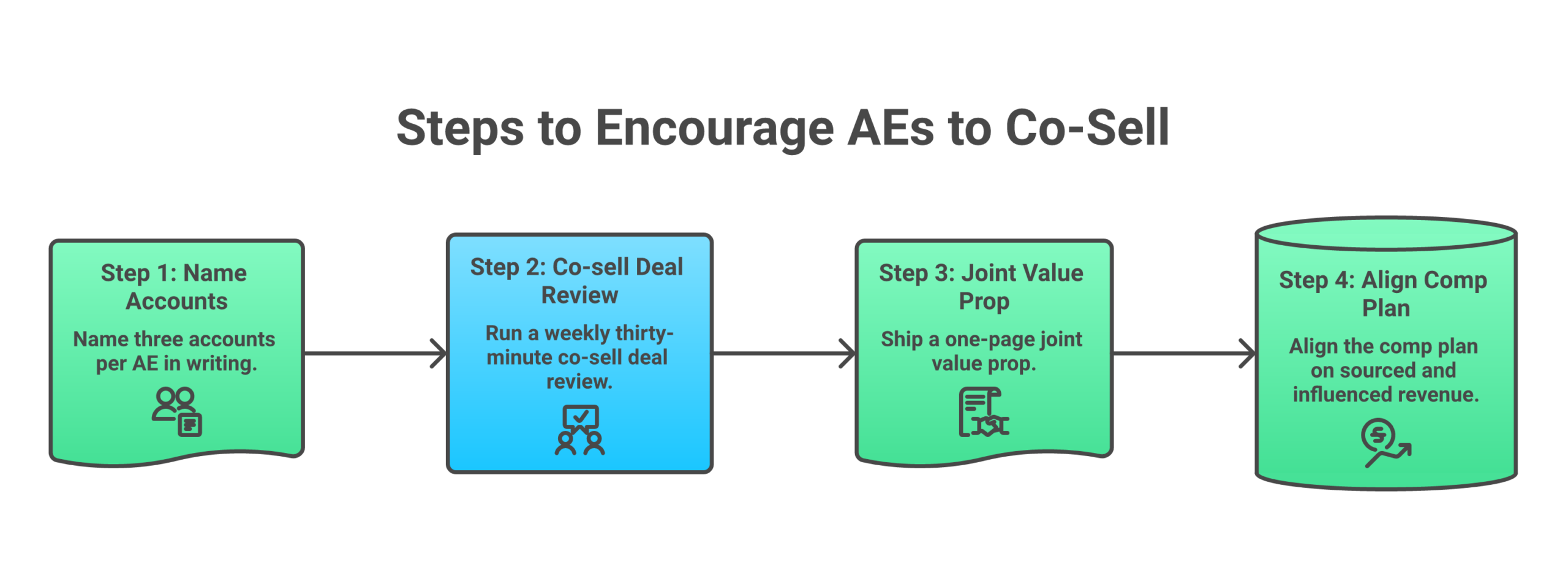
- Name three accounts per AE, in writing: Pick three target accounts where the partner has signal (overlap, an active customer, a named champion) and the AE has an open opportunity or a credible reason to open one. Three is the number that fits in an AE’s working memory; ten is the number that fits in nobody’s.
- Run a weekly thirty-minute co-sell deal review: Same time, same room, the partner manager and the AE owners from both sides. Walk the three accounts each. Name the next action. Note any account that has not moved in two weeks. The cadence is the motion.
- Ship a one-page joint value prop the AE can read in two minutes: Headline, the two specific buyer problems the partnership solves, the one proof point per problem, and the joint discovery question the AE should ask first. If the AE cannot read it in two minutes, the AE will not use it.
- Align the comp plan on co-sourced and co-influenced revenue: Confirm with revenue operations that co-sourced deals pay full commission and co-influenced deals carry a smaller but real accelerator. AEs read the comp plan more carefully than any partner enablement deck.
Common pitfalls that kill AE adoption
- Asking the AE to work twenty accounts at once: A long target list signals to the AE that nothing is actually expected. Three named accounts beat twenty every time.
- A partner manager who runs every meeting alone: When the partner manager carries the call, the AE never owns the relationship and never builds the muscle. The AE has to be in the room with the partner from week one.
- A joint value prop written for the partner’s marketing team: If the asset reads like a co-branded landing page, the AE will not open it. It has to read like the talk track the AE would use in a discovery call.
- A comp plan that pays only on partner-sourced and ignores influenced: Most large co-sell wins are influenced, not sourced. A comp plan that drops influenced revenue tells the AE that the work does not count.
- Skipping the deal review when the calendar fills up: The cadence is the program. Cancel it twice and the AE concludes co-sell is optional. It is not.
What this looks like in practice
A mid-market B2B SaaS team with eight AEs picked three target accounts per AE off a Crossbeam overlap report with a top hyperscaler partner. The partner manager set a Wednesday 9:30 thirty-minute room. Revenue operations confirmed co-influenced paid a fifteen percent accelerator. Within six weeks, sixteen of twenty-four named accounts had a partner-sourced meeting on the calendar; within one quarter, the team booked four co-sourced deals against a starting baseline of zero.
Forecastable’s POV on AE co-sell adoption
AE co-sell adoption is an operating problem, not a culture problem. The teams that win do four things mechanically: they shrink the target list, they install a cadence, they ship a one-page asset, and they fix the comp plan. The teams that struggle keep adding training, town halls, and dashboards on top of the underlying friction.
The forecast follows the motion. When three accounts per AE are in a weekly room with a partner counterpart, the partner-sourced and influenced pipeline number moves on a predictable curve, and finance starts trusting the rollup. Without the cadence, the number is partner-self-reported and the budget conversation gets harder every quarter.
The honest read is that most partner programs do not fail because the partners are wrong. They fail because the AEs were never given a small, named, weekly motion to run. Get the motion right and AE behavior follows.
Forecastable is a partnerships operating platform; the tools named above are independent third-party platforms, and naming them is not an endorsement of any specific deployment over another. Evaluate each on your own motion.
Frequently asked questions
How many accounts should each AE work in a co-sell motion? Three named accounts per AE per quarter is the working ceiling. Ten or more dilutes attention; fewer than three leaves no margin for an account that stalls.
Should the partner manager attend every AE meeting? Yes for the first three meetings on each account, then no. The partner manager’s job is to set the rails, not to carry the deal forever.
What if our comp plan does not pay on influenced revenue? Fix that first. Co-sell adoption will not happen at scale until the comp plan recognizes co-influenced wins. A fifteen to twenty percent accelerator is a defensible starting point.
How long does the weekly co-sell deal review need to be? Thirty minutes. Sixty becomes a status meeting and gets cancelled. Thirty stays sharp and survives the calendar.
Do we need a PRM to run AE co-sell? Not at the start. A spreadsheet, a Slack channel, and a recurring meeting will run a co-sell motion for a quarter. Bring in a PRM (Introw, Euler, Impartner, PartnerStack, Channelscaler) when the motion is repeatable and you need workflow, deal registration, and partner workspace.
Next step
If AE co-sell adoption is the next thing to fix in your program, the move is to name three accounts per AE, install the weekly thirty-minute room, and audit the comp plan in the same week. The cadence is what changes the curve.
Start your growth journey now to walk through what a working co-sell motion looks like in your specific environment, or read the orientation on co-sell for the broader operating
Uncover Your Growth Potential
Schedule a Discovery Call