Skip to content
Logo — It’s All AboutThe Team
  • Home
  • Who We Serve
    • By Category
      • SaaS
      • Professional Services
      • Platforms (Large Ecosystems)
      • Private Equity
    • By Role
      • Chief Revenue Officers (CRO)
      • Chief Financial Officers (CFO)
      • Chief Marketing Officers (CMO)
      • Chief Executive Officers (CEO)
      • Sales Leaders
      • Partnership Professionals
  • Solutions
    • By Partner Program Maturity
      • Partnerships Foundation
      • Partnerships Acceleration
      • Ecosystem-Wide Orchestration
    • Specialized Solutions
      • Net-New Named Account Development
      • Large Ecosystems
      • M&A: Post-Acquisition Internal Cross-Selling
  • Education
  • Company
    • Our History
    • Security
  • Login
Logo — It’s All AboutThe Team
  • Home
  • Who We Serve
    • By Category
      • SaaS
      • Professional Services
      • Platforms (Large Ecosystems)
      • Private Equity
    • By Role
      • Chief Revenue Officers (CRO)
      • Chief Financial Officers (CFO)
      • Chief Marketing Officers (CMO)
      • Chief Executive Officers (CEO)
      • Sales Leaders
      • Partnership Professionals
  • Solutions
    • By Partner Program Maturity
      • Partnerships Foundation
      • Partnerships Acceleration
      • Ecosystem-Wide Orchestration
    • Specialized Solutions
      • Net-New Named Account Development
      • Large Ecosystems
      • M&A: Post-Acquisition Internal Cross-Selling
  • Education
  • Company
    • Our History
    • Security
  • Login
  • Home
  • Who We Serve
    • By Category
      • SaaS
      • Professional Services
      • Platforms (Large Ecosystems)
      • Private Equity
    • By Role
      • Chief Revenue Officers (CRO)
      • Chief Financial Officers (CFO)
      • Chief Marketing Officers (CMO)
      • Chief Executive Officers (CEO)
      • Sales Leaders
      • Partnership Professionals
  • Solutions
    • By Partner Program Maturity
      • Partnerships Foundation
      • Partnerships Acceleration
      • Ecosystem-Wide Orchestration
    • Specialized Solutions
      • Net-New Named Account Development
      • Large Ecosystems
      • M&A: Post-Acquisition Internal Cross-Selling
  • Education
  • Company
    • Our History
    • Security
  • Login
Back to all blogs
  • Co-Selling
Alex Buckles

Co-Sell KPIs: The Scorecard That Defends Budget

A partnerships leader presenting a co-sell KPI scorecard on a wall monitor to a CRO and a CFO in a quarterly review, deep navy and warm amber palette

What are co-sell KPIs?

Short answer: Co-sell KPIs are the small set of headline numbers a partnerships leader commits to and is reviewed against: producing-partner rate, partner-sourced pipeline, partner-influenced revenue, and joint-deal cycle time. They are the scorecard, not the instrument panel, and they exist to answer one question from finance: is co-sell worth the spend?

A KPI is not the same as a metric, and the difference matters. A metric is anything you can measure about co-sell. A KPI is a metric you have chosen as a commitment, given a target, and agreed to be judged on. A program can track fifty metrics. It should carry four or five KPIs.

The discipline is in the selection. The temptation is to elevate every number to KPI status, which produces a scorecard nobody can act on and a leader accountable for everything and therefore nothing. A good KPI set is short, owned, and tied to outcomes a CFO recognizes as revenue.

This post covers which numbers belong on the co-sell scorecard, which ones look important but are not, and how to set targets that survive a budget review.

Why co-sell KPIs matter in 2026

Three forces have made the co-sell scorecard a high-stakes artifact. Co-sell now drives a material share of pipeline, so it is large enough to draw finance scrutiny. Budget cycles have tightened across B2B, and any spend that cannot show a number gets cut first. And partner-influenced revenue is now expected to be reported with the same rigor as direct, so a co-sell program that cannot produce a credible scorecard is a program that cannot defend itself.

The case for a disciplined KPI set has three layers. At the strategy layer, the KPIs are what align the partnerships team, sales, and finance on what co-sell is for; a vague scorecard means three teams optimizing three different things. At the operating layer, a short KPI set tells a partnerships leader where to spend attention this quarter. At the financial layer, the scorecard is the program’s budget defense, and a defense built on activity counts rather than revenue outcomes does not hold.

The reality most programs live is a scorecard full of vanity. Partners signed, meetings held, assets shipped. Every number goes up and to the right, and none of them answers whether co-sell produced revenue. When the budget review comes, the program has data and no case.

How co-sell KPIs actually work

A defensible co-sell scorecard carries four or five KPIs. Each one has a target, an owner, and a direct line to revenue.
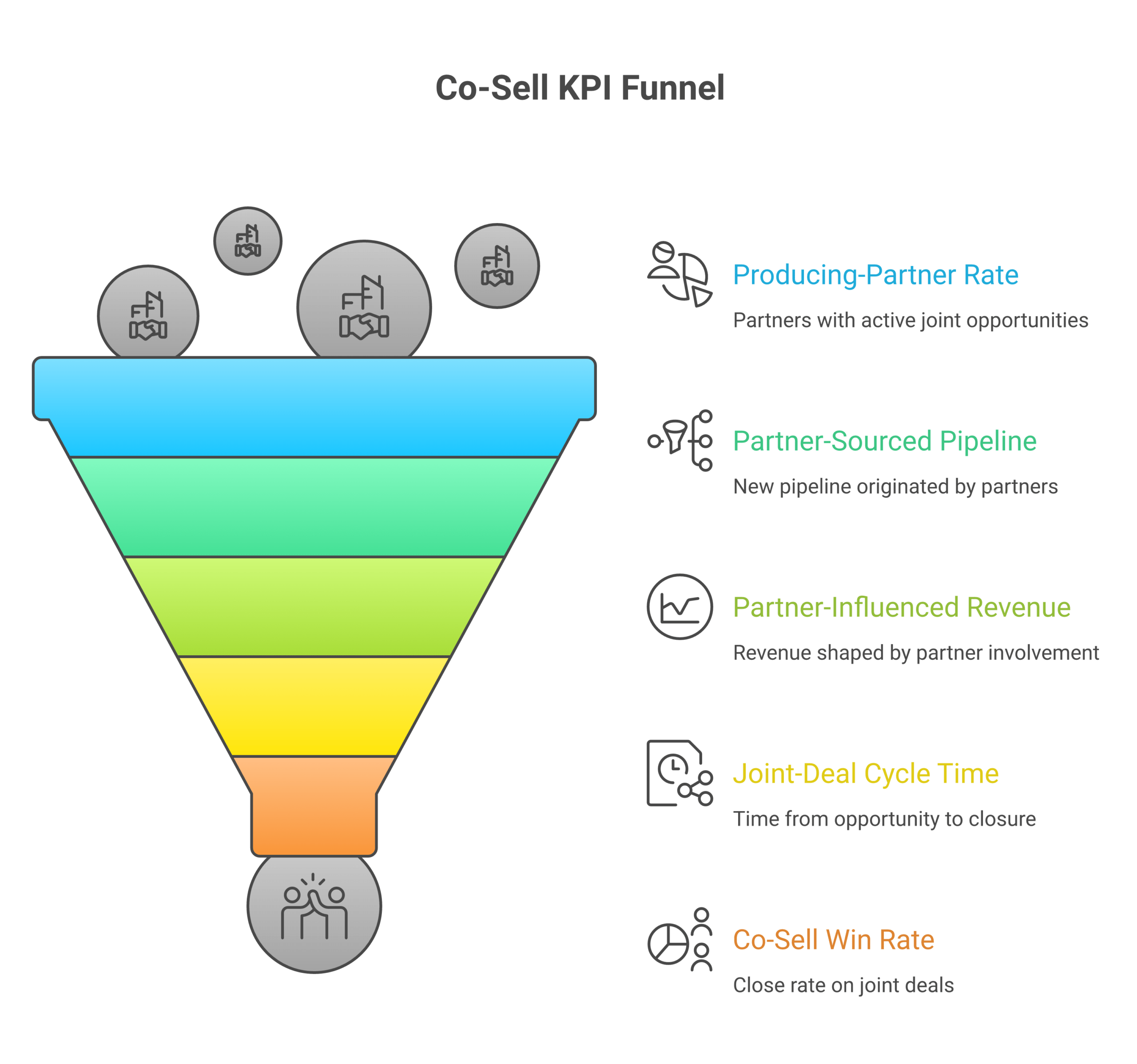
Framework diagram of the five co-sell KPIs that defend a budget: producing-partner rate, partner-sourced pipeline, partner-influenced revenue, joint-deal cycle time, and co-sell win rate.

  1. Producing-partner rate: The share of signed co-sell partners with at least one live joint opportunity in the period. This is the truest health number in co-sell, because it exposes the gap between partners signed and partners working. A program signing partners with a low producing rate is leaking.
  2. Partner-sourced pipeline: The dollar value of new pipeline where the partner originated the opportunity. This is the KPI finance recognizes fastest, because sourced pipeline is unambiguous: without the partner, the deal would not exist.
  3. Partner-influenced revenue: Closed-won revenue where a partner materially shaped a deal the vendor also worked. It is harder to attribute than sourced pipeline and needs a clear, agreed definition, but it captures the larger share of co-sell value.
  4. Joint-deal cycle time: The average time from joint-opportunity creation to closed-won, compared against the direct-sales baseline. Co-sell should compress cycle time; if it does not, the motion needs inspection.
  5. Co-sell win rate: The close rate on joint opportunities versus comparable direct deals. A higher joint win rate is one of the strongest arguments for the motion, and one of the easiest for finance to grasp.

The closing point is that every KPI on this list ties to revenue or to a revenue-relevant efficiency. Producing-partner rate predicts future pipeline, sourced pipeline and influenced revenue are revenue, and cycle time and win rate are efficiency gains a CFO can value. A number that does not connect to one of those does not belong on the scorecard.

Common pitfalls

Co-sell KPI sets fail in consistent ways, and most failures trace to selecting the wrong numbers or too many.

  • Vanity KPIs: Partners signed, meetings held, assets shipped, treated as headline numbers. They go up regardless of whether co-sell produced revenue, so they defend nothing.
  • Too many KPIs: A scorecard of fifteen numbers. The leader is accountable for everything, can prioritize nothing, and the review loses focus.
  • No target: A KPI tracked but never given a number to hit. Without a target it is a metric, not a commitment, and it cannot be passed or missed.
  • Influenced revenue with no agreed definition: Partner-influenced revenue counted differently by partnerships, sales, and finance. The number then gets argued instead of trusted.
  • No owner on the KPI: A scorecard number nobody is personally accountable for. Unowned KPIs drift and decay.

What this looks like in practice

Co-sell KPIs are produced from the same stack that runs the motion. The tools do not generate the KPIs; they supply the underlying data the scorecard rolls up.
A partnerships leader rebuilds the co-sell scorecard before a budget review. The old version had eleven numbers, mostly activity counts. The new version has five KPIs: producing-partner rate with a target of 60%, partner-sourced pipeline with a quarterly dollar target, partner-influenced revenue on a definition agreed in writing with finance, joint-deal cycle time benchmarked against direct, and co-sell win rate. Each KPI has a named owner. At the budget review, the leader shows producing-partner rate up from 35% to 58%, sourced pipeline above target, and a joint win rate eight points higher than direct. The program keeps its budget and adds a headcount.

The contrast is the leader who walks into the same review with eleven activity numbers all trending up. Finance asks one question, how much revenue, and the scorecard cannot answer it. The program holds flat at best.

Forecastable’s POV

The co-sell scorecard fails most often not because the numbers are bad but because there are too many of them and they measure the wrong layer. Partnerships leaders elevate activity to KPI status because activity is easy to grow and feels like progress. Partners signed always goes up. Meetings held always goes up. A scorecard built on those numbers is a scorecard that cannot be missed, which means it also cannot be trusted.

Across our client base, the leaders who win budget reviews carry four or five KPIs that all map to revenue, and they put producing-partner rate at the top. That number is the honest one. It does not let a program hide behind a big signed-partner count, because it asks how many of those partners actually have a live deal. A leader who can move producing-partner rate has a real story; a leader who only grows the signed count has a vanity chart.

The contrarian point is that the co-sell scorecard should be built with finance, not shown to finance. The partner-influenced revenue definition in particular needs to be agreed in writing before the number is ever reported, because a number finance helped define is a number finance defends, and a number finance sees for the first time in a review is a number finance discounts.

If you are rebuilding your co-sell KPIs, cut to five, give every one a target and an owner, and write the influenced-revenue definition down with your CFO.

Forecastable is an independent third-party professional services company. Our evaluations of co-sell measurement and tooling are based on publicly-available information as of May 2026 and our own client experience.

Frequently asked questions

How many co-sell KPIs should a program have?
Four or five. Producing-partner rate, partner-sourced pipeline, partner-influenced revenue, joint-deal cycle time, and co-sell win rate cover the program without overloading the review.

What is the single most important co-sell KPI?
Producing-partner rate. It exposes the gap between partners signed and partners actually working a deal, which is where most co-sell programs leak.

What is the difference between co-sell KPIs and co-sell metrics?
KPIs are the small set of numbers a leader commits to and is judged on. Metrics are the broader set of everything measured. Every KPI is a metric; most metrics are not KPIs.

Why are activity counts bad KPIs?
Partners signed, meetings held, and assets shipped grow regardless of whether co-sell produced revenue. They cannot be missed, so they cannot defend a budget.

How do you set co-sell KPI targets?
Benchmark against the program’s own prior periods and against the direct-sales baseline for cycle time and win rate. Set targets with finance so they are credible in a review.

How is partner-influenced revenue defined?
With a written definition agreed by partnerships, sales, and finance before it is reported, since the three teams will otherwise count it differently and the number will be argued.

Next step

If your co-sell scorecard is a long list of activity numbers, it will not survive the next budget review. Cut to five revenue-linked KPIs, lead with producing-partner rate, and agree the influenced-revenue definition with finance in writing.

Talk to our team about your co-sell scorecard →

The co-sell hub holds the broader operating context, and the co-sell metrics write-up covers the fuller measurement system the KPIs sit on top of.

Uncover Your Growth Potential

Whether starting with a single sales team or a single partner, any co-sell motion can be live within 30 days.

Schedule a Discovery Call
Latest Insights
Two professionals review charts and documents at a conference table as a presentation screen shows a business strategy slide on the wall.
  • Co-Selling
Alex Buckles

Co-Sell Strategy: Building a Motion That Produces

What is a co-sell strategy? Short answer: A co-sell strategy is the set of decisions about which partners you sell with, which accounts you go after together, and how the joint motion runs. It chooses where co-sell effort goes so the company produces partner pipeline by design rather than by lucky overlap. It is not […]

Read Article
A partner enablement lead running a co-sell training session with three account executives around a table, a printed joint pitch one-pager and a deal-registration workflow on the screen behind them, deep navy and warm amber palette
  • Co-Selling
Alex Buckles

Co-Sell Training: Teaching Reps to Sell With Partners

What is co-sell training? Short answer: Co-sell training is how a company teaches its reps to run joint deals with partners, the pitch, the workflow, and the handoffs that a co-sell motion requires. It exists to turn a co-sell strategy into rep behavior, so the motion runs in the field rather than living in a […]

Read Article
An account executive and a partner rep running a joint customer call, a shared screen showing the customer's account and a printed joint pitch on the desk, deep navy and warm amber palette
  • Co-Selling
Alex Buckles

How to Co-Sell: A Step-by-Step Guide for Reps

What is co-selling? Short answer: How to co-sell comes down to four steps: find the accounts you and a partner both have reason to work, agree who does what, run the joint deal, and settle credit before close. It is two companies working one account together so the combined motion closes faster than either would […]

Read Article
A sales leader and a partnerships lead at a sales floor reviewing a per-rep account list with a recommended partner per account, a printed spiff and registration workflow on the screen behind them, deep navy and warm amber palette
  • Co-Selling
Alex Buckles

How to Get Sales Team to Co-Sell, Step by Step

What does getting a sales team to co-sell mean? Short answer: How to get sales team to co-sell reduces to one rule: make the partner the easy path on accounts reps already work. They adopt a partner when it shortens their next close, not when they are told partners matter, so engineer that on real […]

Read Article
Logo — It’s All AboutThe Team

Quick Links

  • Who We Serve
  • Solutions
  • Resources
  • Pricing
  • Our History

Social Media

  • Linkedin

Legal

  • Privacy Policy
  • Terms of Service
Quick Links
  • Who We Serve
  • Solutions
  • Resources
  • Pricing
  • Our History
Social Media
  • Linkedin
Legal
  • Privacy Policy
  • Terms of Service

Stay ahead on ecosystem-led growth

Logo — It’s All AboutThe Team
© 2025 Forecastable. All rights reserved.
Book Your Strategy Call
Request Enrollment Details

[contact-form-7 id=”dfbeed3″ title=”Request Enrollment Details”]

Mollie Bodensteiner

Revops Advisory
  Mollie Bodensteiner is an experienced operations professional with a demonstrated track record of utilizing technology to support operational processes that drive performance and innovation. She currently is the Vice President of Operations at Sound and owns go-to-market agency, MB Solutions. Mollie has previously held operations leadership roles at Deel, Syncari, Corteva and Marketo. She has over 14 years of experience in both B2C and B2B operations and technology. When she is not working, Mollie enjoys spending time with her husband, three small children, and two large dogs. Childhood Career/Dream: Growing up in the age of Disney and Nick@Nite I always wanted to be a child actor (good thing that never was actually pursued 🙂 Favorite Win: I am not sure I have a specific “win” but I think I get the most joy and excitement from coaching others and watching them hit major milestones in their career. The first time you get to promote someone on your team or watch them lead a major project – are always career highlights! Personal Fun Facts: Favorite Song: If it’s love, Train Favorite Movie: Good Will Hunting Favorite Meme: Disaster Girl
Forecastable resources: Co-Sell Orchestration Platform · All Use Cases · Live in 30 Days · Co-Sell Playbook

Kelsey Buckles

Director of Operations


My journey from Education to Operations has equipped me with a unique perspective and skill set that perfectly aligns with Forecastable’s mission to help businesses improve sales collaboration through partner co-selling strategies.

At Forecastable, I am passionate about empowering teams and organizations to unlock the full potential of strategic partnerships. By leveraging my expertise in communication, leadership, and operational efficiency, I contribute to creating seamless co-selling processes that align with business goals and deliver exceptional results.

The intersection of my educational foundation and operational experience fuels my dedication to fostering alignment, building trust, and enhancing collaboration between partners. I am driven by the opportunity to contribute to a platform that not only optimizes sales strategies but also strengthens relationships that lead to long-term growth.

Paul Jonhson

Chief Technology Officer (Co-founder)


Paul Johnson has 20+ years of software development and consulting experience for a variety of organizations, ranging from startups to large-enterprise organization with highly-complex needs.

Mr. Johnson has a long track record of successful technology deployments.
This, combined with his deep passion for machine learning and exceptional user experience design, allows him to lead our technical direction from the front with confidence.

Alex Buckles

Product, Partnerships, and Value Engineering (Co-founder)


After serving in The United States Marine Corps, Alex Buckles spent the next two decades as a student of revenue production and an advocate for innovation.

Along the way, he has helped numerous companies achieve double and triple-digit growth by crafting and executing high-performing go-to-market strategies, with co-selling at the center of each.

As a once-advanced technical marketer, an expert sales & partner professional, and a strong customer success advocate, Mr. Buckles understands the impact of these functions aligning not only on revenue production, but on the day-to-day execution of the go-to-market strategy. This concept of revenue-team alignment is what quickly became the foundation of Forecastable back in January of 2018.

In his free time, you’ll find him spending quality time with his children, one of whom is on the autism spectrum. 1 in 36 children in the U.S. are on the spectrum and boys are four times more likely to be diagnosed than girls.

With that in mind, Mr. Buckles plans on dedicating the rest of his life serving those living with autism, through his organization Pathways for Autism. From his perspective, there must be a scalable and financially self-sustaining infrastructure established to put as many individuals with autism as possible on a path towards complete independence as adults.