Co-Sell Agency: What to Outsource and What to Keep In-House

What is a co-sell agency?
Short answer: A co-sell agency is an external firm that runs co-sell programs on behalf of a vendor. It is different from an advisor (who coaches) or a consultant (who designs). The agency executes the mechanics: account mapping, partner cadences, deal reviews, attribution reporting, and partner-program operations.
The agency model exists because most partnerships orgs are understaffed for the operational load of running a multi-partner co-sell program. Hiring two more partner-ops people takes nine months. An agency can pick up the operational load in 30 days. That is the value prop. It is also where most agency engagements go wrong.
Three properties define a working co-sell agency relationship. First, scope is defined by mechanic, not by partner: the agency owns account mapping, prep, attribution, and ops across the whole portfolio, not the relationship for any single partner. Second, the agency operates inside the vendor’s tooling, not its own: vendor’s CRM, vendor’s PRM, vendor’s ecosystem data platform. Third, there is a written SLA on cadence attendance and reporting cadence, with named agency staff who do not rotate.
Adjacent terms get conflated. A co-sell advisor coaches the in-house team and leaves a runnable motion behind. A consultant produces a scoped deliverable and exits. A managed-services PRM vendor runs the tool. A co-sell agency is a longer-term operational extension of the in-house partnerships team.
Why a co-sell agency matters in 2026
Three forces have made the agency model more relevant than it was in 2022. Partnerships orgs are under pressure to scale partner-sourced pipeline without scaling headcount, and the operational load (account mapping, deal-review prep, attribution hygiene, hyperscaler-marketplace ops) has grown faster than partnerships teams have. Hyperscaler co-sell programs have specific operational requirements (ACE submissions, Microsoft Partner Center hygiene, GCP Partner Sales Console workflows) that benefit from dedicated specialist labor. And RevOps teams that historically absorbed partner-ops work are themselves under headcount pressure, which has pushed partner-ops to either an agency or a dedicated partner-ops hire.
The operating case is three layers. At the strategy layer, the in-house partnerships team should be spending its time on partner-facing relationships and internal selling, not on Tackle submissions and Crossbeam list hygiene. At the operating layer, an agency can absorb operational load in 30 days where a hire takes six to nine months and may not survive ramp. At the financial layer, a well-scoped agency engagement is typically 30 to 60% of the fully-loaded cost of the equivalent in-house team for the same scope.
The operating reality is that most co-sell agencies fail. The failure mode is consistent and predictable: agencies get hired to do the partner-side trust work, which does not actually transfer well to external operators. Partners want to talk to the vendor’s named partner manager, not an agency person. The agency model that works keeps the partner-facing voice in-house and outsources the mechanics. For broader industry context, see ChannelNomics’ agency-services coverage.
How a co-sell agency actually works
A working co-sell agency engagement runs across five sequenced mechanics. None of them involve the agency being the partner-facing voice. That is the foundational design choice and where most engagements get it wrong.
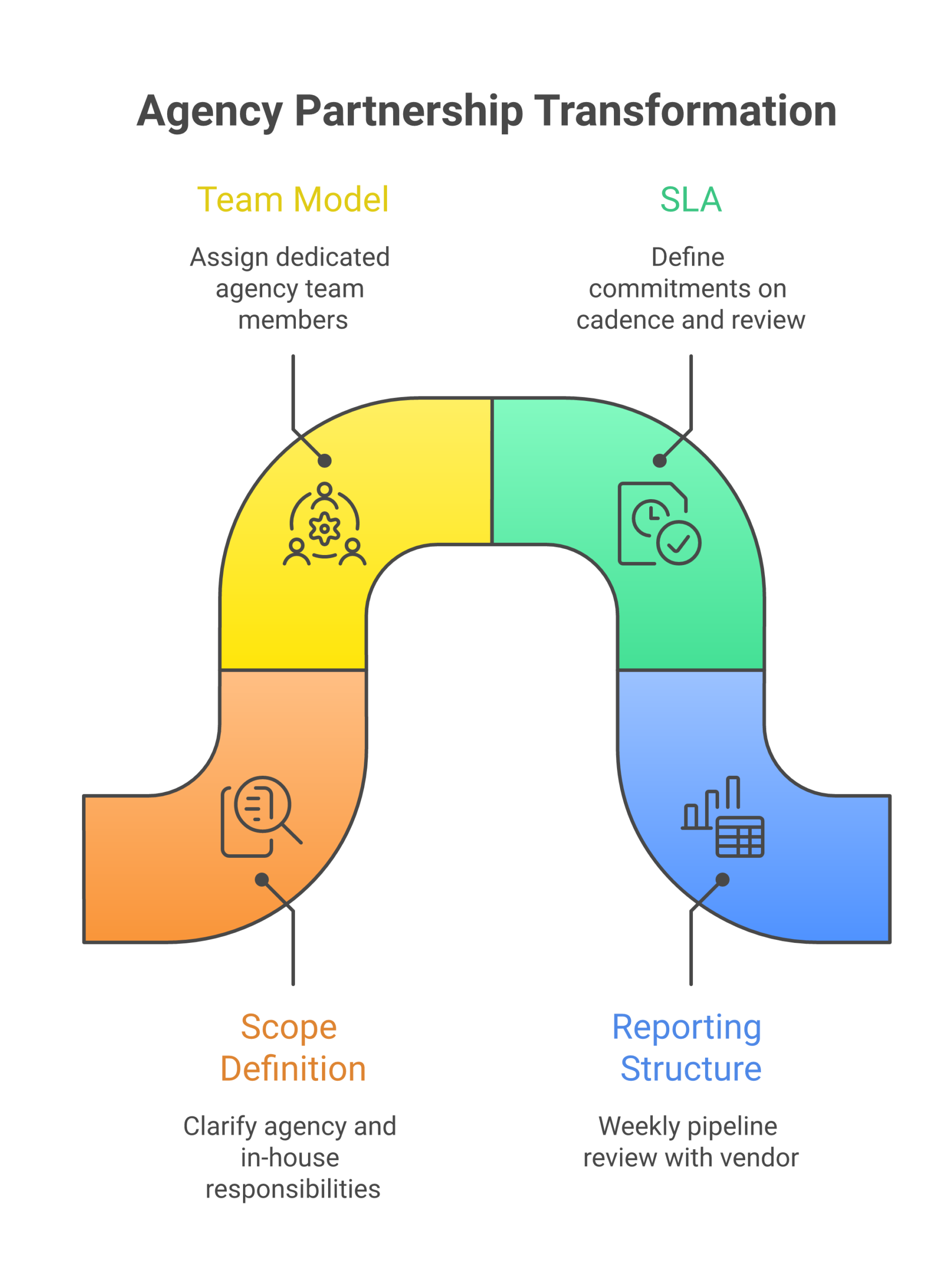
- Scope definition: A written scope-of-work document that specifies what the agency runs and what stays in-house. Agency typically owns account mapping, deal-review prep, attribution reporting, hyperscaler marketplace ops, and PRM hygiene. In-house keeps partner-facing relationships, partner manager calls, joint deal reviews with the partner in the room, and executive-level partner conversations.
- Team model: Named partner managers, BDRs, and ops staff on the agency side. Same people stay on the account for the duration of the engagement. If the agency rotates staff every quarter, walk away.
- SLA on partner cadence and deal-review attendance: Written commitments on how quickly the agency prep deck is delivered before each weekly deal review, how Crossbeam overlap refreshes are pushed, how Tackle or Labra submissions are turned around. SLAs are the difference between an agency and a freelancer.
- Reporting structure: A weekly pipeline review between the agency and the vendor partnerships leader, with a fixed reporting template. Partner-sourced pipeline, partner-influenced revenue, cadence attendance, first-opportunity timing. Without the weekly review the agency drifts toward easy work and away from accountability.
- Transition criteria: A defined trigger for when work moves from agency to in-house. Typically when partner-sourced pipeline crosses a defined revenue threshold, the in-house team scales headcount and the agency steps back to a narrower scope or exits.
The closing point is that the agency model is operational leverage, not relationship outsourcing. The vendor’s named partner manager remains the partner-facing voice. The agency makes that partner manager faster, better prepared, and more accountable. That is the model that works.
Common pitfalls
Most co-sell agency failures are foreseeable. They concentrate around the same five mistakes, and four of them are scope errors made by the vendor at contract time.
- Outsourcing the partner-facing voice: The single biggest failure mode. Agency staff show up to partner cadences instead of the vendor partner manager. Partners disengage inside 90 days because the relationship feels transactional and outsourced. The trust does not transfer.
- No written scope: Vendor and agency operate on a verbal understanding of what the agency owns. Six weeks in, every conversation is a scope argument. Pipeline does not move.
- Rotating agency staff: Agency assigns junior staff who rotate every quarter to keep margin. The vendor partnerships leader spends every quarter re-onboarding the same engagement. Walk away from agencies that do this.
- Agency in the wrong tools: Agency uses its own CRM, its own Crossbeam instance, its own reporting tooling. Data does not flow into the vendor’s system of record. Attribution becomes unverifiable. Insist the agency operates inside the vendor’s tooling.
- No transition plan: The agency engagement runs indefinitely with no defined trigger for in-housing. Three years in, the partnerships function is structurally dependent on an external vendor and the in-house team has no operational muscle.
What this looks like in practice
A co-sell agency engagement sits on top of a three-layer tooling stack. The agency does not provide the tools. The vendor owns the tools and the agency operates them.
The agency market itself sorts into a few buckets. Forecastable operates as a fractional or scope-of-work option focused on partner-program operations and the design layer above it. WorkSpan-adjacent service shops focus on co-sell ops execution. Named channel agencies focus on traditional reseller-channel motion. The in-house complement is the vendor’s named partner manager, the vendor’s RevOps team, and the vendor’s partner marketing team. None of those roles get outsourced in the model that works.
A mid-stage ISV hires a co-sell agency on a scope-of-work that covers account mapping across 25 tier-1 and tier-2 partners, weekly deal-review prep decks for the top 10 partners, ACE and Microsoft Partner Center submission and hygiene, and weekly pipeline reporting to the VP of Partnerships. Partner-facing voice stays in-house with three vendor partner managers. After two quarters, partner-sourced pipeline lifts 35 to 50%. The vendor partner managers report spending roughly 60% more of their time on partner-facing conversations and 60% less on prep and ops.
The same ISV considers an alternate model in which the agency takes over partner-facing voice for tier-2 partners to free up the vendor partner managers entirely for tier-1. Inside 90 days, tier-2 partner attendance drops, two named partners go quiet, and partner-side AEs report not knowing who the actual vendor contact is. Same agency, same tier-2 partners, same vendor brand. The only variable is who is in the partner-facing seat.
Forecastable’s POV
Most co-sell agencies fail because they are hired to do the partner-side trust work, which does not transfer well to external operators. Partners want to talk to the vendor’s named partner manager, not an agency person. That is the foundational design constraint and most engagements get it wrong from the contract on.
The agency model that works is execution-on-the-mechanics: account mapping, prep, attribution, ops. The vendor’s own people remain the partner-facing voice. This is not a small distinction. It is the entire difference between an agency engagement that lifts partner-sourced pipeline 35 to 50% in two quarters and one that loses partner trust within 90 days.
The contrarian point is that the right scoping question is not “what do we want to outsource” but “who do we need partners to see when they pick up the phone.” Anything that does not require the vendor brand on the call can go to an agency. Anything that does has to stay in-house, full stop. Most vendors get this exactly backwards, outsourcing the partner manager role and keeping the spreadsheet work, because the spreadsheet work feels harder and the partner conversations feel like soft skills.
If you are evaluating a co-sell agency right now, the test is simple. Ask them how they handle partner-facing conversations. If the answer is “our partner managers run the relationship,” walk away. If the answer is “we make your partner managers faster,” keep talking.
Forecastable is an independent third-party professional services company. Our evaluations of the co-sell agency market are based on publicly-available information as of May 2026 and our own client experience.
Frequently asked questions
What should never get outsourced to a co-sell agency?
Partner-facing conversations. Executive-level partner relationships. Joint deal reviews with the partner in the room. Anything where the partner expects to talk to the vendor brand. Outsource the mechanics, not the voice.
What is the typical agency engagement cost?
Scope-of-work engagements run roughly $15K to $50K per month depending on portfolio size and hyperscaler complexity. A comparable in-house team (two partner-ops, one BDR) is typically $40K to $70K per month fully loaded.
How do we know if the agency is performing?
Four leading indicators. Weekly prep decks delivered on SLA. Account-mapping overlap refreshed weekly. Hyperscaler submissions turned around inside 48 hours. Vendor partner managers report spending more time on partner-facing conversations than on prep. If any of those break, the engagement is drifting.
Should an early-stage company hire a co-sell agency?
Usually no. Pre-Series B, the in-house partnerships team is small enough that one person can run both partner-facing and operational work. The agency model kicks in when the partner portfolio is too large for the in-house team to operate without dropping balls.
How does the agency model differ from a fractional CPO?
A fractional CPO is an interim executive who sits in a chair on the org chart, typically full-time-equivalent. A co-sell agency is a longer-term operational extension of the in-house team that runs specific mechanics. Different jobs, different fit patterns.
Can a co-sell agency design the operating model too?
Some can. Forecastable does both design and operational scope under a single engagement, but most named channel agencies focus on execution only and assume the operating model is already in place. If your model is not designed yet, get the design done first, then bring in the agency.
What about hyperscaler-specific co-sell agencies?
For ACE, Microsoft Partner Center, and GCP Partner Sales Console work specifically, specialist agencies and tooling vendors (Tackle, Labra, Suger, Clazar) can absorb the marketplace and submission load efficiently. Use them for the mechanics and keep the partner manager relationship with your hyperscaler PDM in-house.
Next step
If you are over-stretched on partner-ops load and your vendor partner managers are spending more time on Tackle submissions than on partner conversations, a well-scoped co-sell agency engagement is the highest-leverage fix you can make this quarter. The trick is scoping it correctly: mechanics out, voice in.
Talk to our team about co-sell agency scope →
The co-sell hub holds the broader context on how an agency fits inside the full co-sell operating mod
Uncover Your Growth Potential
Schedule a Discovery Call