T-Mobile Partner Program: How the Business and Wholesale Programs Work

Short answer: The T-Mobile partner program for business is called the T-Mobile for Business Partner Program. It’s for firms that sell or bundle T-Mobile business services, from advisors to resellers. Partners can get pay, market development funds and a free account-matching tool for co-selling. T-Mobile Wholesale is a separate track for brands that build on its network. The vendors who get noticed bring T-Mobile business deals, often through its other partners.
Looking for the T-Mobile partner portal login? Go to the T-Mobile partner portal.
Already in the program? Here’s how partners turn it into pipeline.
What is the T-Mobile partner program?
T-Mobile runs more than one partner program, so it helps to be clear. This page covers the two business programs:
- T-Mobile for Business Partner Program: the channel program for firms that sell, bundle or support T-Mobile business services.
- T-Mobile Wholesale: the program for brands that run their own wireless service on T-Mobile’s network.
It doesn’t cover retail dealer stores or consumer affiliate links. Those are different programs with different goals.
On its partner program page, T-Mobile calls the business program its “CRN 5-Star Partner Program.” It says the program “offers competitive compensation and exclusive rewards to boost your sales efforts.” All details below are as of November 8th, 2026.
What types of T-Mobile business partners are there?
T-Mobile groups its business partners into three models. Here’s how its program page describes each one:
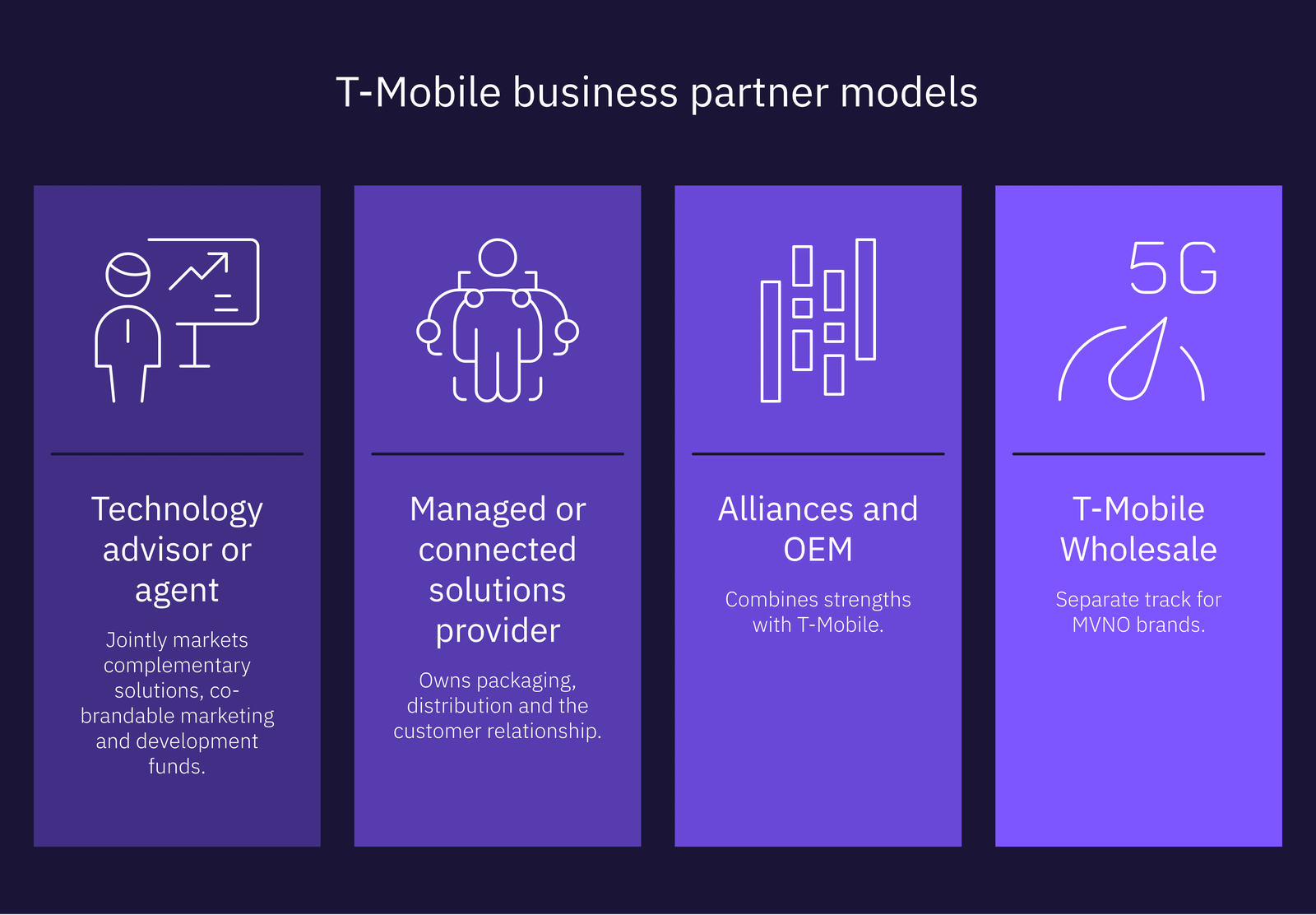
| Partner model | What the partner does | What stands out |
|---|---|---|
| Technology advisor or agent | Jointly markets complementary solutions | Co-brandable marketing resources and development funds |
| Managed or connected solutions provider | Owns end-to-end packaging and marketing | Controls distribution and the customer relationship |
| Alliances and OEM | Combines strengths with T-Mobile | Joint value for buyers |
The FAQ then names nine partner types. They run from technology advisors and sub-agents to wireless resellers, distributors, alliances and OEMs. Around any one business buyer, you’ll also meet tech alliance partners, agencies and consultancies, ISVs, implementation partners, and the list goes on.
T-Mobile says the rules vary by model. It doesn’t post tiers or revenue bars on its public pages. So expect the details to come from the Partner Portal or a channel manager.
What partners can sell
Per the FAQ, partners can sell or bundle voice, managed and high-speed internet, advanced networking, SuperBroadband, SuperMobile and T-Priority. What you can sell depends on your model. T-Mobile says the Partner Portal shows what’s on the list today.
How do you join the T-Mobile for Business Partner Program?
Joining starts with an application. Here’s the path T-Mobile describes:
- Apply. Submit the form on the T-Mobile for Business Partner Registration page.
- Get reviewed. T-Mobile checks whether you fit. It may ask for more details or lay out next steps.
- Get approved. Acceptance is “subject to applicable program requirements and approval.”
- Work from the Partner Portal. That’s where products and partner tools live.
T-Mobile also lists an email for onboarding questions on the program page. It doesn’t post fees or formal rules. Existing partners log in through the T-Mobile for Business Partner Portal.
What do T-Mobile business partners get?
Benefits vary by partner type. Still, T-Mobile names the same set on its program page and in its FAQ.
The core benefits
- Pay and rewards: “competitive compensation and exclusive rewards.”
- Account matching: free access to an account-matching platform to help partners co-sell.
- Channel experts: in-region, dedicated channel experts.
- Marketing: co-brandable marketing resources and development funds.
- Support and training: tech support, training and sales help.
The FAQ adds that support may come from T-Mobile directly or “through a partner’s Primary.” In other words, your day-to-day contact may be a Primary partner, not T-Mobile. That shapes who you’ll talk to.
Why account matching matters
Pay is only part of the offer. T-Mobile also gives partners a tool to match accounts, and it lists account mapping as a benefit. So T-Mobile is telling partners to find shared accounts and work them together.
My read: T-Mobile wants partners who turn overlap into deals. One caution from my own work, though. Big firms guard their data. Small partners tend to share a lot. The big ones share little until a sales leader with a big number asks for it. Still, a partner who won’t plug in a tool will share a list of accounts when there’s a plan for it.
What is the T-Mobile Wholesale program?
T-Mobile Wholesale is for brands that want to sell wireless under their own name. T-Mobile says it’s “an industry leader in the Mobile Virtual Network Operators (MVNO) space.” It also says it has provided solutions to more than 200 brands.
The wholesale page lists these solution areas:
- MVNO solutions to build and grow a wireless business on T-Mobile’s network.
- Fixed wireless for business, home and backup use.
- Network APIs and services for new products and platforms.
- Additional solutions, including platform services such as SIM fulfillment, customer care, an e-commerce platform and a mobile app.
You start with the “Start here” form on the wholesale page. T-Mobile doesn’t post wholesale terms.
How does a vendor get T-Mobile’s attention?
Say you sell software, security or IoT tools that run on T-Mobile’s network. You might be an alliance partner. Or you might sell alongside T-Mobile partners without a formal role. Either way, the same thing gets noticed: new T-Mobile for Business deals.
T-Mobile doesn’t publish how it ranks partners. But look at what it funds. Account matching, co-selling, development funds and in-region channel experts all point one way. T-Mobile wants partners who open new business accounts.
Why partner-sourced pipeline beats going it alone
Think about who already holds the buyer’s trust. For example, an advisor helps a company pick its carrier and its network. Meanwhile, a managed service firm runs that company’s IT. And neither one is waiting for your cold email.
Together, though, you have a reason to call the same accounts. That’s partner-sourced pipeline: deals that start because a partner opened the door. Here’s how partner-sourced and partner-influenced pipeline differ, if the terms are new.
There’s a catch, though. If your own SDR team books the meeting, it most likely won’t count as partner-sourced. Run the outreach as the partner, on the partner’s behalf, and it can. Then take the results to your T-Mobile channel contact. Now you’re bringing new business connectivity deals, not asking for leads.
Start with the accounts, not the pitch
Most partner meetings waste the first ten minutes opening spreadsheets live. Instead, set an agenda of named accounts before the call. Then sort each one three ways:
- Ask: accounts where you want the partner’s intro.
- Give: accounts where you can hand the partner something.
- Mutual: accounts where you both have a reason to go in together.
If you use Crossbeam, that sorting is where account mapping turns into pipeline. Either way, the list comes first. If you also build on messaging, Twilio Partner Connection counts deals partners source and influence toward its tiers.
Win over T-Mobile’s channel team, one region at a time
T-Mobile puts channel experts in each region, and your day-to-day contact may sit at a Primary partner instead. Map them all, and keep the map current. If you settle into one comfortable team, one departure can put you back at zero.
Each of those people needs something to sell. A technology advisor, for instance, earns when a business client upgrades its connectivity. So give that advisor a bundled offer: your IoT or security product plus a T-Mobile business plan, scoped for a few multi-site clients, with a stated value and a clear funder. Partners rarely respect free, so a free pilot with no price on it rarely gets forwarded.
Begin in the region where you already win. Then ask each channel manager what they think before you launch.
What does a partner GTM motion in the T-Mobile ecosystem look like?
A partner go-to-market (GTM) motion is one campaign, run with one partner, into accounts you both care about. Here’s how we run one in the T-Mobile ecosystem:
- Pick the partner. Pair your company with an advisor, a managed provider or a distributor that sells T-Mobile.
- Agree on the accounts. Overlap your lists and choose businesses where both of you belong in the conversation.
- Write one joint story. Answer one question: why these two firms, for this business, right now?
- Run the outreach. Calls come first, made by a human SDR in the partner’s name. Email, LinkedIn and, where it makes sense, a field marketing event round it out.
- Hand off the meetings. Booked meetings go to whoever owns the deal, with the partner’s context attached.
- Track every result. Count meetings, pipeline and new T-Mobile lines or services, so you have proof for T-Mobile’s channel team.
That’s the work we do. Forecastable is a B2B partnerships agency that sells outcomes: partner-sourced pipeline, measured on SQOs, pipeline and revenue. Our campaign operations team and human SDRs run the motion with your partner, or as your partner team. Eva, our AI partner ops agent, logs every touch, and you get full MCP access to all of it. No seats, and no PRM required.
One-off motions are quoted individually. Roughly $15K tends to be the average for a one-off motion with one partner, with a part-time SDR making a limited number of calls. That’s a way to prove the model before you scale it. For planning, one SDR makes about 1,000 cold calls a month. A program running three to five motions either prioritizes which motions get SDR calling or adds a second SDR. Our Produce My Pipeline program is the version that runs every quarter.
Partners often fund these motions, too. Big partners rarely pay for your tools, but they will fund a program that produces pipeline. T-Mobile lists development funds as a partner benefit. Any GTM motion could cost you $0 if partners pay for it. Before you fund one alone, read how market development funds work.
Related reading
- Partner Program Business Case: Winning Budget
- Partner Spiffs: When Short-Term Incentives Work
- Sales Pipeline Stages: What They Are and How They Work
- Tech Partners vs Business Partners: The Real Split
- What Is a Channel Partner in Business?
Frequently asked questions
What is the T-Mobile for Business Partner Program?
It’s T-Mobile’s channel program for firms that sell, bundle or support T-Mobile business services. T-Mobile calls it its “CRN 5-Star Partner Program.”
What partner types does T-Mobile support?
T-Mobile names nine. They include advisors, sub-agents, managed and connected providers, resellers, Primaries, distributors, alliances and OEMs.
Does T-Mobile offer market development funds to partners?
Yes, for partners who qualify. T-Mobile lists them next to account mapping, tech support and training. Benefits vary by partner type.
How do I become a T-Mobile business partner?
Apply on the T-Mobile for Business Partner Registration page. T-Mobile checks your fit and may ask for more details. Then it decides.
Is T-Mobile Wholesale the same as the partner program?
No. Wholesale is for brands that sell wireless under their own name. The partner program serves firms that sell T-Mobile for Business services.
Is this the same as becoming a T-Mobile retail dealer?
No. This page covers the business and wholesale programs only. Retail stores and consumer programs run on their own.
What’s the bottom line on the T-Mobile partner program?
The T-Mobile partner program pays for new business. It also hands partners account matching and development funds to find that business together. So don’t wait for T-Mobile to send you deals. Instead, build pipeline with the advisors and solutions providers who already sell to your buyers. That’s what gets a platform’s attention. Selling network and security too? Then the Cisco 360 Partner Program is the closest comparison. Our directory of partner programs covers the rest.
Forecastable is an independent third-party B2B partnerships agency. We are not affiliated with or endorsed by T-Mobile. Program details are drawn from T-Mobile’s public pages and are current as of November 8th, 2026.
Are you a technology vendor or advisor selling alongside T-Mobile for Business? Find out which GTM motion to run first. Book a Program-Fit Analysis
Uncover Your Growth Potential
Schedule a Discovery Call