Skip to content
Logo โ€” Itโ€™s All AboutThe Team
  • Home
  • Who We Serve
    • By Category
      • SaaS
      • Professional Services
      • Platforms (Large Ecosystems)
      • Private Equity
    • By Role
      • Chief Revenue Officers (CRO)
      • Chief Financial Officers (CFO)
      • Chief Marketing Officers (CMO)
      • Chief Executive Officers (CEO)
      • Sales Leaders
      • Partnership Professionals
  • Solutions
    • By Partner Program Maturity
      • Partnerships Foundation
      • Partnerships Acceleration
      • Ecosystem-Wide Orchestration
    • Specialized Solutions
      • Net-New Named Account Development
      • Large Ecosystems
      • M&A: Post-Acquisition Internal Cross-Selling
  • Pricing
  • Education
  • Company
    • Our History
    • Security
  • Login
Logo โ€” Itโ€™s All AboutThe Team
  • Home
  • Who We Serve
    • By Category
      • SaaS
      • Professional Services
      • Platforms (Large Ecosystems)
      • Private Equity
    • By Role
      • Chief Revenue Officers (CRO)
      • Chief Financial Officers (CFO)
      • Chief Marketing Officers (CMO)
      • Chief Executive Officers (CEO)
      • Sales Leaders
      • Partnership Professionals
  • Solutions
    • By Partner Program Maturity
      • Partnerships Foundation
      • Partnerships Acceleration
      • Ecosystem-Wide Orchestration
    • Specialized Solutions
      • Net-New Named Account Development
      • Large Ecosystems
      • M&A: Post-Acquisition Internal Cross-Selling
  • Pricing
  • Education
  • Company
    • Our History
    • Security
  • Login
  • Home
  • Who We Serve
    • By Category
      • SaaS
      • Professional Services
      • Platforms (Large Ecosystems)
      • Private Equity
    • By Role
      • Chief Revenue Officers (CRO)
      • Chief Financial Officers (CFO)
      • Chief Marketing Officers (CMO)
      • Chief Executive Officers (CEO)
      • Sales Leaders
      • Partnership Professionals
  • Solutions
    • By Partner Program Maturity
      • Partnerships Foundation
      • Partnerships Acceleration
      • Ecosystem-Wide Orchestration
    • Specialized Solutions
      • Net-New Named Account Development
      • Large Ecosystems
      • M&A: Post-Acquisition Internal Cross-Selling
  • Pricing
  • Education
  • Company
    • Our History
    • Security
  • Login
Back to all blogs
  • Partnerships Roles & Hiring
Alex Buckles

Tech Partners vs Business Partners: The Real Split
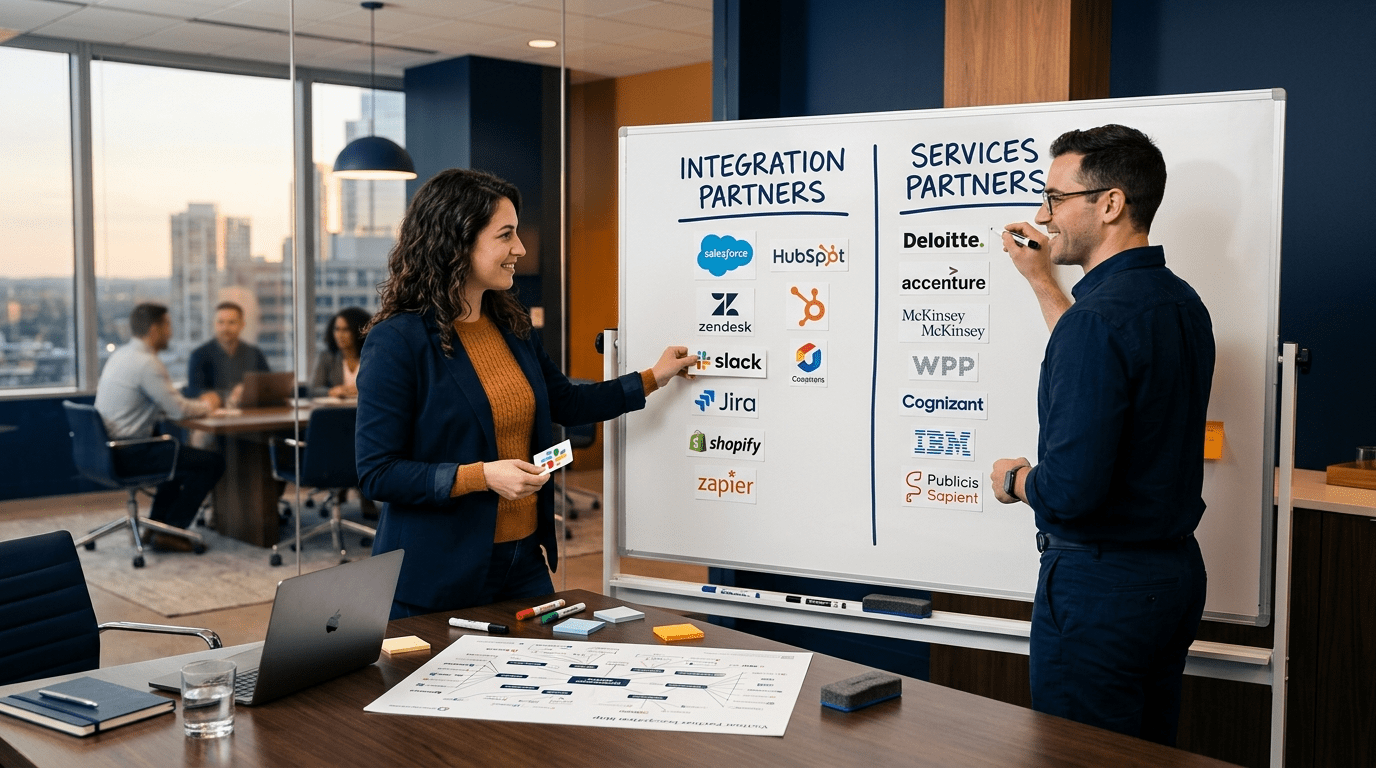
Two partnerships strategists at a whiteboard sorting partner logos into two columns, one for integration partners and one for services partners, a printed partner map on the table, deep navy and warm amber palette

What is the tech partners vs business partners distinction?

Short answer: Tech partners vs business partners is the difference between partners who create value through product integration and partners who create value through services, relationships, and reach. It separates the company whose software connects to yours from the firm that sells, implements, or advises customers on your behalf, and the two require genuinely different motions.

The labels get used loosely, and the blur causes real damage. A team that treats every partner the same way ends up running a generic program that serves neither type well, because what a tech partner needs and what a business partner needs barely overlap.

Getting the distinction right is not about taxonomy for its own sake. It decides who you assign, what you measure, and how you invest, and those decisions are the difference between a partner that produces and a partner that sits idle.

Why tech partners vs business partners matters in 2026

Ecosystems have grown crowded, and in 2026 the programs that produce are the ones that run distinct motions for distinct partner types rather than a single undifferentiated playbook. A tech partner judged on services revenue and a business partner judged on integration depth will both look like failures, when the real failure is the measurement.

The second reason is resourcing. Tech partners and business partners consume your team’s time in completely different ways, one through product and engineering coordination, the other through sales enablement and deal support. Treating them as interchangeable means you staff the program wrong and starve whichever motion needs the attention you did not plan for.

The third reason is buyer experience. A customer who meets you through an integration expects a different journey than one who meets you through a trusted advisor, and a program that does not understand the tech partners vs business partners split delivers a muddled experience to both.

How the tech partners vs business partners split actually works

The distinction works as an operating tool when you let it drive who you assign, what you measure, and how each motion runs.
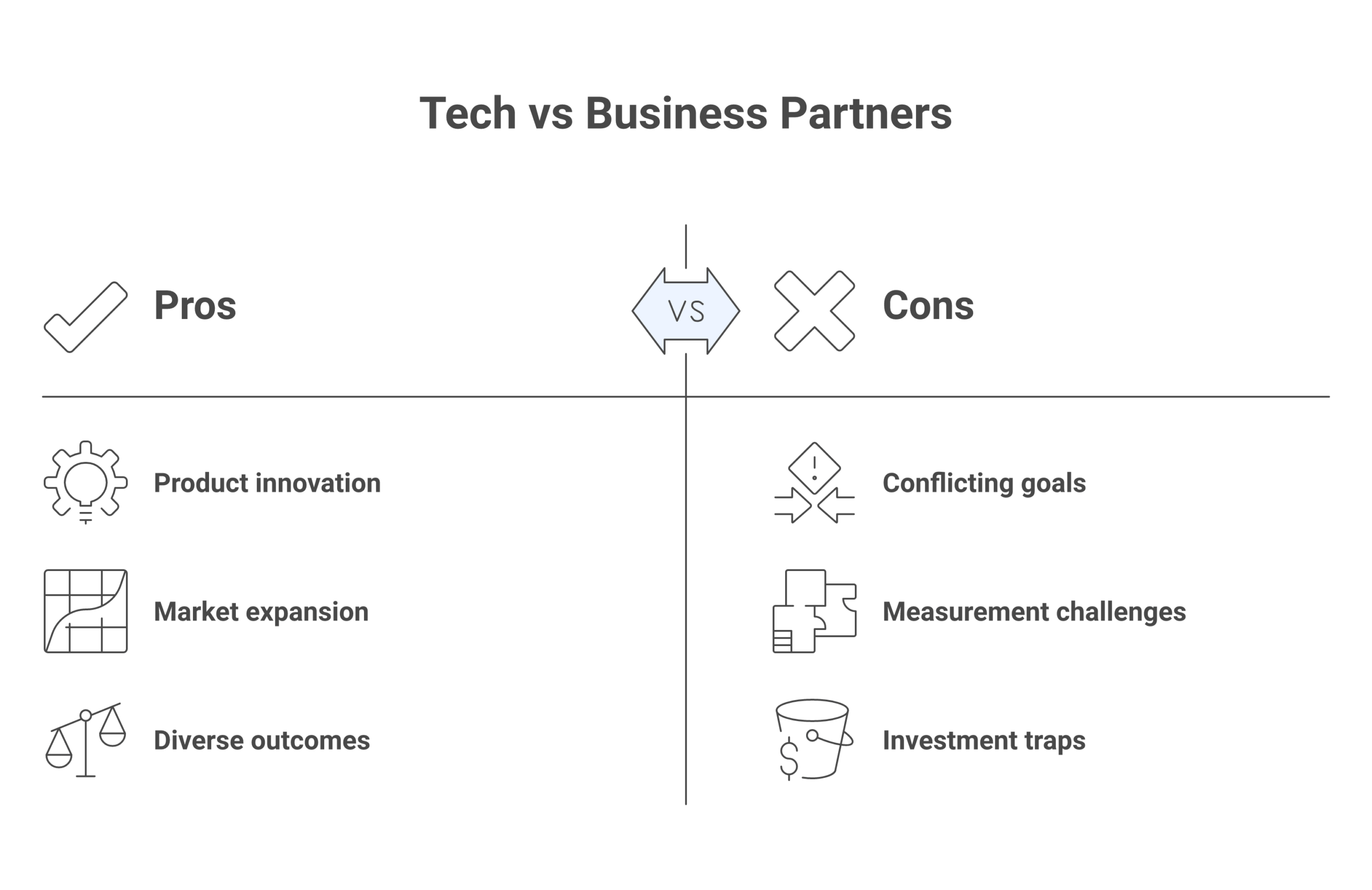
tech partners vs business partners framework: Tech partners create value through the product, Business partners create value through reach and services, The two are measured on different outcomes, Some partners are both, and that is the...

  1. Tech partners create value through the product: A tech partner integrates with your software, and the value shows up as a better combined product the customer can buy and use. The motion is engineering coordination, joint roadmap, and co-marketing the integration, and the right owner sits close to product, not to the sales floor.
  2. Business partners create value through reach and services: A business partner sells, implements, or advises, and the value shows up as access to customers and the ability to deliver. The motion is sales enablement, deal registration, and margin, and the right owner is a partner manager who thinks like a seller.
  3. The two are measured on different outcomes: A tech partner is judged on integration adoption and influenced pipeline; a business partner is judged on sourced revenue and delivery capacity. Holding each to the other’s metric guarantees a false read on whether the partner is working.
  4. Some partners are both, and that is the trap: A firm can integrate and resell at once, and the mistake is forcing it into one box. Run both motions with that partner explicitly rather than picking a single label and underserving half of what the relationship could produce.
  5. The investment model differs by type: Tech partners often need product and engineering time more than dollars; business partners often need margin, leads, and enablement more than roadmap. Matching the investment to the type is what turns a signed partner into a producing one.

The split is doing its job when each partner is assigned, measured, and resourced according to how it actually creates value, and it is failing when one generic program treats an integration partner and a reseller as the same thing.

Tech partners vs business partners compared

Dimension Tech partners Business partners
Source of value Product integration that improves the combined offering Reach, relationships, and services that move and deliver deals
Primary motion Joint roadmap, engineering coordination, co-marketing Sales enablement, deal registration, co-sell, delivery
Right internal owner A partner role close to product and engineering A partner manager who operates like a seller
Core metric Integration adoption and influenced pipeline Partner-sourced revenue and delivery capacity
Typical investment Product and engineering time, technical enablement Margin, leads, sales enablement, certification
Customer experience Buys a better connected product Meets you through a trusted advisor or implementer

A worked example shows why the split matters. A company signed an integration partner and a regional services firm in the same quarter and ran both through one generic onboarding. Six months later both looked like failures. The integration partner had a finished connector almost no customers used, because no one had co-marketed it or built the joint roadmap that drives adoption. The services firm had certified consultants but no pipeline, because no one had enabled their sellers or set up deal registration. The fix was to stop running one program. The integration partner moved to an owner who sat with product and ran a real co-marketing push around the connector; the services firm moved to a partner manager who enabled its reps and turned on deal flow. Same two partners, two different motions, and both started producing within a quarter.

Forecastable’s POV on tech partners vs business partners

The position we hold is that the split is not a label exercise, it is a resourcing decision, and the teams that get it wrong almost always get it wrong by running one motion for everyone. The generic program feels efficient and is quietly the most expensive choice you can make, because it underserves both partner types at once and produces a program that looks busy and yields little.

The second conviction is that the most valuable partners often refuse the binary, and that is a feature, not a problem. A firm that both integrates and resells can be among your best partners precisely because it touches the customer through product and through services, but only if you run both motions with it deliberately. Forcing a both-type partner into a single box is how programs leave their largest opportunities on the table.

The honest caveat is that the line is not always clean, and obsessing over the perfect taxonomy is its own trap. The point of the tech partners vs business partners distinction is not to file every partner into a tidy box, it is to make sure each partner is assigned, measured, and resourced according to how it actually creates value for the customer. When in doubt, follow the value, not the label.

Forecastable is a partnerships operating platform; any third-party tools or platforms referenced here are independent third-party products, and naming them is not an endorsement of one deployment over another. Evaluate each against your own motion.

Frequently asked questions

What is the basic difference between tech partners and business partners?
Tech partners create value through product integration; business partners create value through reach, relationships, and services. One improves the combined product, the other moves and delivers deals, and the two require different owners, metrics, and investment.

Can a partner be both a tech partner and a business partner?
Yes, and some of the best ones are. A firm can integrate with your product and resell or implement it at the same time. The mistake is forcing it into one category; the right move is to run both motions with that partner deliberately.

Who should own tech partners versus business partners internally?
Tech partners are best owned by a role that sits close to product and engineering, because the motion is integration and roadmap. Business partners are best owned by a partner manager who operates like a seller, because the motion is enablement, deal flow, and delivery.

How should I measure each partner type?
Measure tech partners on integration adoption and influenced pipeline, and business partners on sourced revenue and delivery capacity. Holding each to the other’s metric produces a false read and usually makes a working partner look like a failure.

Why does treating all partners the same fail?
Because a single generic program serves neither type well. Tech partners need product time and co-marketing; business partners need margin, leads, and enablement. One undifferentiated motion starves whichever need you did not plan for and produces a busy program with little output.

Which partner type should I prioritize?
Neither by default; prioritize by where value reaches your customers fastest given your stage and motion. Early product-led companies often lean on tech partners, while companies that need market reach or delivery capacity lean on business partners. Let the value path, not the label, set the priority.

Next step

If your program runs one motion for every partner, the move this quarter is to sort your partners by how they actually create value, assign tech partners to a product-adjacent owner and business partners to a seller-minded one, and measure each on the outcome that fits its type.

Start your growth journey now to run the right motion for each kind of partner, or see the orientation on the partner program for how the split fits the broader operating model.

Uncover Your Growth Potential

Whether starting with a single sales team or a single partner, any co-sell motion can be live within 30 days.

Schedule a Discovery Call
Latest Insights
A partnerships leader and a RevOps analyst at a wall monitor reviewing a partner-sourced pipeline growth chart while planning headcount, printed tier ladder on the table, deep navy and warm amber palette
  • Partnerships Roles & Hiring
Alex Buckles

Scaling a Partner Program: What Actually Has to Change

What is scaling a partner program? Short answer: Scaling a partner program is the work of growing partner-sourced revenue faster than the headcount and effort you add to produce it, by turning a few repeatable wins into a system that does not depend on any single person. It is an operating problem, not a recruiting […]

Read Article
Two executives from partnering companies at a small table agreeing on a shared revenue goal, a one-page joint plan with named owners between them, deep navy and warm amber palette
  • Partnerships Roles & Hiring
Alex Buckles

What Is Executive Alignment in Partnerships?

What is executive alignment? Short answer: Executive alignment is a shared, resourced commitment between the senior leaders of two partnering companies to a specific joint outcome, with each side putting real people, budget, and accountability behind it. It is the difference between two leaders who like each other and two leaderships who have agreed on […]

Read Article
A partner manager and a partner's account executive running a joint deal review at a conference table with a shared account list and a co-sell plan printed between them, deep navy and warm amber palette
  • Partnerships Roles & Hiring
Alex Buckles

Working With Partner Sales Teams: The Operating Rules

What is working with partner sales teams? Short answer: Working with partner sales teams is the day-to-day practice of getting another company’s sellers to spend their limited selling time on deals where you help them win, by being useful to their number rather than asking them to carry yours. It is a relationship measured in […]

Read Article
Two partner managers planning an AWS re:Invent partner strategy at a whiteboard mapping target accounts to booth meetings, a printed agenda and badge lanyards on the table, deep navy and warm amber palette
  • Partnerships Roles & Hiring
Alex Buckles

AWS re:Invent Partner Strategy: Working the Show

What is an AWS re:Invent partner strategy? Short answer: An AWS re:Invent partner strategy is the plan a company brings to the conference for turning the week into partner-sourced pipeline, the target accounts, the booked meetings, the AWS field connections, and the follow-up. It treats the show as a sourcing event, not a brand-awareness trip. […]

Read Article
Logo โ€” Itโ€™s All AboutThe Team

Quick Links

  • Who We Serve
  • Solutions
  • Resources
  • Pricing
  • Our History

Social Media

  • Linkedin

Legal

  • Privacy Policy
  • Terms of Service
Quick Links
  • Who We Serve
  • Solutions
  • Resources
  • Pricing
  • Our History
Social Media
  • Linkedin
Legal
  • Privacy Policy
  • Terms of Service

Stay ahead on ecosystem-led growth

Logo โ€” Itโ€™s All AboutThe Team
ยฉ 2025 Forecastable. All rights reserved.
Book Your Strategy Call
Request Enrollment Details

[contact-form-7 id=”dfbeed3″ title=”Request Enrollment Details”]

Mollie Bodensteiner

Revops Advisory
  Mollie Bodensteiner is an experienced operations professional with a demonstrated track record of utilizing technology to support operational processes that drive performance and innovation. She currently is the Vice President of Operations at Sound and owns go-to-market agency, MB Solutions. Mollie has previously held operations leadership roles at Deel, Syncari, Corteva and Marketo. She has over 14 years of experience in both B2C and B2B operations and technology. When she is not working, Mollie enjoys spending time with her husband, three small children, and two large dogs. Childhood Career/Dream: Growing up in the age of Disney and Nick@Nite I always wanted to be a child actor (good thing that never was actually pursued ๐Ÿ™‚ Favorite Win: I am not sure I have a specific โ€œwinโ€ but I think I get the most joy and excitement from coaching others and watching them hit major milestones in their career. The first time you get to promote someone on your team or watch them lead a major project – are always career highlights! Personal Fun Facts: Favorite Song: If itโ€™s love, Train Favorite Movie: Good Will Hunting Favorite Meme: Disaster Girl
Forecastable resources: Co-Sell Orchestration Platform · All Use Cases · Live in 30 Days · Co-Sell Playbook

Kelsey Buckles

Director of Operations


My journey from Education to Operations has equipped me with a unique perspective and skill set that perfectly aligns with Forecastable’s mission to help businesses improve sales collaboration through partner co-selling strategies.

At Forecastable, I am passionate about empowering teams and organizations to unlock the full potential of strategic partnerships. By leveraging my expertise in communication, leadership, and operational efficiency, I contribute to creating seamless co-selling processes that align with business goals and deliver exceptional results.

The intersection of my educational foundation and operational experience fuels my dedication to fostering alignment, building trust, and enhancing collaboration between partners. I am driven by the opportunity to contribute to a platform that not only optimizes sales strategies but also strengthens relationships that lead to long-term growth.

Paul Jonhson

Chief Technology Officer (Co-founder)


Paul Johnson has 20+ years of software development and consulting experience for a variety of organizations, ranging from startups to large-enterprise organization with highly-complex needs.

Mr. Johnson has a long track record of successful technology deployments.
This, combined with his deep passion for machine learning and exceptional user experience design, allows him to lead our technical direction from the front with confidence.

Alex Buckles

Product, Partnerships, and Value Engineering (Co-founder)


After serving in The United States Marine Corps, Alex Buckles spent the next two decades as a student of revenue production and an advocate for innovation.

Along the way, he has helped numerous companies achieve double and triple-digit growth by crafting and executing high-performing go-to-market strategies, with co-selling at the center of each.

As a once-advanced technical marketer, an expert sales & partner professional, and a strong customer success advocate, Mr. Buckles understands the impact of these functions aligning not only on revenue production, but on the day-to-day execution of the go-to-market strategy. This concept of revenue-team alignment is what quickly became the foundation of Forecastable back in January of 2018.

In his free time, youโ€™ll find him spending quality time with his children, one of whom is on the autism spectrum. 1 in 36 children in the U.S. are on the spectrum and boys are four times more likely to be diagnosed than girls.

With that in mind, Mr. Buckles plans on dedicating the rest of his life serving those living with autism, through his organization Pathways for Autism. From his perspective, there must be a scalable and financially self-sustaining infrastructure established to put as many individuals with autism as possible on a path towards complete independence as adults.