B2B Demand Generation Agency: Pipeline Through Your Partners

Short answer: Forecastable is the B2B demand generation agency that builds pipeline through your partners. We run partner GTM motions with SDRs, partner webinars, field events and partner ABM. Programs are often funded by partners through MDF and co-funding, so it could cost you $0. And we measure the work in meetings, sales-qualified opportunities (SQOs) and cost per SQO, not activity.
What does a B2B demand generation agency do?
A B2B demand generation agency creates interest in your product and turns it into sales conversations. Typically, agencies run paid media, content, email nurture and cold outbound. Then they report on leads.
But that model has a math problem. Research from Professor John Dawes at the Ehrenberg-Bass Institute found that only about 5% of B2B buyers are in market right now. Meanwhile, the other 95% won’t buy for months or even years. So the job isn’t just reaching buyers. It’s being the name they already trust when they’re ready.
Trust is also harder to earn on your own. According to Gartner’s research on the B2B buying journey, buyers spend only 17% of their buying time meeting with potential suppliers. Plus, a typical buying group for a complex purchase has six to 10 decision makers. In other words, most of the decision happens without you in the room.
So who is in the room? Often, it’s your partners:
- The integrator implementing the rest of the stack.
- The reseller who already holds the relationship.
- The platform your product plugs into.
- Agencies, MSPs, technology partners, and the list goes on.
Why choose partner-sourced demand generation?
Partners already have what traditional demand gen tries to buy. They have attention and credibility inside your target accounts. When a partner your buyer trusts says your name, it lands differently than your tenth ad. When the target list is short and named, that becomes partner-led ABM.
| Traditional demand gen agency | Partner-led demand gen (Forecastable) | |
|---|---|---|
| Who reaches the buyer | Your brand alone | Your partners, in their name, alongside yours |
| Main channels | Paid media, content, nurture, cold outbound | Partner GTM motions, partner webinars, field events, partner ABM |
| Who pays | Your marketing budget | Often your partners, through MDF and co-funding |
| What gets reported | MQLs, clicks, cost per lead | Meetings, SQOs, pipeline, cost per SQO |
| Pipeline credit | Marketing-sourced | Partner-sourced, per each platform’s own attribution policy |
| Trust signal | First party | Third-party credibility |
Partner-led demand gen surrounds the buyer with more trusted reasons to engage. In week one they hear from one partner. In week two, a different partner brings a different angle. Eventually, the one name every buyer keeps hearing is yours. Here’s our partner marketing strategy guide if you’re building the plan in-house.
The credit rule that changes the math
Here’s the rule I give every team. If your SDR team books it, it isn’t partner-sourced. Run the same outreach with the partner, under the partner relationship, and it counts as partner-sourced. That’s why we run motions as your partners, not just as you. If the terms are new, here’s how partner-sourced and partner-influenced pipeline differ.
What services does a partner-led demand generation agency include?
In practice, every program is built from the same set of services:
- Partner GTM motions: A GTM motion is a priced, workshopped campaign run with one partner or several, into accounts you both care about. It runs on email, LinkedIn and calls. Sends can go out as you, the partner, both, or a group of partners.
- SDR coverage: Real human SDRs, not AI, make the cold calls inside your partner GTM motions. One SDR makes about 1,000 calls a month. With three to five motions running, we prioritize which motions get SDR calls, or add a second SDR for more calling. Real people handle replies and follow-up, never AI agents.
- Partner webinars: We run them soup to nuts. That covers the registration page, recruiting, outbound and hosting. You and your partner own the content and Q&A, with our producer on standby off camera.
- Field events: Happy hours, dinners, roadshows, executive experiences and conference activation. We handle the invite list, the venue and the attendees.
- Partner ABM: Your best ABM channel may not be yours. Partner ABM means the same target accounts, more trusted paths in and one coordinated strategy. We stagger the outreach so no account gets overcommunicated.
Which co-marketing motions should you start with?
We start most teams on four co-marketing motions:
- Partner co-hosted webinar series: a shared audience, speakers from both sides, promotion the partner commits to, and joint follow-up.
- Closed-lost and stalled-deal reactivation: we group stalled deals by why they stalled. Then a partner with the relationship opens the door again.
- Target-account workshops and executive roundtables: small invited groups, recruited account by account through sellers and partners.
- Customer-and-partner proof sessions: a customer walks through a real rollout with the partner, and both sales teams invite prospects.
Each co-marketing motion is fixed-fee.
One note on staffing. SDRs work the partner GTM motions. By contrast, webinars and events are run by a campaign operations specialist.
Why the marketing calendar is the bottleneck
Here’s a pattern we see often. A partner asks for a joint event. Then the partner manager goes to marketing. This quarter is full, and next quarter is mostly full too. Now they’re fighting other partner managers for a slot. Meanwhile, the partner waits in line.
That’s the real constraint on partner events. It isn’t ideas or budget. It’s your own team’s calendar. So we run the events ourselves, without taking slots from your marketing team. We still build the invite list from partner data. Specifically, we invite people who are already customers of your partners, because your product is relevant to what they run.
How does an engagement with Forecastable run?
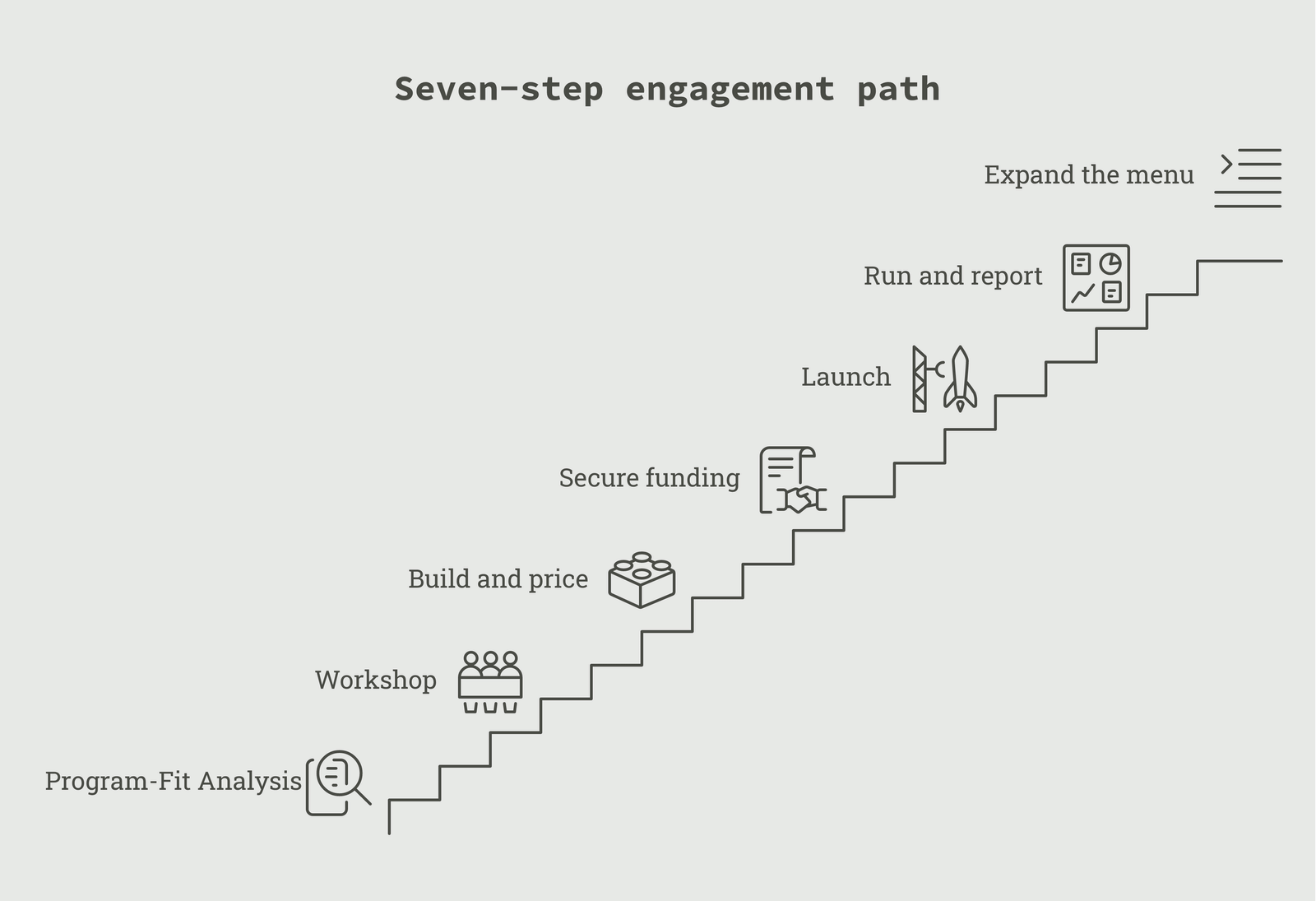
Every engagement follows the same path:
- Program-Fit Analysis. It’s a 30-minute call with a senior partnerships leader. We figure out which program fits, who needs to be involved and which partners could fund it. If nothing fits, we’ll tell you.
- Workshop. Next, we learn where you need to win. That could be net new logos, a vertical, expansion, rip-and-replace or a launch. Then we pick the partners who should produce.
- Build and price the motions. Each GTM motion gets a scope and a price everyone can see.
- Secure the funding. We invite partners to the program, on your behalf or alongside your partner managers. The hand-raisers fund the first motions.
- Launch. Typically, a working motion is ready about two weeks after the workshop. It goes live in two to three weeks, depending on calendars.
- Run and report. After launch, the motions run for two full months. You see every send, reply and meeting as it happens.
- Expand the menu. Over time, the motions that work become a menu. New partners can pick from it and fund their own seat at the table.
We contract a quarter at a time, with no long-term lock-in. Our Produce My Pipeline program is the done-for-you version of this model.
How is partner-led demand generation funded?
Partners fund programs, not tools. Ask a partner to pay for your software and they’ll say no. But ask them to fund a program that produces sales-qualified opportunities, and the answer changes. In many cases, they want a basic plan to justify it. After that, they care about one thing: did it deliver the SQOs?
That’s where market development funds (MDF) come in. Remember, the M in MDF is market, not marketing. MDF is meant to be spent, and nobody gets promoted for saving it. Still, it’s a big budget with a measurement problem. Too often it gets spent ad hoc, with no line to revenue.
Here are the funding options we see most:
- Your partnerships budget, whether fixed or dedicated to partner GTM.
- MDF you control that’s set aside for the partner program.
- MDF from your partners, who fund all of a program or split it.
- A combined pool of the above.
Even at $0 budget, it’s not the end of the road. And if you have use-it-or-lose-it MDF at quarter end, you can turn it into GTM credits. GTM credits are $1 for $1, good for a year, and apply to motions next quarter or the one after. For the full picture, read our MDF guide.
How do you measure a B2B demand generation agency?
Measure it on pipeline, not activity. Calls made and emails sent show effort. They don’t show what an executive cares about.
Here’s what we report, partner by partner:
- Target accounts engaged by each motion.
- Meetings held, not booked.
- SQOs created from each motion.
- Pipeline by partner and by quarter.
- Cost per SQO, so every MDF dollar competes on the same number.
We also track partner as its own funnel type, not as a slice of marketing inbound. Then compare that cost per SQO with what your marketing team pays for an SQO today. Partnerships teams are usually underfunded. But when partners produce SQOs for less than marketing spends on the same result, the budget conversation changes.
Also, every party sets goals up front and sees the activity in real time. Meanwhile, Eva, our AI partner ops agent, watches the data in the background.
Related reading
- Double, Triple, and Quadruple Your GTM Dollars Through Partners
- Joint Demand Generation: How to Run Co-Marketing That Converts
- Partner Pipeline Hygiene: Keep Co-Sell Clean
- Sales Pipeline Generation: Build It Warm-Channel-First
- Sales Pipeline KPIs: The Ones Your Board Should See
Frequently asked questions
How much does a B2B demand generation agency cost?
Our Partner-Sourced Pipeline program starts at $50,000 a quarter. That activates a campaign operations specialist, one SDR and the platform. GTM motions plan at about $12,500 each, so four fill the $50,000. Fully run webinars are $10,000 each. Standard physical events are about $10,000 each, priced by complexity. A second SDR is $10,000 a month. Partners can cover all or part of a program. See our published pricing.
What’s the difference between demand generation and lead generation?
Lead generation captures contact details from people who already show interest. Demand generation creates the interest in the first place. Partner-led demand gen does both, through partners your buyers already trust. And if you only need meetings set, see our appointment setting services.
Does a partner webinar count as partner-sourced pipeline?
It can. If a partner invites its customers and they show up because of that invite, the meeting can count as partner-sourced. Credit always follows the platform’s own attribution policy.
Do I need MDF to get started?
No. Often, a partner who raises a hand funds the first motion. Other times, you split the cost with one or more partners.
Which partners do you work with?
We work only with B2B partners. That includes resellers, integrators, SIs and GSIs, agencies, MSPs, VARs, distributors, technology partners and hyperscalers, and the list goes on. We don’t run affiliate, influencer or ambassador programs. For reseller and distributor programs, see our channel marketing services.
How fast can partner demand gen produce meetings?
Typically, a working motion is ready about two weeks after the workshop. Then it goes live in two to three weeks, depending on calendars. From there, it runs for two full months, and you see every meeting as it’s booked.
Do I need a PRM or new software?
No. We run with or without a PRM. You don’t log into anything new, and you see everything through the Forecastable MCP in the AI tools you already use.
What’s the bottom line?
Your buyers already trust your partners. So the fastest demand gen channel you have may not be yours at all. As a B2B partnerships agency, we run that channel for you. It’s often paid for by partners and measured in meetings, SQOs and cost per SQO.
Want to see which partners could fund your demand generation? Book a Program-Fit Analysis
Uncover Your Growth Potential
Schedule a Discovery Call